

Despite a 2022 study showing that LGBT+ students face greater risks than other youth in schools, the Puerto Rico Department of Education eliminated protections against bullying based on sexual orientation and gender identity in 2024.
The study, titled Youth Risk Behavior Survey 2020–22, was commissioned by the Mental Health and Addiction Services Administration (ASSMCA, in Spanish) and conducted by the Central University of the Caribbean for $500,000. It surveyed 112,000 students from grades 7 to 12. The findings revealed that adolescents who identify as gay, lesbian, bisexual, trans, or nonbinary experience higher rates of depression, anxiety, substance use, suicidal ideation and attempts, and school bullying than their heterosexual peers.
A section of the study titled Risk Behaviors Among Adolescents by Sexual Identity confirmed that LGBT+ youth face greater mental health challenges and risky behaviors, partly due to the hostile environments in which they are forced to live. ASSMCA uses the term “sexual identity” to refer to homosexual, heterosexual, and bisexual orientations.
Clinical psychologist Caleb Esteban, an associate professor at Ponce Health Sciences University (PHSU), explained that students who identify as trans or nonbinary may be at even higher risk because they experience stigma not only for their sexual orientation but also for their gender identity — factors that heighten chronic stress.
Despite the alarming findings, ASSMCA released only part of the study in 2023, omitting results related to LGBT+ students. Those findings later surfaced through anonymous sources and were reported by El Nuevo Día in July 2024. The agency subsequently provided the results to the Gender Investigative Unit, an alliance between Todas and the Centro de Periodismo Investigativo (CPI), but never shared the full report, despite repeated requests since last August. ASSMCA’s press officer, Julissa Pérez Rentas, provided only a summary of the findings.
“This is a special report requested by the Office of Planning for use in competitive grant proposals,” Pérez Rentas said when asked why the full study was not released.
The epidemiological study aims to periodically assess substance use and other risk behaviors among school-aged youth, as well as their risk and protective factors. It is part of the Youth Risk Behavior System program, through which ASSMCA monitors children and teens, according to the agency’s contract with the Central University of the Caribbean. Although the program has existed since 1990, this was the first time students’ sexual orientation was included in the analysis of their mental health.
Despite data showing the mental health needs of LGBT+ students in schools, ASSMCA has yet to publish that portion of the study on its website.
The agency has not taken any measures in response to the findings to address the problem. However, it maintains that no one faces discrimination when seeking services through ASSMCA, according to the agency’s former administrator, Carmen Bonet Vázquez.
ASSMCA and Education Ignore Study Results
During the government transition hearings in December 2024, Bonet Vázquez said she “did not know where [the study] came from” and added, “I can’t speak about a report I haven’t even seen.”
On September 20, 2024, months after the study’s results were reported in the press, then–Education Secretary Yanira Raíces signed a Circular Letter 004-2024-2025 that, rather than implement policies to address the risks faced by LGBT+ students, eliminated sexual orientation and gender identity from the bullying intervention protocol in public schools.
That directive repealed Circular Letter 011-2023-2024 — also signed by Raíces — which had previously voided two earlier circulars enacted to ensure equal treatment for trans students and establish an anti-bullying protocol inclusive of LGBT+ people.

The study finding reveals that the government was fully aware of the physical and mental health risks LGBT+ students face. Yet it chose to look the other way by removing sexual orientation and gender identity from the public policy addressing bullying in schools, the Gender Investigative Unit found.
Current Secretary of Education, Eliezer Ramos Parés, who held the same position under former Governor Pedro Pierluisi, signed the 2023 circular that included explicit protections for students based on sexual orientation and gender identity. Under the new administration, he now says that cases of bullying against LGBT+ students “are not something that has been normalized.”
In an interview with the Gender Investigative Unit, Ramos Parés said, “Bullying is bullying, and it has to be addressed regardless of where it comes from or the reasons behind it.”
During the interview, Ramos Parés never mentioned the term LGBT+ nor made specific references to trans or nonbinary students. He argued that existing protocols are sufficient to address any bullying incidents that occur in schools.
“I can’t say that public policies are being implemented that are ‘anti-people.’ I have parents writing to me every day about situations in their schools,” the secretary said when asked about the elimination of policies that offered specific protections. “I’m not saying it doesn’t happen — it does — but it’s not a generalized situation; it’s not the kind of issue we see most often. That doesn’t mean they lack protections, and I think those protections lie, above all, in the process of educating ourselves,” he added.
He committed to reviewing the circular letters following the changes made by Raíces, but denied that there is a significant number of bullying cases against LGBT+ students.
Alarming Mental Health Risk Data
In this edition of Youth Risk Behavior Survey 2020–2022, students were asked whether they identified as heterosexual, homosexual or lesbian, bisexual, “describe identity another way,” or “not sure of sexual identity.” Experts interpret the last two categories as referring to nonbinary or trans individuals.
Across all categories of risky behavior — including alcohol, tobacco, and drug use — and mental health challenges such as anxiety, depression, and behavioral problems, students who identified as homosexual, lesbian, or bisexual exceeded their heterosexual counterparts. In some measures, those who “describe their identity another way” matched or surpassed both groups.
The most alarming category involves suicidal thoughts and attempts. Among students who identified as lesbian, gay, or bisexual, 21.6% reported having suicidal thoughts in the past year, and 25.2% said they had attempted suicide, five times higher than heterosexual students (4.4% and 5%, respectively). Meanwhile, 15.7% of those who “describe their identity another way” reported suicidal thoughts and 20.8% reported attempts, three times higher than heterosexual students.
“When you see statistics on suicidal thoughts and attempts, these young people are literally dying. We have to do something about it. This is a matter of life and death,” clinical psychologist Miguel Vázquez told the Gender Investigative Unit. The specialist added that those who “describe their identity another way” could also be considered part of the LGBT+ community, making the figures even more concerning.
ASSMCA Delays Study on LGBT+ Mental Health
When Bonet Vázquez was questioned during the government transition hearings, she did not answer whether ASSMCA had programs specifically focused on LGBT+ people. Nor did she provide the number of individuals from this group who receive services from the agency. However, she revealed that ASSMCA had commissioned the University of Puerto Rico (UPR) to conduct another scientific study on mental health among LGBT+ people, which she said could be ready “in a year and three months,” or by early 2026.
“This is a great opportunity for this population to be included — to have a scientific study that will give us real data,” she said.
The project, titled the Puerto Rico’s Needs on Mental Health and Substance Use Study, is currently underway, according to ASSMCA’s August statement to the Gender Investigative Unit. However, the agency now estimates the process will take longer than Bonet initially announced.
“An estimated two-year period has been set for data collection and preparation of the final report. At this time, the team of interviewers is in the final phase of training and expects to begin collecting data from the adult population in September,” said Pérez Rentas, ASSMCA’s press officer.
The agency approved a contractual amendment extending the agreement to conduct the study through March 2026. A preliminary report is expected during the first half of 2027, Pérez Rentas added.
Two Administrations, One Anti-LGBT+ Public Policy
Early in her term, Governor Jenniffer González signed Act 14-2025, the Fundamental Right to Religious Freedom Act. The legislation allows professionals to invoke religion as a shield to deny services to LGBT+ people, a form of discrimination.
The law states that “the right to religious freedom includes both the right to act and the right to refrain from acting in accordance with one’s religious beliefs” and that “citizens do not forfeit their right to freedom of expression based on sincere religious beliefs simply by being part of a profession regulated and licensed by the government.”
In addition, the Legislature approved Senate Bill 350, which seeks to establish the Act for the Protection of the Health and Well-being of Minors, an anti-trans measure that aims to criminalize medical practices such as hormone therapy and surgical procedures that modify or remove sexual organs in individuals under 21. The measure was returned to the Legislature for reconsideration after Health Secretary Víctor Ramos recommended allowing young people between 18 and 21 who had already begun hormone treatment to continue it. It is now Act 63-2025.
In the House, House Bill 165 was approved, which would prohibit inclusive bathrooms in government buildings.
A Local Study Reflects a Global Reality
Although few studies analyze the mental health of LGBT+ people in Puerto Rico, several experts say that the limited data available mirrors global trends observed among both minors and adults in this population.
“This closely replicates what has been found elsewhere, that the proportion or percentage of people in the [LGBT] community showing these symptoms is even double that of the heterosexual population. It’s a serious public policy issue,” said Margarita Francia, a clinical psychologist, co-coordinator of the Committee on Sex, Gender, and Sexual Diversity of the Puerto Rico Psychology Association, and a patient advocate at San Juan Capestrano Hospital, a mental health hospital and substance abuse treatment center.
A 2023 study by the research and consulting firm Gallup found that LGB adults from Generation Z (those born between 1997 and 2010) experience higher levels of anxiety and stress than their heterosexual counterparts. While 63% of heterosexual respondents said they had good or excellent mental health, only 38% of LGB adults said the same.
Clinical psychologist Caleb Esteban, one of Puerto Rico’s leading researchers on LGBTQIAP+ populations, points to the theory of chronic stress to explain why LGBT+ people face greater mental health challenges.
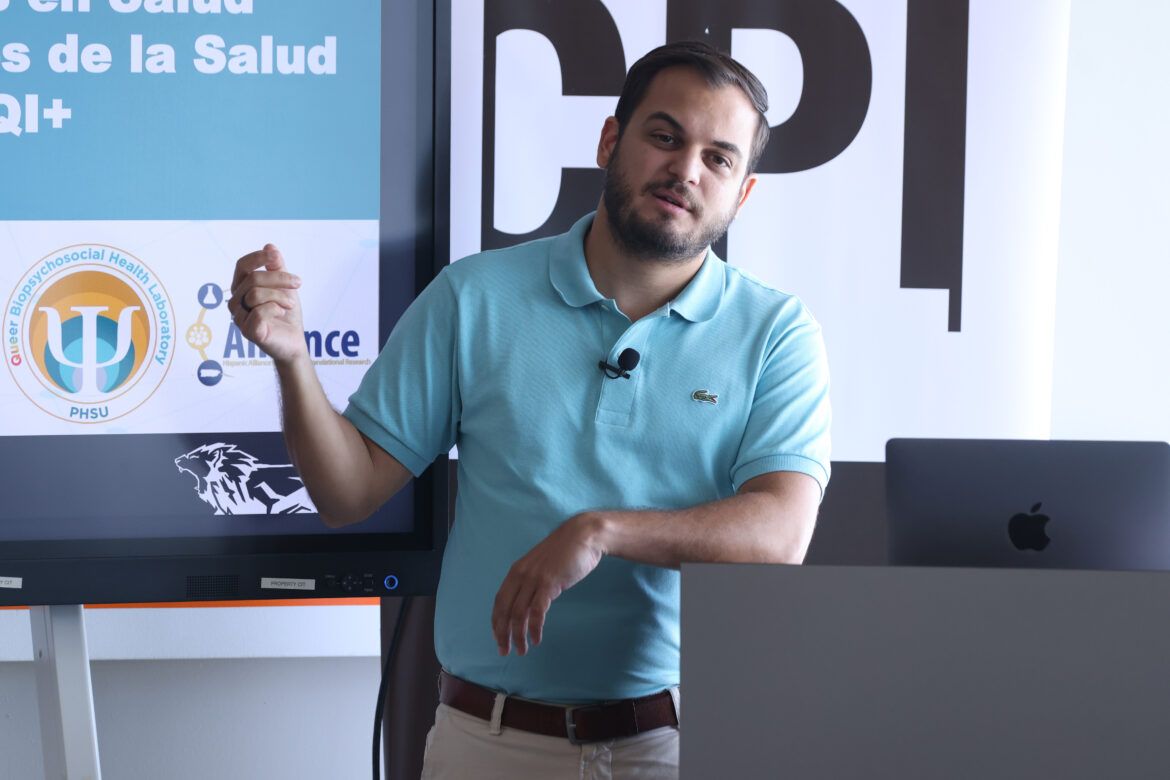
Photo by Brandon Cruz González | Centro de Periodismo Investigativo
“Usually, heterosexual people experience the everyday stress of work, debt, and other pressures, but LGBT people face an additional factor, the stigma related to their sexual orientation or gender identity,” Esteban said. For trans and nonbinary individuals, this stress can be even higher than for LGB people, leaving them “constantly hypervigilant,” a condition worsened by the wave of anti-trans measures introduced in recent years in both Puerto Rico and the United States.
More Policies That Heighten Stress for the LGBT+ Population
At least six other legislative measures currently under consideration affect LGBT+ rights in areas such as adoption, participation in sports, inclusive bathrooms, health care, and the use of inclusive language. It remains to be seen whether these bills will pass both the Legislature and the governor’s approval. This administration has also removed coverage for hormone treatments for trans people from Plan Vital, the government health insurance program, a direct blow to this community.
These measures partly mirror the anti-LGBT+ public policy trend of the U.S. government. Since returning to the White House, President Donald Trump has denied the existence of transgender identity, signed at least eight executive orders targeting LGBT+ people — four of them explicitly anti-trans — and ordered the removal of health information about this community from federal websites, significantly affecting the services and funding that these individuals and their allied organizations receive.
“Hatred doesn’t make us disappear,” said clinical psychologist Miguel Vázquez, cofounder and executive director of True Self Foundation. This nonprofit promotes diversity in sexual orientation and gender identity in Puerto Rico. “What happens is that our health is put at risk, and that ends up becoming a public health issue,” he said.
This investigation was made possible through a grant awarded by the Instituto de Formación Periodística of the Centro de Periodismo Investigativo, with the support of True Self Foundation, Coalición Orgullo Arcoíris and Amnesty International Puerto Rico.
This translation was generated with the assistance of AI and reviewed by our editorial team to ensure accuracy and clarity.

