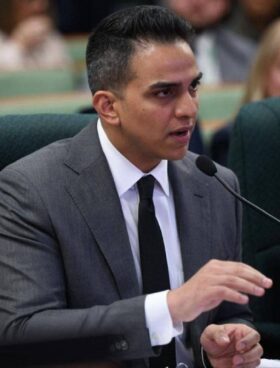



Jorge Galva, former executive director of the Puerto Rico Health Insurance Administration (ASES, in Spanish), said the agency must take immediate action regarding First Medical Health Plan, one of the insurers participating in the government’s Vital Plan. He also questioned the information the company submitted to the Office of the Commissioner of Insurance of Puerto Rico.
The health care executive and attorney, who led ASES under the New Progressive Party administrations of former Govs. Wanda Vázquez and Pedro Pierluisi, made the comments in response to a Centro de Periodismo Investigativo (CPI) investigation that revealed serious delays by First Medical in paying providers and the resulting impact on patient services.
“If First Medical has the money, ASES must use every legal resource at its disposal to ensure that providers are paid,” Galva said on CPI’s Agenda Propia program.
If First Medical does not have the money, he said, that means the estimates submitted to the Office of the Commissioner of Insurance “are not accurate.”
“An emergency intervention is needed to determine the company’s true financial condition and protect providers’ interests,” he added.
Puerto Rico Insurance Commissioner Suzette M. Del Valle Lecároz said in April that all insurers participating in the Vital Plan, including First Medical, were meeting capital requirements at the time. The commissioner has not granted CPI an interview on the matter or disclosed whether her office has taken any action against First Medical. In its 2025 annual report filed with the Office of the Commissioner of Insurance, First Medical reported $170.7 million in unpaid claims while also reporting profits of about $5 million.
Galva said First Medical had a dispute over several risk-adjustment factors and payments ASES owed the company in 2023 and 2024. Once the funds were released, he said, he thought, “The problem is over. They’re going to pay” the providers. But that did not happen.
“What they did was start keeping up with current payments. In other words, they began making the payments that were currently due, but they did not pay the overdue amounts,” he said.
ASES has imposed five fines on First Medical totaling nearly $4.8 million, but the company has paid only $300,000 to date, according to information provided by the agency. Three of the fines remain pending in administrative proceedings before ASES. One has been in that process for more than a year and a half. Most of the fines involve failures to pay providers.
Galva said ASES’ processes for evaluating insurers and imposing sanctions “unfortunately move at an astonishingly slow pace.”
“The reason is that, although the contract establishes very strong safeguards regarding the obligations insurers must meet, it also contains procedural protections for the insurers,” he explained. “Therefore, the decision to impose a fine — the fact that I determine that a fine should be imposed — does not mean the problem is over.”
He added that insurers have an opportunity to negotiate in such cases and that this “is an integral part of the procedural rights they are granted.”
“Imposing the fine is only the beginning. After that, the insurer can challenge it. The agency, ASES, can determine that the sanction was properly imposed. The insurer can still seek review before the agency itself, and if the agency upholds the fine, it can go to the Puerto Rico Court of Appeals,” he added.
Galva said the process “is not extraordinary,” because similar procedures can be found in federal regulations governing these types of matters.
“The government should take advantage of the fact that the fines have already been imposed to expedite the review process, accelerate all internal review and appeal proceedings, and move the matter forward as quickly as possible,” Galva said of the fines against First Medical. “If the insurer believes it has grounds to challenge them, then it should go to the Court of Appeals so that the fines can finally be paid.”
“The power insurers wield here in Puerto Rico is not unusual either. In the United States, the private insurance industry accounts for literally hundreds of billions of dollars annually. Insurers have one of the most powerful lobbying operations before Congress to defend their interests, and today they call the shots in the entire U.S. health care system, which revolves around private insurers. That is a fact. In that sense, Puerto Rico is no exception,” he said.
“Taking on insurers requires a measure of political will that has sometimes been stronger and at other times weaker,” he said.
Galva said he conducted a quantitative study that found ASES needed to increase its staff from about 70 employees to 110. The roughly 40 additional employees would have worked in three areas: quality, systems and auditing. Although the new positions had been approved, he said, his “immediate successor, Edna Marín Ramos, did not carry the initiative forward, and those employees — whom ASES desperately needs right now — were never hired.”
CPI requested comment from Marín Ramos but had not received a response by the time of publication.
This translation was generated with the assistance of AI and reviewed by our editorial team to ensure accuracy and clarity.