

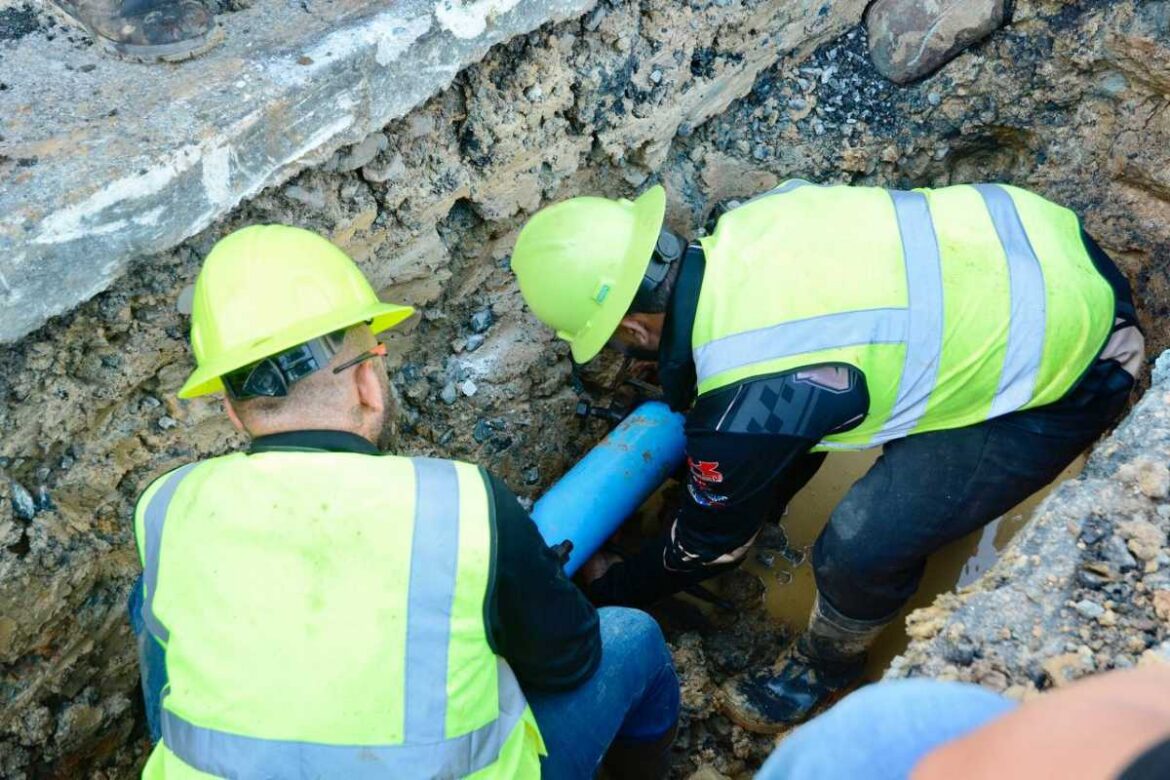


Over the past five years, the Puerto Rico Aqueduct and Sewer Authority (AAA, in Spanish) has not increased the share of funding allocated to repairing and replacing obsolete pipes, valves or connections. That share stands at just 4% for 2026 — a proportion the agency says will decline over the next two years, an investigation by the Centro de Periodismo Investigativo (CPI) found. This is despite broken pipes being the leading cause of treated water loss in Puerto Rico.
The remaining 96% of capital improvement funds has gone toward rebuilding structures damaged by hurricanes and earthquakes, complying with Environmental Protection Agency (EPA) requirements, mitigation projects, water quality improvements, and purchasing electric generators, pressure gauges, technology infrastructure and new vehicles.
Although the budget for repairing and replacing drinking water pipes has increased since 2021, the share of funding devoted to those efforts has been smaller than that allocated to the other categories in the capital improvement budget since that same year. The percentage decline in funding to fix pipes and connections comes as water losses have worsened, in part because of the aging of the AAA’s distribution system, at least seven sources connected to the agency told the CPI.
Of the $845.8 million the AAA allocated for capital improvements in 2025, only $60.8 million, or 7%, was set aside to repair existing infrastructure, according to reports from the public corporation. Sixty-one percent of those funds is for reconstruction projects subsidized by the Federal Emergency Management Agency (FEMA) to repair structures damaged by hurricanes and earthquakes.
That figure contrasts with 2019, when the AAA allocated 43% of the capital improvement program’s $73.5 million to projects to repair and replace pipes and other assets in the distribution system.
AAA President Luis González Delgado acknowledged that the aging of the agency’s 20,000 miles of pipes is one of the main causes of water loss. Still, he did not answer the CPI’s questions about why increasingly less money will be allocated to repairing or replacing obsolete systems.
“Unaccounted-for water loss,” as the AAA calls it, is the calculation of drinking water that is produced and enters the system but does not generate revenue. In addition to physical losses, it includes commercial losses caused by billing or metering errors and theft. Unaccounted-for water loss rose from 59% in 2017 to a record 69% in 2022, according to data analyzed by the CPI.

Photo Provided | Centro de Periodismo Investigativo
Hydrologist Jorge Ortiz Zayas, an expert in water systems and reservoirs w