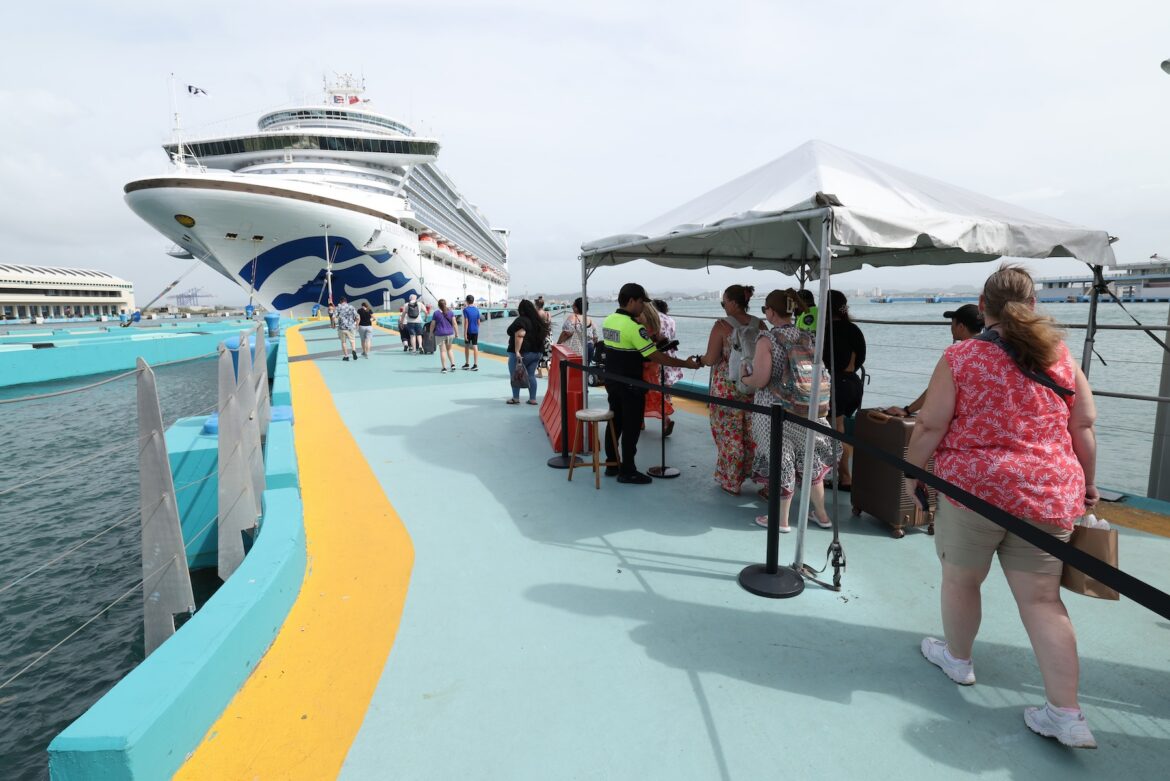
Cruise Passengers Fill Old San Juan’s Streets. Who Gets Their Business?
Cruise visits to Caribbean ports have more than doubled since 2000, rising from about 14.5 million arrivals to roughly 35.5 million in 2025, according to the Caribbean Tourism Organization. The industry and its backers promise economic growth, but critics say the cruise bargain is becoming increasingly unfavorable for island destinations.
Cruise Passengers Fill Old San Juan’s Streets. Who Gets Their Business?
Tour guides, tourist transportation operators, merchants and cultural promoters struggle to make a living in the historic city, sometimes competing with the cruise industry, which takes a share of the tour business.
Bigger ships, smaller returns? The Caribbean’s cruise bargain under strain
Historian and history teacher Rafael Capó García, who guides a group of journalists through the cobblestone streets of Old San Juan, shares facts that offer an unconventional perspective on the colonial enclave.
“In Old San Juan, 20% of all residences are Airbnb’s. Twenty percent! That's the highest percentage in Puerto Rico, except for the island of Culebra.”
Capó adds details that reflect the structural and cultural changes taking place in the city. “All the tax credits under Act 60 are amplified if you invest in tourism. If you want a 90% exemption from taxes on construction materials, the project must be 100% tourism-related. If you want an electricity credit, your project must include a tourism component. If you incorporate anything related to tourism, the benefits are magnified, and that has created a visitor-driven economy in Old San Juan.”
He explains that he and his team at Memoria Decolonial counted at least 74 souvenir shops in the historic city, more than 50 of them on San Francisco and Fortaleza streets.
“There are 74 souvenir shops in this city, which is small,” he said in amazement. “We counted 10 smoke shops, all on San Francisco and Fortaleza streets. They all sell the same thing. And we counted five stores selling creams, run by these people who come up and harass you, touch you and say, ‘Come. Where are you from?’ and take you by the hand into the store. They only talk to tourists.” In English.
Most of the souvenirs are made in China. The smoke shops, which are not part of Puerto Rican culture, are generally empty, and the stores selling creams do not carry any local products either.
A few steps from the Cathedral of San Juan Bautista, where Capó is speaking to the journalists during a special educational tour, a line of tourists makes its way up Cristo Street.
Capó is not a tour guide, but his nonprofit educational organization, Memoria Decolonial, offers tours for students, academics and groups of visitors interested in learning about the history of the city and Puerto Rico from a critical perspective. The tours visit major landmarks and monuments in the historic district, including La Fortaleza, nearby streets, Paseo La Princesa and Castillo San Felipe del Morro. At these sites, Capó tells lesser-known stories that challenge conventional narratives and connect the past to Puerto Rico's present-day colonial reality.
The Puerto Rico Historic Building Drawing Society offers tourists another way to explore the walled city.
Photo provided
Tour operators are among the businesses that depend on the cruise industry in Old San Juan. But the tours commonly offered to cruise passengers present an idealized image of Puerto Rico “because they try not to make people uncomfortable, so they don't talk about the racism and colonialism that have been part of Puerto Rico's history,” Capó said.
“We don't work with cruise tourists,” the historian stressed. He made the decision to avoid exposing his team to friction with tourists who might react negatively to Memoria Decolonial's content, which critically examines Spanish and U.S. colonization.
A study by the Florida-Caribbean Cruise Association (FCCA), which represents cruise industry stakeholders in the Caribbean, found that Puerto Rico is tied with Key West for the lowest level of cruise passenger spending on excursions in the Caribbean, averaging just $42 per passenger.
An investigation by the Centro de Periodismo Investigativo (CPI) found that while Old San Juan and its residents bear the costs and pressures of growing cruise tourism, a significant share of the business generated by those visitors stays with the cruise lines themselves or a couple of tour operators that receive government incentives.
Working as a Tour Guide in Old San Juan
Juan Rampolla Nieves is a partner at San Juan Happy Tours, a tour operator in Old San Juan. He transports tourists to attractions in the historic city, where most cruise ships visiting Puerto Rico dock. He charges between $30 and $75 per person. Many of his customers are cruise passengers who arrive without reservations.
Tours, however, are not his only source of income. Rampolla has two other jobs. He finds it an uphill battle to compete with larger tour operators that receive tax incentives and sell their excursions through cruise lines.
Until last year, local tour operators EcoQuest, Rico Sun Tours, Tour Coop and United Tour Guides received tax benefits under the Puerto Rico Incentives Code. One of those benefits was $1 for every passenger who purchased one of their excursions aboard the cruise ship that brought them to Puerto Rico. Tour operators can contract directly with cruise lines to provide excursions and transportation at the piers.
From 2022 through 2025, the four tour operators received more than $365,000 in tax incentives, according to the Puerto Rico Tourism Company (PRTC). Their services are not limited to tours of the historic city. They also offer guided excursions to other attractions, including El Yunque in Río Grande and the Bacardí Distillery in Cataño.
Of the four, United Tour Guides, Tour Coop and Rico Sun Tours include Old San Juan among their tour offerings. EcoQuest ceased operations this year and did not offer tours of Old San Juan.
The Tourism Company has two main requirements for businesses seeking tax incentives, agency press officer Reimarie Carrero said. First, they must have the agency's approval to offer excursions or tourist transportation services at the piers. Second, they must be hired directly by cruise lines to provide those services.
“As part of its destination development mission, the PRTC facilitates communication between new operators and cruise lines to expand the range of excursions available, but it does not participate directly in any negotiations. Likewise, interested operators are invited to periodic training sessions sponsored by the PRTC to meet the standards required to secure direct contracts with cruise lines,” Carrero said.
However, negotiating with cruise lines “is not a path that's open to everyone,” warned Alexandra N. Sánchez Soto, owner of My Puerto Rico Tours.
Sánchez explained that tour guides, particularly those specializing in walking tours, cannot sell their services at the port unless they are subcontracted by companies authorized by the government agency. This forces them to rely on social media, websites or referrals from former customers to attract new tourists.
According to Jorge Luis Echevarría, founder of a tour and tourist transportation company, contracting with cruise lines and gaining access to tax incentives is virtually impossible because the required insurance coverage is extremely expensive. That comes on top of other licenses and authorizations the government requires.
Tour operators and guides are governed by regulations. Operators do not have to be companies. They can also be groups of tour guides who apply for certification from the PRTC and the Transportation and Other Public Services Bureau to provide tourist transportation as well. Tour guides must be certified. They can work independently or through a tour operator. Although guides are required to be certified to provide their services, tour operators may occasionally hire uncertified guides if they have a special permit.
Independent tour guides who cannot negotiate with cruise lines depend on travelers who have not purchased services from any of the four operators before disembarking, or on being hired by those operators when needed.
Hasta As of July this year, Puerto Rico had 429 registered tour guides, according to the Tourism Company.
Tour guides sell their excursions to cruise passengers who have just arrived in Old San Juan.
Photo by Brandon Cruz González | Centro de Periodismo Investigativo
Humberto Fumero Agosto, a tour guide in Old San Juan, said he primarily offers tours to visitors who arrive by plane and stay in the historic city, as well as cruise passengers and some corporate clients. “Many cruise lines already presell their excursions and have their own suppliers or tour operators,” he explained.
Fumero said tour operators sometimes subcontract him to serve their cruise passengers. When working independently, he finds customers through platforms such as GetYourGuide, Viator and Civitatis. He charges $30 to $50 per person when working on his own, compared with an hourly rate when working for tour operators. He earns essentially the same amount either way because he sometimes works for operators and other times independently.
Debbie Molina Ramos, meanwhile, has worked as a tour guide for nearly three decades. A few years ago, she moved to western Puerto Rico, although she still occasionally offers tours in Old San Juan. Like Fumero, she charges $50 per person for tours of the city. Most of her customers contact her because of her years of experience in the industry and because they find her contact information online.
She operates independently and does not need tour operators as intermediaries. This is her only job, and she told the CPI that she “makes a good living” from it.
According to the FCCA study, 34% of cruise passengers visiting Puerto Rico as a port of call purchased at least one tour in 2024. Of those, 67% booked directly through the cruise line, 28% through a travel agency and the remaining 5% after arriving onshore.
Most tourists “purchased their excursions directly from cruise lines. The cruise lines, in turn, retained a portion of the price charged as a management fee or sales commission,” according to the study.
One operator who contracts with cruise lines is María Alexandra Pla, owner of Colonial Adventure at Old San Juan. She has offered excursions to cruise passengers in Old San Juan since 1995 and has contracts with cruise lines. She specializes in walking tours of the historic city, generally the most sought-after option among visitors spending only a few hours in Puerto Rico.
The price varies depending on the contract between the tour operator and the cruise line, she explained. Unlike the other companies receiving tax incentives, her business does not provide tourist transportation.
“We set a net price, and most of the ships double or triple it,” Pla said.
Samuel De La Rosa Padilla, owner of MVP Tours Puerto Rico, which provides services through cruise lines when there is an overflow of passengers at the port, as well as directly to cruise passengers, said cruise companies pocket approximately 60% of the profits. Three other tour operators corroborated that estimate.
“It's unfair competition,” De La Rosa Padilla lamented. “They're on top [the large tourist transportation companies]. They're the ones dealing with the customers. They're the ones who snatch up the customers when they arrive. ... We have to deal with the customers who are left over, because we deal with those who don't buy an excursion on the ship. ... It's a bit tedious and an uphill battle.”
He said disputes frequently arise with cruise companies “because they sell at a higher price, and we basically sell the same excursion for much less.”
Residents have complained about the use of scooters in the historic city.
Photo by Brandon Cruz González | Centro de Periodismo Investigativo
The Crown Jewel Is Not Being Properly Preserved
Old San Juan's architecture is one of Puerto Rico's greatest assets, attracting tourists from around the world who admire its beauty without necessarily knowing its colonial past.
According to Karen Garnik, spokesperson for Discover Puerto Rico, the walled city's infrastructure has a 78% positive perception rating, while its historic forts receive favorable ratings from 88% of tourists. El Morro is the tourist attraction most frequently mentioned by cruise passengers in the Caribbean.
She added that most cruise passengers choose cultural and historical tours of the city rather than going to the beach or participating in water sports.
“Old San Juan doesn't just sustain the cruise economy,” Garnik said. “Every dollar comes from a heritage that still endures.”
But although tourists' favorable impressions of Old San Juan stem precisely from its unique residential and historical character, that heritage is not being adequately preserved, according to longtime residents such as Vanessa Droz.
“Things have changed. Maybe 20 or 30 years ago, people still followed the Puerto Rican Institute of Culture's requirements for restoring properties. Today, those requirements aren't worth two cents,” Droz said. “Everyone here does whatever they want with the exteriors and interiors of properties because there's no one, not even the State Historic Preservation Office, stepping in to make sure the city is preserved ... to ensure what a historic district is supposed to be: preservation, rehabilitation and reconstruction,” she added.
Old San Juan has experienced rapid population loss in recent years.
Photo by Brandon Cruz González | Centro de Periodismo Investigativo
The CPI has also documented the strain that the steady arrival of cruise ships places on public infrastructure, to the detriment of Old San Juan residents. Traffic congestion, low water pressure, a lack of public restrooms and deteriorating streets are among the signs that the 11% increase in cruise ship arrivals over the past decade has exceeded the resources available to the city and its community.
The city's increasing commercialization near the cruise ship piers also draws negative ratings from 40% of visitors because it detracts from Old San Juan's historic character. Visitors also give the deteriorating cobblestone streets a 60% negative perception rating because, they said, the conditions make it harder to get around, particularly for older visitors and people with disabilities. Another 52% complained about overcrowding, especially on days when multiple cruise ships are docked, according to Discover Puerto Rico data.
Mixed Views Among Cultural Workers and Merchants
Elisa Sánchez Torres, manager of Casa Estrecha (The Narrow House) on Tetuán Street in Old San Juan, explained that the historic property primarily attracts tourists who arrive by plane and stay in the city.
“Almost always, they [cruise passengers] come with a prepaid tour, and there are companies that have a monopoly. When tourists disembark, when the cruise ships arrive, there are ... large companies dedicated exclusively to tourism in Old San Juan,” Sánchez said.
“Because Casa Estrecha is one of the places where they stop, talk and tell the history of the house, everyone gathers in front of the entrance. ... In my case, it affects me because people are constantly stopping, talking ... taking pictures. They block access,” she added.
Sánchez said some cruise passengers have complained about the $10 admission fee and the discounts offered to residents.
According to the FCCA study, cruise passengers' favorite activity is taking tours, which sometimes include stops at cultural centers.
María Ángela López Vilella, executive director of the Museo de las Américas in the Ballajá Barracks in the northern part of the city, said tourists account for nearly half of the museum's visitors. In more than three decades of working there, she has noticed no reluctance among cruise passengers to pay the admission fee. She emphasized that most visit the museum on their own rather than as part of organized excursions.
López noted that tour operators offer excursions outside the city, limiting the economic benefits that remain within the walled city.
“We don't benefit from those excursions,” she said. “At one point, they included us as part of the tour. But now they simply pass by and tell [cruise passengers] where we are.”
Tourists learn about Puerto Rico's history during a tour of the historic district.
Photo by Brandon Cruz González | Centro de Periodismo Investigativo
Old San Juan merchants said some of their sales come from cruise passengers who buy their products, whether they are on a tour or not. They also serve residents and other travelers, whose purchases help balance their finances when fewer cruise ships are in port.
The second most popular activity among cruise passengers in the Caribbean, at 42%, is shopping for jewelry, watches and clothing. It is also the category in which they spend the most, totaling $268 per passenger, according to the FCCA study. Ingrid Jeffs, owner of the Olé Puerto Rico hat shop on Fortaleza Street, said her sales depend primarily on tourists, but not exclusively on those arriving by cruise ship.
“There might be a day when there's only one cruise ship or no cruise ships at all, and I still do extremely well,” Jeffs said. “I don't close the store because there are no cruise ships. I'm always going to open because there are people staying in hotels.”
The walled city has at least 16 tourist accommodations, including hotels, guesthouses and bed-and-breakfasts, according to the Tourism Company's lodging registry. About 710 short-term rentals are advertised, according to Airbnb data. Short-term rentals tend to be listed on multiple platforms, including Vrbo and Booking, among others.
Josian Emanuelli Fortuño started his business after years of working in multiple industries.
Photo by Brandon Cruz González | Centro de Periodismo Investigativo
According to FCCA data, 31% of people taking Caribbean cruises purchase handicrafts and souvenirs once they reach their destination. This is the fourth most popular activity among these customers. Josian Emanuelli Fortuño, owner of CAOS Art Gallery, sells artwork on Fortaleza Street. He said Puerto Ricans, not foreign visitors, are the ones who buy most of his pieces.
“It always helps when there are [cruise passengers],” he said, while noting that his paintings attract more interest from locals.
On average, cruise passengers spend no more than $25.78 on food and beverages per destination, according to the FCCA. At least 38% take advantage of their time in Puerto Rico to sample traditional cuisine.
Karen Clark Cortés, owner of the Rincón Ibérico restaurant in Old San Juan, said half her customers are tourists who have researched her business on social media beforehand and come because they are interested in its menu. They generally order desserts, drinks or Puerto Rican fast food rather than main courses because they eat aboard their cruise ships.
“In addition to walk-in customers, we have a tour group coming in almost every day that brings people to sample our dishes,” Clark said.
This translation was generated with the assistance of AI and reviewed by our editorial team to ensure accuracy and clarity.