
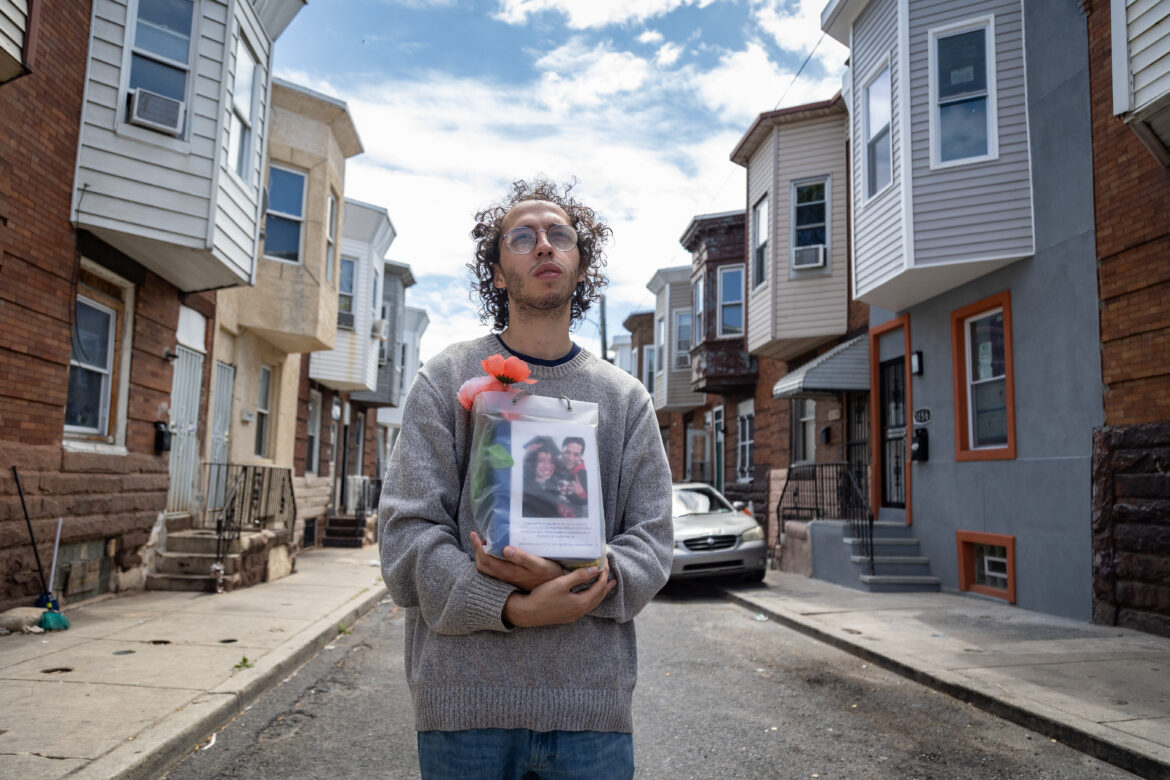
Guillermo Santos Jr., 21, cradles his father’s urn held in a gift bag.
The box is heavier than he thought it would be. Outside his childhood home, Santos looks down.
“This is the longest I’ve ever held him,” Santos said.
His father — Guillermo Santos Sr. — died of a fentanyl overdose in 2021, months after his virtual high school graduation. Santos Sr. moved from Puerto Rico to Philadelphia after his father sent him to the U.S. to learn English. There, he met Cheri Honkala and, soon after, Santos Jr. was born.
Raised in the heart of Kensington, a working-class Philadelphia neighborhood with a longstanding Puerto Rican community, Santos Jr. recalls the caw of his neighbor’s roosters waking him for school. Walking to Market-Frankford Line, the city’s elevated train known locally as “The El”, he passed people lying out on the sidewalks.
“It wasn’t odd to me that my father was a heroin addict because everyone around me was, because of my neighborhood,” Santos said.

Photo by Solmaira Valerio | Centro de Periodismo Investigativo
Long associated with Philadelphia’s opioid crisis, he describes Kensington as tight-knit. Although gunshots were constant, neighbors knew his mom, a housing rights activist, and protected their home.
Guillermo Santos Jr. is among the roughly 33% of people in Philadelphia who personally know someone who has died by overdose, according to Pew Heritage Trust’s most recent data. The state’s Department of Health tally from 2024 reveals that Latinos comprise 9.7% of total overdose deaths; city public health data from 2023 put the overdose death rate at 77.9 per 100,000 residents. Nationwide, more than 42% of people have been impacted in some way by an overdose death.
Today, the young Philadelphian lives in New York City. During visits to Philly, he notices that his neighborhood is in the same condition as when he left, while new development crops up.
“The way that Philadelphia keeps itself frozen and doesn’t actually deal with a lot of the issues that are torturing its residents is so mind-boggling to me,” he added. “It is really devastating.”
His mom agreed.
“I raised a son after his dad died from an overdose in a city that didn’t have shit to offer,” Honkala said.
The city’s death certificate data reveals that unintentional overdoses are the second-leading cause of death among Puerto Rican residents for two years in a row. An analysis by Centro de Periodismo Investigativo (CPI) of 2023 public health data reveals men die of overdoses at double the rate of their female counterparts – across all racial and ethnic groups.
Within the last 10 years, drug overdose deaths were highest among Puerto Rican men aged 45 to 54, according to a research paper in the International Journal of Drug Policy.
Air Bridge: one-way tickets and promises of rehabilitation
This crisis isn’t new. Its roots trace back to the city’s economic crisis in the 1970s, which disproportionately impacted Black and Latino residents of industrialized neighborhoods like Kensington. In the 1980s, North Philadelphia became a hub for open-air drug markets.
“The drug economy was a very real financial attraction for young people whose families had few options for survival,” according to American Quarterly, a journal published by Johns Hopkins University Press.
When factories shut down in the late 1980s, unemployment rates soared, hitting racially segregated and economically disadvantaged areas the hardest. What began as a way out of poverty drew younger generations into drug use and homelessness.
In the 1990s, a movement known as “Air Bridge,” run by pastors and government officials, gave people with substance use disorders one-way tickets from Puerto Rico to cities such as New York, Chicago and Philadelphia.
In Philadelphia, “Air Bridge” areas included Kensington and Fairhill that comprise the ZIP codes 19125, 19133, and 19134, some of the city’s poorest. A 2017 BBC report estimated that thousands landed in Philly from Puerto Rico through the Air Bridge movement.
Charito Morales, a community advocate in Philadelphia, witnessed Air Bridge’s false promises in real time when her brother was sent for rehab 30 years ago, but the care never came.
Morales’ family sent her brother, Alvin Luis Morales-Soto, to the U.S. under the guise of quality rehabilitation and medical care that did not exist in Puerto Rico and Air Bridge promised. When the family lost contact, she went undercover on her own and experienced the living conditions first-hand.
A Philadelphia Inquirer investigation from 2016 illuminated harrowing practices. People living in squalor, 20 men stuffed into tiny bedrooms in a small rowhome that should fit no more than 10. SNAP benefits held hostage. No phones.
Morales served as a key source for the Inquirer, motivated to understand what happened to her brother.
“They brought him here — what did they offer him? Rehabilitation and all sorts of things,” Morales said. “My family, unaware and uninformed, believed this was the ideal place because it was the United States, and there are so many benefits, so many resources compared to Puerto Rico, and he would have everything within reach.”
He died of an overdose on June 18, 1998.
A former outreach worker with Asociacion de Puertorriqueños en Marcha (APM), a non-profit organization dedicated to Latino health and community services, identified as “AJ” for privacy purposes, told CPI that some unregulated recovery house managers connected to Air Bridge were fueled by greed, since they intercepted and pocketed government benefits.
“Well, there was money to be made,” he told CPI.
AJ recalls a specific case involving a Christian ministry that operated as a recovery house. He said that one day, when the pastor was away, he found mail tucked above a cabinet in the church’s administrative office. The letters, he said, were addressed to program participants. AJ said he suspected that the mail may have been redirected from the recovery house to another address. In his view, that could have made it easier for third parties to access public benefits.
Tracy Esteves Camacho, a harm reductionist who met with Puerto Ricans who arrived by way of Air Bridge, heard the same thing first-hand.
“A lot of people were telling me the same story,” she said. “No one knows exactly if it’s the recovery houses here or if it’s someone in Puerto Rico trying to move these people around. A lot of them would end up here with nobody.”
With nowhere to go, many program participants ended up houseless, some living beneath a bridge, covering themselves with cardboard boxes to stay warm in the winter. AJ said these conditions worsened the substance use issues they had left the island hoping to fix.
The few who found legitimate help, however, recovered and found stable housing. Today, AJ said, wraparound services such as housing and regulated addiction treatment seem out of reach, or not as much of a priority, particularly for Spanish-speakers.
“It’s a human disaster, the result of human error, an error by the Department of Health. A failure to classify narcotics use as a mental illness; instead, they criminalize it and continue to criminalize it,” Morales said.
A Neglected Crisis
Overdose deaths have steadily increased over the years in Philadelphia, disproportionately impacting Black and Hispanic residents, deemed to be an overlooked health crisis since 2023.
Santos Jr. says the barriers his father faced in the ‘90s persist today.
“We’re not doing anything about it because throughout my entire childhood, he kept wanting to get better. He was putting in active steps and he was shown that there was no place to go except back under the ‘El Train’,” he said, referring to the bridge area where some unhoused people would go.
Honkala, his mom and a licensed medical care provider, agreed. She runs a rehab program part-time. Guillermo’s father is one of many who have been failed by disconnected social and health networks.
He was on and off city housing lists for 18 years, survived nine overdoses, and lived with worm-infested infections on his limbs. He was also HIV positive.
“He had a lot of people around him that tried to get him whatever was available to get him the help that he needed and there was nothing,” she said. “Every time that he was sick and he was going into withdrawal and he’d go to Episcopal or Kensington Hospital, he would have to sit in the waiting room for 13 hours, shit himself, throw up on himself, and convince himself that, ‘Oh yeah, I want to stay here and get clean.’”

Photo by Solmaira Valerio | Centro de Periodismo de Puerto Rico
In 2020, Esteves Camacho worked closely with Puerto Rican communities living with HIV who use intravenous drugs, providing care in a medical clinic integrated within a syringe exchange program at Prevention Point Philadelphia.
She knew Guillermo Santos Sr. and recalled him showing her photos of his son. Santos Sr. had plans to become a barber in the future.
“It makes me want to cry. He was such a good person,” Esteves Camacho said.
He began using drugs again after his girlfriend’s overdose death, and his visits to the addiction treatment center, Prevention Point, became more unpredictable.
“It wasn’t his personality. He was hurting,” she added. “It was really heartbreaking when he passed away, knowing he had a son and that now this person is going to have to live without their father.”
The Rope Always Breaks at its Weakest Point
The needs of the community in the throes of the opioid crisis are colliding with local and federal funding cuts.
On January 13, the Trump administration abruptly canceled, then 24 hours later restored, nearly $2 billion for mental health and addiction treatment. In July of 2025, the Trump administration issued an executive order to reevaluate and halt discretionary Substance Abuse and Mental Health Services Administration grant funds for harm reduction programs or “safe consumption” sites. Despite public health reports lauding its benefits, the administration falsely claimed that these methods “only facilitate illegal drug use and its attendant harm.”
Instead, federal dollars will be prioritized for drug courts and mental health courts. This is happening in Philadelphia already. In June 2024, Philadelphia Mayor Cherelle Parker ceased funding the needle exchange programs, deferring to local nonprofits and philanthropic groups. Parker’s administration opted for a law-enforcement-heavy approach and changed how Opioid Settlement Funds are distributed.
In the last two years, Philadelphia City Councilmember Quetcy Lozada, who represents the 7th District, has introduced resolutions and new bills that limit certain efforts, such as safe injection sites, and where mobile care units can provide services. The 7th district includes neighborhoods hardest hit by the opioid epidemic, such as Harrowgate, Kensington and Olde Richmond.
She told CPI that she believes safe injection sites “keep them in that vicious cycle.”
Research shows that safe injection sites help reduce HIV transmission, infections and other diseases caused by sharing needles. Public health experts explain that harm reduction is one tool to reduce health risks and overdose deaths.
Advocates warn that limiting where outreach workers and mobile care units can operate will delay critical care, putting more people at risk of infection or medical crises. Lozada told CPI her office is working with providers and community organizations to better understand what she can do to support the people in her district.
“No one is turning a blind eye now,” Lozada said. “Folks need to understand that this is not a ‘Let’s have a conversation today’ type of situation. It is very much still a crisis and we are still ground zero. That has not changed. The focus has been, and continues to be, prevention and education and making sure that everybody’s on the same page and that we continue to grow in the same direction.”

Roz Pichardo, founder of Sunshine House, sees nearly 80 people by 9 a.m. on some days. Recently, Pichardo doubled the number of nurses on site, prompted by confusion surrounding the mobile care unit operation. People searched for her.
“We already feel like we’re triage here. There’s too much red tape,” Pichardo said. “How do we reduce stigma in a community that’s plagued with addiction? Just keep talking, keep showing people what empathy and compassion look like. Maybe they will pick up on it.”
She reiterates that care is not one-size-fits-all.
Some reports suggest that Police Assisted Diversion and Case Management, Assessment, Re-entry and Empowerment Services (PAD CARES) and “Wellness Courts” may not be working as intended.
Lozada proposes government-run medical programs, such as triage centers and “stabilization centers,” that address the physical symptoms and barriers to recovery, including open wounds.
“For a long time, the voices of those who were on substance abuse or those who are living in substance abuse were prioritized over those who are just trying to live day by day in that community,” Lozada told CPI.
She says residents want a better quality of life, for children not to be exposed to people with gaping wounds, and for elders in the neighborhood to feel safe walking around.
“The government created this. Government needs to respond to it,” she added.
In a follow-up interview, Lozada told CPI: “We’re constantly meeting and having conversations about what is working, what is not working. What needs to be adjusted? Where do we need more services? Who are the providers that are actually providing the work and the services and who are not? And those who are not, how do we re-allocate or readjust values to those programs that are actually having a positive impact?”
City officials’ plans remain unclear, however, Lozada said partnerships are still evolving.
Policy Shifts and the Limits of Enforcement
Yet, researchers like Luis Valdez, an assistant professor in community health and prevention at Drexel University and founder of the GANAS Health Initiative, have concerns.
“Can we stop looking at this as a wasted budget line item?” asked Valdez. “People are dying. Those people are also constituents, folks that have families and hopefully futures and people that grew up in these districts, right? The problem wasn’t created by drug use. The drug use is a symptom of all these other things that are happening.”
Some experts say officials’ decisions to restrict certain programs have complicated outreach efforts. Multiple harm reduction advocates claim city leaders are disregarding medical advice on addiction care.
“Our own health and human services (department) is not using evidence-based practices. We’re on a really shitty trajectory from the top down,” said Nicole O’Donnell, a peer recovery specialist with the Center for Addiction Medicine and Policy (CAMP) at the University of Pennsylvania Medicine System. CAMP provides patients with a prescription for buprenorphine via telehealth services.
“People view substance use as a choice instead of an illness. The people out there using are also victims of the opiate problem and so is the neighborhood. We’re trying to figure out… how do we support both?” added O’Donnell, who is in recovery and lost a sister to an overdose.
She testified before the city council in May, explaining that CAMP prioritizes connecting people to low-barrier rehabilitation treatment options and to a physician for continued care.
Meanwhile, new mixtures of street drugs, like xylazine, have complicated treatment and harm reduction efforts. In August 2024, a city health alert reported the emergence of an even more potent substance: medetomidine. Mixed with fentanyl, this drug can trigger potentially life-threatening symptoms — such as muscle rigidity and slowed breathing — that require admission to an intensive care unit.
Those shifts in the drug supply are showing up in hospitals. In the last two years, health care workers have experienced a sharp increase in emergency room visits related to substance use injuries and withdrawals, according to city data. Patients have also exhibited complications with wound infections and severe withdrawal symptoms.
“[That data is] a sign and symptom of other things that we’re tracking,” said Jeannmarie Perrone, emergency room physician and director of Medical Toxicology and Addiction Medicine at the University of Pennsylvania.
Perrone presented this data to the Kensington Caucus in May. Between January and September of 2024, more than 200 patients with addiction were admitted to intensive care units at Temple University Hospital, University of Pennsylvania Medicine and Jefferson Health.
“[That] is really unheard of for opioid withdrawal,” Perrone told the city council.
Language Barriers, Gaps in Access
Spanish-speaking Puerto Rican populations already struggled to access health care, a previous CPI investigation found. Latino providers are even rarer in substance use programming.
Esteves Camacho, who is from Caguas, Puerto Rico, was one of those providers. She was raised in Philadelphia and saw people lit up when she spoke in their language.
“It’s important to have the cultural context of being Puerto Rican,” she said. “I’ve been in the [hospital] room when [doctors] attempted to use language-line with someone but he had a Puerto Rican (Spanish) dialect. The person on the other line was not Puerto Rican, so they didn’t know what he was saying.”
But language isn’t the only barrier. After Hurricane María, Puerto Rican migration to Philadelphia increased, driven in part by people seeking medical care and social services. Experts told CPI that some arrivals include people with substance abuse problems, often low-income and eligible for Medicaid, a pattern also reflected in multiple studies.
In those cases, access to treatment often depends on Medicaid, the public program that funds a significant share of behavioral health services, and one that is now under threat. Government medical assistance covers nearly half the cost of treatments for people with substance use disorder, according to the Kaiser Family Foundation (KFF).
A 2017 state hearing revealed that 1,626 Hispanic Philadelphia residents from Air Bridge neighborhoods sought drug or alcohol treatment programs through the city’s Medicaid-funded behavioral health service, Community Behavioral Health (CBH). Today, residents in those same areas are more likely to use Medicaid-funded centers, especially for substance use disorder.
In 2021, 114,268 Pennsylvanians with substance use disorder relied on the aid, KFF data show. As of July 2025, Philadelphia topped the list for total Medicaid behavioral health spending, tallying in at $151,422,117, according to Pennsylvania’s health department data.
However, Latinos in the city are more likely to be underinsured or enrolled in Medicaid.
Medicaid funding hangs in the balance as the Trump administration slashes budgets dedicated to harm reduction services and raises barriers to enroll or renew benefits.
Pennsylvania is expected to be among the hardest-hit states, with an estimated $46 billion decrease over the next decade, according to KFF. Peer support, inpatient and outpatient rehabilitation, and mental health support could be destabilized for nearly 18 million people across the U.S.
“La cuerda parte por lo más finito [The rope always breaks at its weakest point]. Who are those 18 million Americans? Are they drug users? Probably. People who are on methadone. People who are using drugs,» said sociologist Camila Gelpí-Acosta.
‘A blueprint of what not to do’
Puerto Rico, along with the Dominican Republic, has some of the highest rates of injection drug use in the Caribbean. Those areas also see increased demand for selling and buying drugs, says Josh Romig, assistant special agent in charge at the DEA Philadelphia field office, who has tracked drug trafficking for 26 years.
“Puerto Rico is positioned closely to the Dominican Republic, [which] sees Puerto Rico as a very viable and much easier option to import drugs, especially small amounts,” he said.
Drug trade has collided with a layered public health crisis, says Gelpí-Acosta.
“We’re talking about these six decades of using Puerto Rico as a launch pad towards the Northeast,” Gelpí-Acosta said. “It’s created a humongous drug-using population on the island in the archipelago.”
Limited addiction programs in Puerto Rico have pushed people to relocate to cities like Philadelphia, while drug trafficking organizations thrive on demand, as documented by an academic study in Centro Journal. Gelpí-Acosta and her wife founded El Punto en La Montaña, one of the few syringe exchange programs in Puerto Rico, seeing how drug use contributes to other health conditions such as HIV and hepatitis C. She underscored that weakened health care systems act as a catalyst for migration.
“They left the island because there were no services, because of many other complicated reasons,” said Gelpí-Acosta. “And here in the United States, they find services, but they end up homeless anyway, and they continue to use drugs. And then the HIV, overdose, and hepatitis C vulnerabilities remain unaddressed.”
Without treatment, people living with HIV or hepatitis C face chronic health complications, cancer and death. Advocates and scholars say that failing to treat these conditions overlooks critical pieces of harm reduction.
“It’s not just an opioid crisis … It’s a syndemic of overdose displacement. It’s structural neglect,” Valdez said.
The GANAS Health Initiative supports Latino men in Philadelphia, addressing overlapping needs such as housing, education and poverty.
The latest drug bust illuminates those connections. In late October of 2025, federal and state officials indicted 33 members of a prominent drug trafficking ring in Kensington, led by dealers from Puerto Rico based in Philadelphia.
Allegedly, the head of the trafficking group allowed members to sell drugs “in exchange for rent,” according to the Department of Justice.
The drug economy in North Philadelphia persists in the ZIP codes with the highest poverty rates and the least social services funding.
“We have a blueprint of what not to do with alcohol from 1920 to 1932,” sociologist Gelpí-Acosta said, referring to the period known as the Prohibition era. “And yet, here we are. We continue to illegalize drugs, creating more dangerous drugs out there, not under our control. [Except] they’re not trafficking whiskey, they’re trafficking fentanyl.”
Valdez said health conditions that arise from substance use disorders emerge from what he calls “maladaptive coping skills” to stress. For example, suppressed trauma and limited access to Latino providers can exacerbate issues leading to self-medication.
Latinos often face complications with providers who are unfamiliar with their migration stories, family values or cultural taboos around mental health and addiction.
“Language and cultural competency or responsiveness is not there,” Valdez said, rattling off other complications such as health insurance limitations and poor quality housing. “Folks in power, whether we like it or not, would prefer an easy solution to a problem that’s really complex.”
Emily Seeburger, MPH, a mental health and substance use analyst, student, and volunteer with The Everywhere Project, echoed Valdez.
“Culture is such a big part of our health context,” Seeburger said. “To not have that, we are not equipped in the city to provide adequate health care.”
‘No other way’
In Portugal, addiction specialists have identified possible solutions such as decriminalizing drugs, aiming to eliminate barriers to housing and jobs. Portugal’s program changed how law enforcement interacts with users: Rather than arrest people who use or have drugs on them, police officers work as social workers do and connect people to treatment options. In addition, the government provides free health care to expand access to methadone treatment.
“If we are dealing with a chronic relapsing disease, we must keep the investment that equates to this situation,” said Portugal’s drug policy pioneer, Dr. João Goulão, in a 2023 panel discussion at Georgetown University. He acknowledged doubt of the policy’s effectiveness and the decreased participation in the program but blamed a lack of government-backed funding in social services.
Unintentional overdoses and long-term rehabilitation efforts require a health-first approach, he insisted.
This stands in stark contrast to Philadelphia Mayor Cherelle Parker’s strategies.
“The single biggest risk factor for drug overdose death is a period of incarceration,” Seeburger said. “We’re not telling the whole story if we’re looking at acute overdose.”
Despite multiple requests, the mayor was unavailable for comment.
In 2024, Lozada told CPI the city must “respond aggressively” to address addiction.
“There are people we are allowing to die on those streets because we are afraid of what the optics will look like. We have to bring people into our system. There’s no other way,” she said. “We have to make people healthy in our system. … In a way, the optics are not going to look good.”
Pichardo, who helps people living on the streets and reverses multiple overdoses weekly, called these methods “retraumatizing.”
“They’re going to relapse because there’s no real structure. There’s no desire. It was forced upon them,” she said. “Twenty years of addiction does not equal 16 days of treatment.”
Luis Soto, a peer specialist, agrees. While he applauded Lozada’s efforts, he rejected the idea of coercing people into treatment.
“We cannot force recovery to no one,” he said. “That’s not the way.”
After his infant son died in 1995, Soto began using drugs. Between 1996 and 2011, he was incarcerated off and on, becoming entrenched in the drug trade along Kensington Avenue. For a few years, he was unhoused, until an outreach worker – who he calls a mentor – helped him.
“In 2011, that’s when I opened my eyes,” Soto recalled.
The following year, Soto began working as a peer specialist. But he noticed a lack of Latino-focused services and shelters.
“There are no substance use treatment [or] resources specifically for women who speak Spanish. There is nowhere in the city of Philadelphia,” Seeburger confirmed. “There is one program for men who speak Spanish.”
In 2024, Soto founded the nonprofit Inspirando Latinos Inc.
“The city [doesn’t] have the background to provide services to this population,” he said.
But Roz Pichardo, Luis Valdez and Luis Soto do, and they aim to fill that gap. Soto wants city officials to invest in more Latino peer specialists who can reach people where they are.

Photo by Solmaira Valerio | Centro de Periodismo Investigativo
In August, Santos prepared to move into a new apartment with friends in New York City. He has been away from home for two years, during which cycles of addiction lured in a new wave of people, some of them his friends in their early 20s.
Determined, he won’t give up. Santos says he draws strength from the solidarity he sees in Kensington, where his mother, families, neighbors and advocates keep pushing for help that matches the scale of the crisis.
“That plea for unity is what keeps me so alive to this kind of stuff,” Santos said.
As the sun sets, he strategizes how to get his record collection to his new home.
Closing the door to his childhood home, his father’s ashes remain on the mantle above the fireplace.
This report was made possible by a fellowship from the Centro de Periodismo Investigativo’s Journalism Training Institute.

Thank you for this excellent article, reminding us that our lives are precious and fragile.
Thank you for such a serious and humane article.
Guillermo Santos was one of my closest friends since we meet in detention back in 97.
He was a very educated man coming from a prestigious family in Arecibo,Puerto Rico.
We were young and very sick from addiction,but in the middle of caos we share our love for music poetry and life.
I left Philly 12 years ago,recover my life and become a respected music teacher at different universities.
I survived for many miracles but one of them was my friend.We took care of each other like brothers, and even though he was younger than me,he taught me how to survive.
He pressure me in to recover my life as a musician.
Guillermo was clean when Josephine (his companion) died.
Called me to Colombia to tell me in tears what just happened.
He lost his soul and that inmense energy..
I will miss him always.