

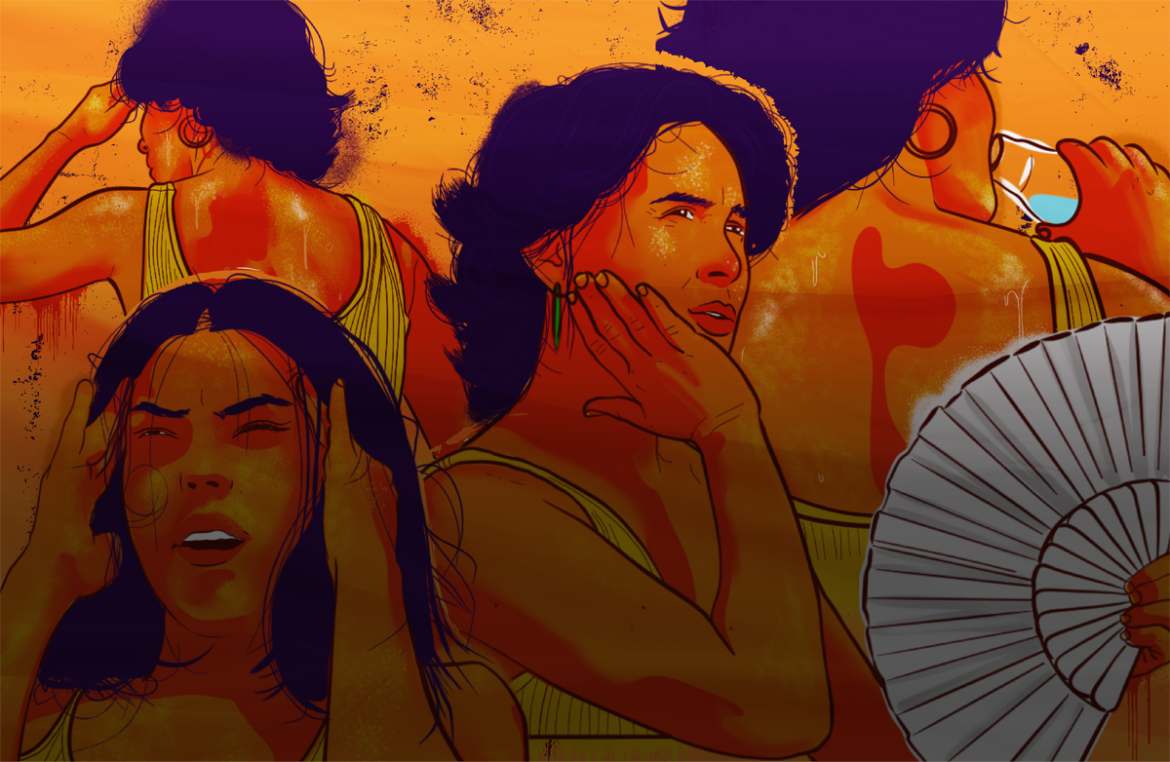

Heat caused by climate change killed nearly 3 million people worldwide between 2016 and 2023, according to a new report published in the medical journal The Lancet. In Puerto Rico, studies indicate that days of extreme heat are associated with an increase in deaths, but there is no uniform, effective system for recording heat-related fatalities, the Centro de Periodismo Investigativo (CPI) revealed.
The Lancet Countdown study, conducted by 146 researchers from different disciplines, presents global findings and also produces regional reports. Last July, the international research project published a report on Small Island Developing States (SIDS) that included Puerto Rico. The study emphasized that these islands are particularly vulnerable to climate change and found a growing risk of death associated with increasing extreme heat.
Pablo Méndez Lázaro, one of the authors of the Lancet Countdown report on SIDS, told the CPI that Puerto Rico cannot always be included in these studies because researchers seek indicators that can be compared across countries and territories.
“Our data collection standards are geared more toward meeting federal agency requirements than those of international agencies,” the scientist said.
Thousands of people in Puerto Rico have died from causes wholly or partly related to extreme heat, said Méndez Lázaro, an environmental scientist. Older adults and people with chronic illnesses are the most affected, he emphasized.
“Unfortunately, we lack a system that effectively documents deaths associated or partially associated with extreme heat,” said Méndez Lázaro, a professor in the Department of Environmental Health at the University of Puerto Rico’s Medical Sciences Campus.
He noted, for example, that death certificates have a section for recording external events that may have triggered a person’s death, but heat is rarely listed there. “We hope that, through training and evidence, clinicians will gradually begin including this type of information,” the scientist said.

Photo by Brandon Cruz González | Centro de Periodismo Investigativo
The Puerto Rico Department of Health keeps a Syndromic Surveillance System that collects data on illnesses related to heat or light exposure. According to the latest report on the department’s website, 442 cases of illnesses related to heat or sunlight, including burns, cramps, heat exhaustion and heatstroke, were recorded from January through September of this year. By comparison, 502 cases were reported during all of 2025.
According to the 2026 Lancet Countdown report, heat caused a record 710,000 deaths worldwide in 2023, the hottest year of the period examined. More than 70% of those deaths were attributed to climate change. Heat-related deaths that year exceeded deaths caused by malaria or human immunodeficiency virus (HIV).
In the United States, climate change is increasing exposure to heat waves, with consequences for heat-related mortality, sleep, physical activity and the ability to work, according to the Lancet Countdown.
In Trinidad and Tobago, exposure to extreme heat puts vulnerable populations at greater risk of heat-related illnesses. All the heat waves the Caribbean country experienced in 2025 were directly linked to climate change.
Health Impacts Are Increasing
Gredia Huerta Montañez, a pediatrician and co-founder of the Puerto Rico chapter of Médicos para la Acción Climática, said there is a direct connection between health and climate because human life depends on climate conditions. “We dress according to the weather, and we plan our social activities around the weather,” she explained.
The problem, she said, is that climate change caused by human activity, primarily the burning of fossil fuels, is accelerating the rise in global temperatures and altering weather patterns, causing illness and death.
“When we talk about health impacts, they are extremely broad. They range from the possibility of heat-related illnesses to injuries from extreme weather events, to drownings, flooding and exposure to microorganisms in contaminated water, to mental health problems,” said Huerta Montañez, who noted that children are particularly vulnerable to the effects of climate change.

Centro de Periodismo Investigativo archives
Huerta Montañez noted, for example, that Puerto Rico has one of the highest childhood asthma incidence rates among U.S. jurisdictions. Asthma, like other chronic illnesses affecting children and adults, is exacerbated by climate-related factors. According to the Department of Health, approximately one in seven children and adolescents in Puerto Rico has asthma.
The Lancet Countdown report concluded that, worldwide, climate change-related health risks and harms have increased more rapidly since 2016 than during the preceding decade.
This period coincides with the entry into force of the Paris Agreement.. The international treaty seeks to reduce greenhouse gas emissions and limit the rise in global temperatures. Despite extensive evidence of the serious health impacts and environmental disasters caused by climate change worldwide over the past decade, U.S. President Donald Trump signed an executive order in January 2025, on the first day of his second term, to once again withdraw the country from the agreement.
The Lancet Countdown authors found that measures such as investing in renewable energy and passing laws addressing climate change and health have produced some benefits. However, those efforts have fallen short of keeping pace with the rapid increase in harm caused by climate change.
“With health impacts accelerating at this rate, what we can expect is that, unless we truly redouble our adaptation and mitigation efforts, losses and damages will continue to increase. And that is ultimately what we want to prevent,” said Marina Romanello, executive director of the Lancet Countdown, based at University College London, during a virtual news conference.
Droughts and Poor Water Management
According to the report, increasingly frequent heat waves and extreme droughts threaten food security. In 2025, droughts affected more than 51% of the world’s land area for at least one month.
Puerto Rico is currently experiencing a drought. Between May and July of this year, much of the island received less than 60% of its usual rainfall, according to the National Aeronautics and Space Administration (NASA). The situation prompted severe drinking water rationing, announced in August, that affected large areas of the island.
The Lancet Countdown also found that the number of days with extreme precipitation has increased, raising the risk of flooding, landslides and the spread of infectious diseases.
An intense El Niño event, a phenomenon involving warming surface waters in the Pacific Ocean, threatens to worsen the effects of climate change, the report’s researchers warned. Temperatures in San Juan broke records last Sunday and Monday, reaching 94 degrees Fahrenheit, according to the National Weather Service (NWS). The previous record for both dates was 93 degrees, set in 2014.
El Niño is expected to continue strengthening into early winter, between November and December, before beginning to weaken, explained NWS meteorologist Emanuel Rodríguez.

Photo by Vanessa Colon Almenas | Centro de Periodismo Investigativo
“For us here in the Caribbean, that means that for the remainder of what should be the rainy season, during October and November, we should continue seeing below-normal rainfall,” Rodríguez said.
“We’re seeing that by the beginning of next year, we should start transitioning toward somewhat more normal conditions, and most likely, by spring and summer 2027, the situation will reverse and we’ll have above-average rainfall. We’re going to shift dramatically from a dry period to one that is much wetter than normal,” he added.
A study by the international organization World Weather Attribution concluded that the climate crisis reduced rainfall in Puerto Rico by 9% during May, June and July of this year, and that the limited rain that did fall evaporated quicker.
According to experts, Puerto Rico’s water problems are not caused solely by a lack of rainfall. Méndez Lázaro said the island is “still very, very, very far behind” in effectively managing its water resources, from water collection strategies to distribution. That is why, he said, authorities quickly resort to water rationing during droughts.
Huerta Montañez also warned that the threat of a water crisis would persist unless the structural problem is resolved. If it is not addressed, “we will all suffer,” she said, particularly vulnerable populations.
“This is fundamental when it comes to climate change. If we don’t have water infrastructure that benefits everyone, we won’t be able to survive,” the pediatrician warned.
Slow Progress in Addressing Climate Change
Although the Lancet Countdown warns that progress in mitigating climate change has been far too slow and lacking, the study acknowledges that legislative action has gained momentum worldwide. Since 2000, the number of laws in different countries referring to both climate change and health has increased approximately 50-fold.
Meanwhile, Puerto Rico’s Climate Change Mitigation, Adaptation and Resilience Plan remains in limbo. Published in April 2024 by the Committee of Experts and Advisers on Climate Change, the document outlines recommendations for addressing the climate crisis.
The Puerto Rico Legislative Assembly has had the document under consideration since April 2024, when the committee formally submitted it, but has failed to fulfill its responsibility to review it. In November, the Joint Committee on Climate Change Mitigation, Adaptation and Resilience issued a favorable report on the plan and sent it to Gov. Jenniffer González Colón. La Fortaleza, the governor’s office, however, returned the document to the House of Representatives.
In August, House Speaker Carlos “Johnny” Méndez said the chamber would consider legislation during the current legislative session to allow the plan to be implemented. However, according to the Resiliency Law Center, the Climate Change Mitigation, Adaptation and Resilience Act, which created the Committee of Experts and Advisers, does not require additional legislation to approve the plan.
The CPI requested an interview with Rep. Méndez to determine the plan’s status but had received no response by the time of publication.
The plan identifies climate change as “a significant and emerging threat to public health” and acknowledges that Puerto Rico lacks a long-term plan to address the health effects of climate change.
Although he said the plan has stalled because of “partisan political discussions,” Méndez Lázaro, who served on the Committee of Experts when the document was drafted, acknowledged efforts such as the Department of Health’s Syndromic Surveillance System. He also highlighted the passage of the Act to Establish the Department of Education’s Action Plan for High-Temperature Events (Act 193 of 2024).
Still, the scientist emphasized that much remains to be done to mitigate the effects of climate change.
“I don’t think we’re going to stop the changes that are taking place. What we can still do is develop mitigation and adaptation strategies that help the most vulnerable populations suffer less and try to protect the sensitive ecosystems that we also depend on,” he said.
For her part, Huerta Montañez said that unless those with decision-making power treat climate change as a priority, “the problem will remain.” She recalled that in 2022, doctors in Puerto Rico called on the government, businesses and communities to take action on climate change, arguing that “there is an urgent need for public policy that prioritizes health and human life.”
This translation was generated with the assistance of AI and reviewed by our editorial team to ensure accuracy and clarity.