

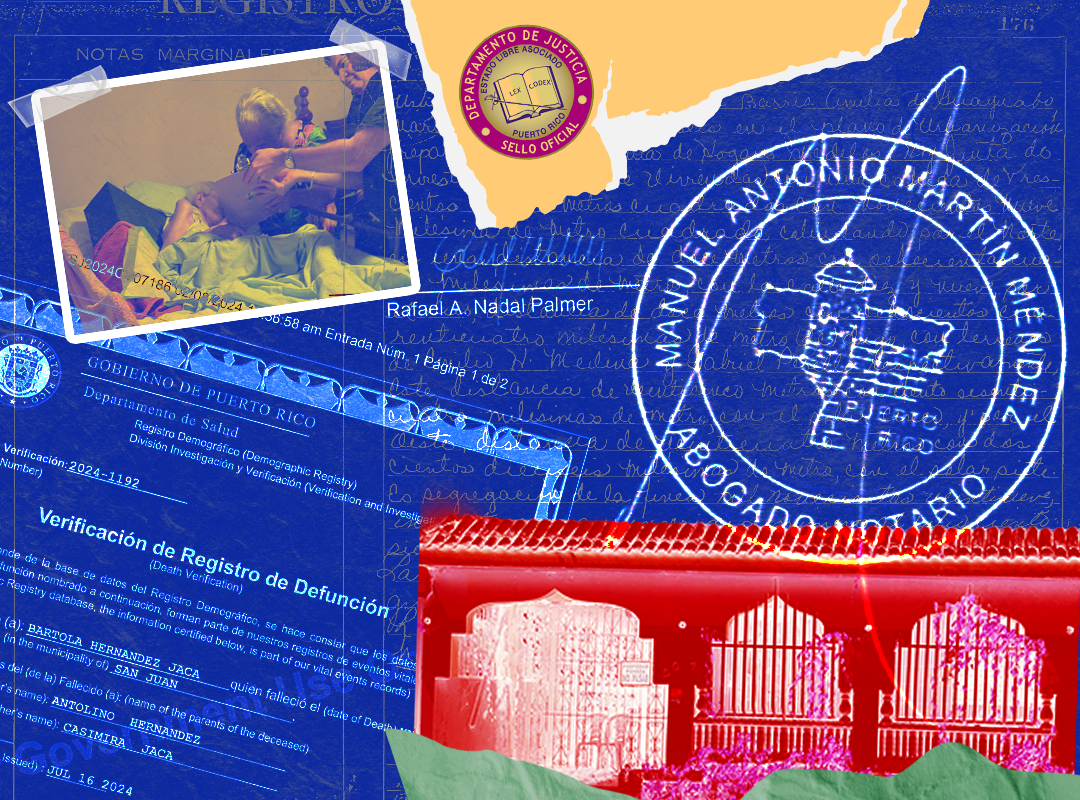

Bartola Hernández Jaca died in 1994, and her daughter, Luz Esther Ávila Hernández, died in 2021. Yet both are listed in a deed dated May 2024 as having authorized a $60,000 sale that transferred ownership of their house to someone unknown to the family. Two of Bartola’s surviving children cannot explain how the transaction took place and was presented as legitimate in the Property Registry. Not only had both women died, but the siblings are certain that no other family member sold the house.
One day in June 2024, another of Bartola’s sons, Atanasio Ávila Hernández, stopped by to check on the house in the Hillside development in the Caimito Bajo sector of San Juan and noticed that repairs were underway. His sister Aida had lived in the house until 2022. She now lives in a nursing home and had not sold the property either.
Atanasio’s visit to the family home set off a legal battle to recover the property, which had passed into the hands of Tribeca Capital Group LLC and Ritocco Investment. The family nearly lost the house. But Puerto Rico’s Office of the Advocate for the Elderly (OPPEA, in Spanish) intervened and filed a lawsuit to invalidate the sale. The case reached the Court of Appeals, which overturned a dismissal by the Superior Court that would have left the house with Tribeca Capital and Ritocco, companies owned by Rafael Arnaldo Nadal Palmer and José A. Pagán Cruz, respectively.
“The allegations raised in the complaint should not be taken lightly, as they involve an elderly woman and raise the possibility of identity theft and fraud,” the Court of Appeals said when it returned the case to the Superior Court.

Photo by Wilma Maldonado Arrigoitía | Centro de Periodismo Investigativo
An investigation by the Centro de Periodismo Investigativo (CPI) identified more than 20 lawsuits filed over the past six years in which people allege they were deceived or misled in property transactions. Others describe difficulties recovering money from deals in which sales were never completed or from other outstanding debts. Some lawsuits allege that property deeds were executed without authorization from the rightful owners or all the heirs. Others seek to invalidate deeds purportedly signed by people who were already dead when the transactions took place.
The transactions challenged in several of these lawsuits were formalized before notaries who certified the identities of those presenting themselves as sellers and stated that they had verified ownership of the properties. At least two notaries involved in the disputed transactions are named as co-defendants. This raises questions about the identification and verification procedures that allowed the sales to be formalized. In several of the cases reviewed, deeds of sale were submitted to the Property Registry because, under the legal presumption of authenticity afforded to notarized documents, those deeds are presumed to be truthful and accurate.
“The notary is a legal professional who performs a public duty and is authorized to certify and authenticate, in accordance with the law, legal transactions and other extrajudicial acts and events carried out before them, without prejudice to the provisions of special laws. It is the notary’s duty to receive and interpret the will of the parties, give it legal form, draft the deeds and notarial documents for that purpose, and confer legal authority upon them,” according to Puerto Rico’s Notarial Act.
The CPI sent questions to Joaquín del Río Rodríguez, administrative director of the Property Registry, who declined an interview. The questions sought an explanation of how deeds purportedly executed by deceased people or people whose identities had been stolen could be registered, and what measures the agency was taking to correct the situation. He did not respond within the time provided.
The CPI’s findings came from court records involving lawsuits against Tribeca Capital Group, Central Park Group, Venture Urban Group, Park Avenue Investment Group or Capital Urban Recovery Group. Nadal Palmer is or was the representative of all these companies, which have since been dissolved or canceled. He is also named personally as a defendant in several of the lawsuits. In 2010, he was convicted of unlawful appropriation.
The presentence report from the criminal case that led to his conviction, which the CPI reviewed in the closed case archives of the San Juan Judicial Center, portrays a man who grew up in a family with substantial wealth but whose adult life was marked by a succession of failed businesses and the loss of his personal fortune. As he struggled to stay afloat, he left debts unpaid to suppliers, landlords and other creditors.

Photo by Brandon Cruz González | Centro de Periodismo Investigativo
Puerto Rico court records show at least 20 inactive lawsuits filed against Nadal Palmer between 2004 and 2010 over debt collection or breach of contract. In 2010, he was convicted of unlawfully taking a diamond valued at $12,394 from Portofino Jewelry in Old San Juan in 2007.
In written statements to the CPI, Nadal Palmer said the claims against him during that period stemmed from financial difficulties that he resolved without declaring bankruptcy.
One person who had rented him commercial space and was interviewed by Luz Acevedo Díaz, a social-penal technician with the Department of Correction and Rehabilitation, described Nadal Palmer as “a shrewd and intelligent person who knows how to swindle third parties who do business with him in good faith.” The comments were included in the presentence report Acevedo Díaz prepared to help the court determine whether to grant him probation.
According to the minutes of the sentencing hearing, Acevedo Díaz did not recommend probation, but Judge Eloina Torres Cancel imposed a three-year suspended sentence.
“I pleaded guilty on my attorney’s instructions. I later asked him to withdraw from the case. And then everything was paid in full,” Nadal Palmer responded in writing.
After completing his sentence, Nadal Palmer applied in 2021 to have the conviction removed from his criminal record certificate, arguing, among other things, that he enjoyed a good reputation in the community. His request was granted. Beginning in 2020, lawsuits resurfaced alleging breaches of agreements and several disputes over property transactions involving his companies.
In the past six years alone, these companies have faced 24 lawsuits involving claims to invalidate property sales, collect debts, invalidate contracts or enforce contractual obligations, obtain possessory injunctions, enforce orders issued by the Department of Consumer Affairs (DACO, in Spanish), and recover damages for unjust enrichment and other alleged harm, among other matters, according to the courts’ electronic records of active and inactive cases.
Several of these lawsuits have been resolved after the allegedly injured parties withdrew their claims upon reaching out-of-court settlements with Nadal Palmer. The court records show that some plaintiffs recovered their money months or years after the disputed transactions, a period during which Nadal Palmer continued buying and selling properties to pursue new deals. Other lawsuits remain unresolved.
We Buy Your House
One of the lawsuits, a debt collection case filed in 2023, was brought against Compramos tu Casa Ahora (“We Buy Your House Now”), the name under which Central Park Group operated, according to the complaint. Two other lawsuits against Nadal Palmer’s companies allege that people received offers from Compramos tu Casa Ahora that were not honored. The company advertised its property buying and selling services on Teleonce, a Puerto Rico TV station that also went to court to collect more than $35,000 in unpaid advertising fees. When the debt remained unpaid, the court issued a writ of attachment against the company’s assets two years ago.
Nadal Palmer said Central Park Group, the company whose assets were subject to the attachment order in favor of Teleonce, had ceased operations. Therefore, he said, “I do not recall at this moment the specific outcome of the attachment order, and it would not be responsible to speculate about it.” Nadal Palmer was listed as president of Central Park Group until its dissolution in 2025.

1/2 Central Park Group LLC, headed by Rafael Nadal Palmer, was registered in January 2017 and dissolved on July 1, 2025.

2/2 Central Park Group LLC, headed by Rafael Nadal Palmer, was registered in January 2017 and dissolved on July 1, 2025.
Over the past 20 years, Nadal Palmer has registered and closed at least 10 corporations, nearly all of them after his criminal conviction, according to the Department of State’s Corporate Registry.
Allegations of irregularities in property sales have remained confined to civil lawsuits. In one case involving Tribeca Capital and Nadal Palmer, the court referred the matter to the Puerto Rico Department of Justice. The plaintiffs warned of a possible pattern, citing the dozens of lawsuits involving Nadal Palmer’s companies. But on Nov. 24, 2025, Puerto Rico Justice Secretary Lourdes Gómez Torres declined to investigate.
“The allegations in the complaint were reviewed with the Economic Crimes Division, which advised that the affected parties must file a formal complaint with the appropriate prosecutor’s office,” the Justice Department said.
After the current Justice secretary decided not to investigate transactions involving Nadal Palmer’s corporations, four more lawsuits were filed against Tribeca and Park Avenue Investment Group LLC, another of his companies. The CPI also learned of at least one other transaction, in April 2026, involving Park Avenue Investment that was reported to police as allegedly fraudulent.
In written statements to the CPI, Nadal Palmer said the claims against him are common in his line of business, which frequently involves inherited estates, and that his companies have completed “more than 500 cases without any problems and to the client’s satisfaction.” He said the notaries who executed the deeds in those transactions are responsible for ensuring the authenticity of what they certified under their notarial authority.
“My business activity involves properties, some of them from inherited estates. By their nature, these transactions may involve risks and disputes concerning the composition of the estate, the chain of succession, the identity of the heirs and the adequacy of the available documents. Those risks are expressly stated in the corresponding contracts,” Nadal Palmer said.
He emphasized that “the existence of those risks does not mean that I participate in, consent to or have knowledge of falsehoods or irregularities.”
The Justice Department did not grant an interview or answer written questions from the CPI seeking an explanation of its decision not to pursue the court’s referral concerning Tribeca Capital. The CPI also asked whether the agency was conducting any investigations arising from complaints filed in other cases.
Stolen Identities
Bartola’s house in Caimito was returned to her daughter Aida after Tribeca Capital, the company that purchased it, agreed to have the deed submitted to the Property Registry declared null and void. But that happened only after Nadal Palmer’s company spent nearly two years fighting in court to keep the house.
Tribeca Capital agreed to the deed’s invalidation “as an act of good faith, without admitting any liability, negligence or unlawful conduct.” The Advocate for the Elderly described the sale as “the commission of fraud in which an elderly woman was illegally deprived of her real property.”
According to the court record, three women sold the Caimito house to Tribeca Capital by assuming the identities of Bartola and her daughters Luz Esther and Aida. The complaint states that notary Manuel Antonio Martín Méndez indicated in the deed that he had identified the purported sellers using their driver’s licenses.
Puerto Rico’s Notarial Act requires notaries to know the parties appearing before them personally or, failing that, to verify their identities through alternative identification methods. One method is to use official photo identification, and when that method is used, the notary must require the documents before proceeding.
For the OPPEA, the sale constituted “abuse in the form of financial exploitation, fraud and the transfer of fraudulent documents.” But the three women who used false identification to sell the Caimito house by impersonating Bartola and her daughters Luz Esther and Aida were never identified.
“The dispute concerning the validity of that deed and the return of the property has already been addressed and adjudicated by a court judgment,” Nadal Palmer said. “That judgment contains no judicial finding that I committed fraud, forgery, impersonation or any other illegal act,” he added.
No OPPEA official was available for an interview or to answer the CPI’s questions, including whether the office had referred any cases to the Justice Department or detected a pattern of illegal property sales involving older adults.
Fake Sellers
In another lawsuit filed in June 2026 against Tribeca Capital and Nadal Palmer, Milomar Investment Corp. alleges that the company “fraudulently induced and orchestrated” Milomar’s purchase of a property for $76,750 from people who were not its rightful owners.
According to the complaint, 10 people allegedly impersonated the actual owners of the house in Río Piedras using signatures and photo identification.
“I believe this claim is an attempt to shift responsibility to me for decisions, verifications and actions inherent to the exercise of notarial duties, over which I had no authority or control,” Nadal Palmer told the CPI. “I have never instructed or authorized anyone to appear using a false identity, nor have I ever been aware of anyone doing so,” he added.
The attorney and notary who executed the deed, Damarie Rosario González, is a co-plaintiff in the case. She alleges that in February 2025, Nadal Palmer contacted her to refer the closing of the house sale to Milomar Investment and brought her the title search. The transaction was completed, and the property was registered in Milomar’s name.
While Milomar Investment was cleaning and repairing the house, people claiming to be its rightful owners showed up at the property. According to the lawsuit, they “were not the same people who had appeared to execute the deeds of sale on Feb. 18, 2025.” The complaint states that the attorney had been presented with identification documents that purportedly were valid.
According to the complaint, “given the uncertainty as to whether it actually holds lawful and valid title,” Milomar Investment wants to reverse the transaction and return ownership to the rightful owners. But doing so is not straightforward. Milomar needs the court to invalidate the deed that made it the property’s owner and order the Property Registry to reverse the registration of the sale so the rightful owners can regain title to the house.
In an interview with the CPI, Rosario González said she regretted trusting the validity of the documents Nadal Palmer presented to her. She said she decided to join the purchasing company in filing the lawsuit to vindicate the rights of the property’s rightful owners.
“I was his victim, but at the same time I feel bad because I am a legal professional and a notary. The public trust is placed in me. I was deceived,” Rosario González said.
Virmarilys Pacheco, executive director of the Colegio Notarial de Puerto Rico, explained that what is known as fe pública notarial, the authority delegated by the government to a notary, allows the notary to confer authenticity, legality and validity on documents bearing their seal and signature. Pacheco explained that a legal transaction authorized by a notary can be modified only through a court judgment in a civil or criminal proceeding.
“There is a presumption of validity attached to a document authorized by a notary,” she said. Anyone who disputes that presumption and challenges a notarized document must prove its invalidity, she added.
Pacheco said a notary must be impartial, entrusted with public authority and responsible for exercising that authority properly. In a property sale, for example, the notary must ensure that the seller owns the property and has the legal capacity to sell it.
Nadal Palmer said the statements in the lawsuit against him are merely allegations made by the plaintiffs, not proven facts, because no court has determined that he is liable.
“I expressly reject the allegations of fraud, deception or coordinated wrongdoing made against me,” Nadal Palmer said. “I had no knowledge that anyone was using a false identity or appearing without authorization. As soon as I became aware of the dispute, I acted in good faith and returned the full amount of money received to the investor, without admitting any liability,” he added.
Milomar Investment’s attorney, Edwin León León, told the CPI that although Nadal Palmer had already been served with the lawsuit, no attorney representing him had appeared in court or answered the complaint. He denied that any financial settlement agreement had been reached.
More Dead People Selling Their Homes
In February 2025, Rubén Ernesto Montalvo Martínez and Felixberto Montalvo Álamo, who do not live in Puerto Rico, sued Nadal Palmer and Tribeca Capital, alleging that they had bought and sold a house the plaintiffs inherited from María Pascuala Álamo Rodríguez in the Villa Sierra Berdecía development in Guaynabo without the heirs’ knowledge, “and in fraud of their financial interests.” Other heirs later joined the lawsuit. Tribeca Capital carried out the sale using a power of attorney that Álamo Rodríguez supposedly granted Nadal Palmer in Kissimmee in October 2023. But she died in September 2015.
A month after allegedly obtaining the power of attorney, Nadal Palmer sold Álamo Rodríguez’s house to Tribeca Capital for $40,000. The following day, Tribeca Capital sold the property to Ariana Investment LLC, headed by Mario J. Porrata Rodríguez, for $45,000. Two months later, in January 2024, Ariana Investment sold the house to Ramonita Sánchez Vélez for $165,000, according to the complaint. The deeds were executed by notary Luis Antonio Noriega Morales, who did not respond to the CPI’s phone calls, messages or emailed questions.
Sánchez Vélez alleged that she bought the house, which she described as abandoned and deteriorated, because she wanted to live in the same development as her daughter. In a lawsuit she also filed against Tribeca and Ariana Investment, she said she invested $60,000 in improvements. But after spending that money, she discovered that the “property is the subject of litigation.”
Montalvo Martínez, who has lived in Florida since 2008, told the CPI that he learned from relatives that his grandmother’s house had been sold. They alerted him after seeing a woman who had supposedly bought the house renovating it.
“That’s when my cousin and I found out [that we had lost the house]. The woman [who bought it] is also a victim of the fraud,” the plaintiff said in an interview with the CPI.
The case remains active. Wilfredo Luciano Quiñones, attorney for heirs Montalvo Martínez, Montalvo Álamo and Dávila, was the one who asked the court to refer the matter to the Justice Department. That was the same referral the Justice secretary declined to investigate.
The court record also documents the plaintiffs’ difficulties getting Nadal Palmer to appear for a deposition. He initially cited health problems as a reason he could not attend, then invoked his right against self-incrimination because of the referral to the Justice Department. The judge had to issue several orders before Nadal Palmer’s deposition was finally taken this year.
In July, Nadal Palmer lost his legal representation after his attorney, Jessica Apellániz Arroyo, informed the court that she had “irreconcilable differences” with her client, causing another delay in the proceedings.
In a May 13, 2026, ruling, Judge Teresita Mercado Vizcarrondo stated that “there is no doubt that Tribeca Capital acquired the property through fraud by virtue of a void power of attorney.”
Although Tribeca Capital still faces several active lawsuits, the company was dissolved on July 1, 2025.
The CPI asked Nadal Palmer to explain how he obtained a power of attorney from someone who was already dead when the document was issued. He limited his response to saying that “I did not prepare or authenticate that document” and that he had not submitted it to Puerto Rico’s registry of powers of attorney or wills, referring to the alleged use of false documentation.
Problems With the Deeds
In April 2026, Lumavi Properties Corp., owned by Lumier Rodríguez Díaz, and Thunder Holding LLC, owned by Luz Garay Pagán, purchased equal shares of a property in Yabucoa through Park Avenue Investment Group LLC, which handled the transaction. Nadal Palmer registered that company in November 2024 and dissolved it on Aug. 26 of this year, a month after Rodríguez and Garay filed three police complaints against him and the notary who executed the deed, alleging false pretenses, deception or fraud.
When Rodríguez Díaz, who also buys and sells properties, began the process of reselling the Yabucoa house, she discovered that the property’s rightful owners had died, one of them 40 years earlier, and that their heirs had neither authorized the sale nor received any money from the transaction, she told the CPI in an interview.

Photo by Brandon Cruz González | Centro de Periodismo Investigativo
Rodríguez paid Park Avenue a total of $99,500 for the Yabucoa property and purchase options on two other houses in Levittown and Toa Baja, according to the deeds and sales contracts.
The Yabucoa deed was also executed before notary Manuel Antonio Martín Méndez, the same notary involved in the sale of Bartola’s house in Caimito. The buyers also filed a police complaint against him.
According to the police complaint, the deed was signed at El Viejo Almacén restaurant on Loíza Street in San Juan. Rodríguez Díaz told the CPI that the sellers, Gerónimo Martínez Rivera and Hipólita Medina Marín, were not present at the signing. She said she was told they were elderly and that the document would be taken to them for their signatures. Later, when she began the process of selling the property in early July and the prospective buyer commissioned a title search, Rodríguez learned that Gerónimo, also spelled Jerónimo, had died in 1986 and that Hipólita was also deceased, although she could not establish when.
“Since when do dead people sign?” the police complaint quotes the prospective buyer as asking Rodríguez during the process of purchasing the Yabucoa house.

Photo provided
The CPI tried to contact Martín Méndez by telephone and email and sent him written questions, but he never responded.
According to Rodríguez Díaz, when she confronted Martín Méndez on June 30, 2026, he said that the actual sellers had appeared before him and had been identified. He told her he would speak with Nadal Palmer to resolve the situation and that the company could buy the house so they could “get out of the problem.” Rodríguez Díaz said that afterward, and up to the time of the interview, she had not received a refund, her calls had gone unanswered and, when she visited Park Avenue’s office, she found it closed and abandoned.
Nadal Palmer said he was aware of complaints involving these transactions and that “the police should be given space to investigate.” He maintained that his role in the sale “did not include authenticating the identity or legal capacity of the parties appearing before the notary.”
“It is the notary who authorizes the deed who receives the parties, examines their documents, verifies their identities and certifies the execution of the deed,” Nadal Palmer said about transactions in which deceased people appear as parties to the deeds. “I had no knowledge that anyone intended to make a deceased person appear as a party to a deed, nor did I knowingly participate in any such conduct,” he added.
The two properties on which Lumavi Properties obtained purchase options in Levittown also allegedly have title problems. Rodríguez Díaz claims the title search provided to her at the time of the transaction was altered because it did not mention two federal liens against the property. She discovered this when she requested a copy from the company that had conducted the search. L.J.N Titles Search Company confirmed to the CPI that the title search in its files includes the lien entries.

Photo provided
According to Rodríguez Díaz, the other property belongs to an elderly woman living in a long-term care facility who lacks the capacity to have consented to the sale.
Nadal Palmer said it would be unwise to comment on the transactions involved in the police complaints, even to clarify whether he or the notary had contacted Rodríguez Díaz or Garay Pagán to try to resolve the matter.
“This could interfere with any proceedings being conducted by judicial authorities or any government agency,” he wrote.
The president of Lumavi Properties filed three complaints at police stations in San Juan, Carolina and Bayamón on July 3 and July 9. She also filed a complaint with Puerto Rico’s judiciary against notary Martín Méndez. In addition, she attended an initial interview with the Criminal Investigations Corps (CIC) of the Puerto Rico Police Bureau in Carolina.
“We confirm that there is an active complaint against attorney Manuel A. Martín Méndez and another active complaint against Luis Antonio Noriega Morales. Their contents are confidential under Rule 14 of the Supreme Court Rules,” Jean Pérez Nieves, director of the judiciary’s Press Office, told the CPI.
Noriega Morales is the notary who executed the deeds on the two occasions when the house belonging to the Montalvo Martínez and Martínez Álamo family in Guaynabo was sold without their consent. On Aug. 7, 2026, he filed a lawsuit seeking to invalidate another deed he had authorized in 2024, in which the sellers were deceased. A member of the estate filed a complaint against him with the Supreme Court over that deed, his legal counsel stated during a court hearing. The CPI tried to contact Noriega Morales by telephone and sent questions to his email address, but he did not respond.
The CPI learned from several sources that, in addition to the complaints filed by Rodríguez Díaz, at least two other complaints against Nadal Palmer and his corporations are under investigation by the San Juan CIC. One concerns the case in which the OPPEA represented the Ávila siblings, and the other was filed by Luis Fernando Pagán Cruz, owner of Ritocco Investment Corp.
“It is essential to clarify that I am not a notary. I do not authorize public deeds, exercise notarial authority, certify the identities of the parties or legally determine who has the capacity to appear as an owner or heir,” Nadal Palmer said. “My involvement, when there is any, is commercial in nature. The preparation and authorization of the public instrument, identification of the parties and legal evaluation of the documentation presented are the responsibility of the notary authorizing the deed,” he added.
Who Is Rafael Nadal Palmer?
When Nadal Palmer took the diamond valued at $12,394 in 2007, there was no violence or intimidation, according to the criminal complaint. Instead, Nadal Palmer used his powers of persuasion to convince the jewelry store owner to give him the diamond on credit, promising to pay the $11,000 he owed after giving him a check for $2,144 and $55.68 in cash. Nadal Palmer, then 38, never paid off the debt. The $2,144 check bounced because of insufficient funds, and he exchanged the diamond for cash at a pawnshop.
After being charged, Nadal Palmer attempted to raise his alleged mental incapacity as a defense, but a government psychiatrist found him competent to stand trial. He eventually reached a plea agreement with prosecutors that included a three-year probationary sentence. The jewelry store owner opposed the agreement, according to Acevedo Díaz, the social-penal technician who evaluated whether Nadal Palmer should receive probation after pleading guilty.
Acevedo Díaz, who did not recommend probation, described Nadal Palmer in the presentence report reviewed by the CPI at the courthouse as manipulative, unwilling to take responsibility for his actions because he portrayed himself as a victim, and unconcerned that his conduct harmed others.
“Although he presents himself as a stable, honest and sensitive person, the information obtained portrays him as someone who acts knowingly and with the intention of harming third parties, always using his emotional state as an excuse. He recognizes the impact of his actions and shows no willingness to take responsibility for them,” the official’s presentence report states. “Regarding the facts at hand, he consistently adopted the attitude of a victim, which we believe is a strategy to avoid compensating the injured party,” the report adds.
The document states that Nadal Palmer entered the real estate business at a very young age and, although he was successful at one point, had several businesses in different commercial sectors that failed. Interviews conducted by the social-penal technician, along with court records, show that he stopped meeting several financial obligations, including rent, payments to suppliers and bank debts.
At the time of his conviction, Nadal Palmer drove a “late-model Mercedes-Benz,” according to the social-penal report. Although he said the vehicle belonged to his girlfriend, Acevedo Díaz said she learned it was registered to Soho Movers, a company allegedly operated by Nadal Palmer. The person who incorporated that company also sued him to collect a debt.
During a hearing in the case, the social-penal technician described him as “untrustworthy” and said: “We do not agree that Mr. Nadal should continue operating businesses if he is granted probation, because there is no guarantee that those businesses will not harm the other party. I believe there is a pattern of deceiving people to create the appearance of a business or financial standing that does not actually exist and that he cannot back up.”
Judge Torres Cancel approved the agreement Nadal Palmer reached with the Justice Department to reduce the unlawful appropriation charge from a third-degree to a fourth-degree offense, require restitution of $13,042 and impose a three-year suspended sentence. As special conditions, she ordered him to undergo psychiatric and psychological evaluations, refrain from work or business involving personal money or family businesses until he completed his sentence, remain employed and stay at his residence from 8 p.m. to 7 a.m.
This translation was generated with the assistance of AI and reviewed by our editorial team to ensure accuracy and clarity.