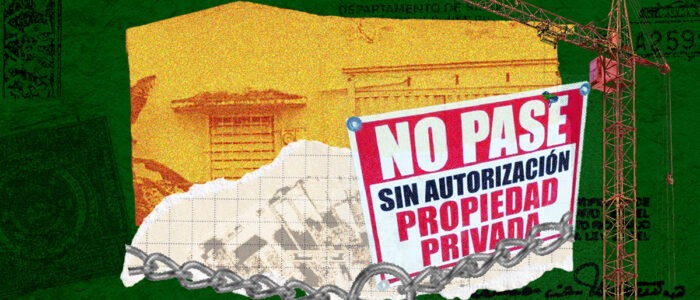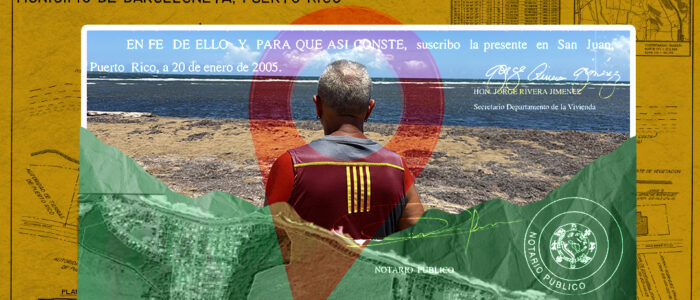



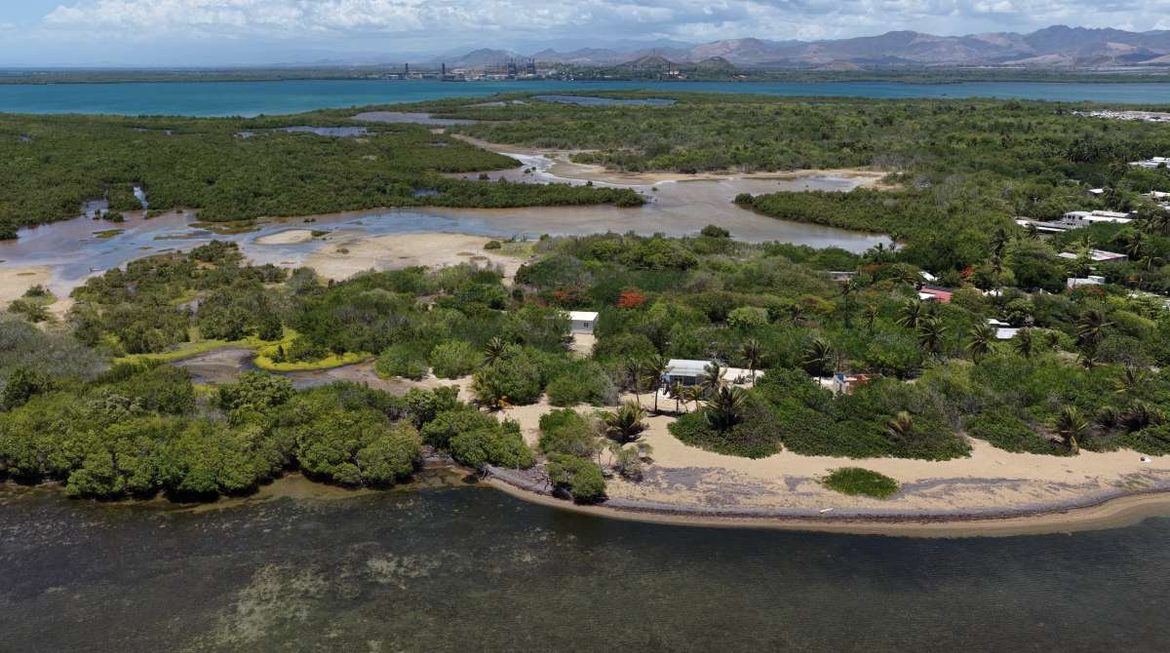
In September 2025, the Guayama Superior Court ordered a fisherman to demolish a small wooden shack he had built on an unused plot of land that did not belong to him in the Jobos neighborhood.
Miguel Ángel Álvarez Pérez, who swore that he owned the 1.78-cuerda property, sued the fisherman for using the lot without a lease agreement between them. Álvarez Pérez asked the court to order the fisherman to vacate the property and remove the wooden structure. The fisherman complied.
However, a joint investigation by the Centro de Periodismo Investigativo (CPI) and Rayos X found that the land on the Guayama coast belongs to the Puerto Rico Department of Housing.
Screenshot | Rayos X
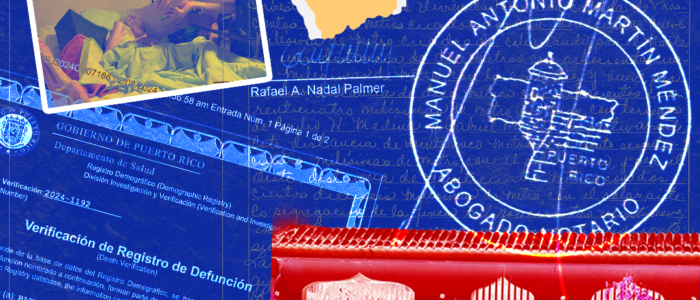
The deed through which Miguel Ángel Álvarez Pérez supposedly purchased the land from the Department of Housing, and which he cited in his lawsuit, does not appear in the corresponding notarial index of Esteban García Malatrasi, the attorney who purportedly notarized the sale. The Department of Housing told the CPI and Rayos X that the agency never conducted the transaction. Former government official Carlos Gerardo Laboy Díaz, who is named in the deed as having authorized the sale on behalf of the Department of Housing, said he never appeared before that notary, that the Social Security number attributed to him in the document is incorrect, and that he never held the position of administrator of the Department of Housing’s Property Administration, as the deed states.
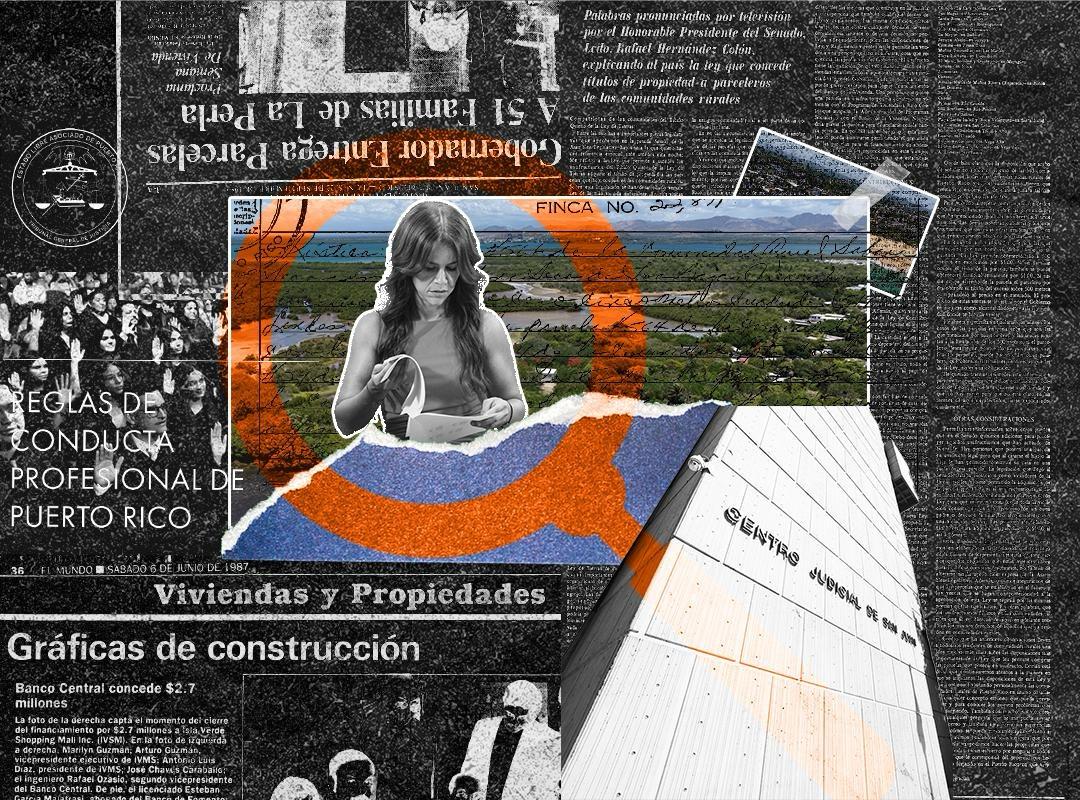
The deed made it past the Department of Housing’s and Property Registry’s safeguards and was registered. In addition, a property registration certificate was submitted to the court as part of the lawsuit. Such certificates are issued by the Property Registry and are admissible as evidence in court. No one noticed that the deed was fraudulent. Why? Because any document bearing a notary’s signature and seal is presumed to be true and accurate.
The Property Registry, a division of the Department of Justice, is where documents related to real estate transactions involving land and buildings are registered, either electronically or in person.
Officials who receive a deed at the Property Registry accept it as valid without assessing the legitimacy or accuracy of its contents because Puerto Rico’s property registration system is built on the principle of public faith in the registry, explained Vivian Godineaux Villaronga, former president of the Puerto Rico Bar Association.
“In other words, it operates on the premise that the notary has already verified everything that needs to be verified, and that the public instrument enjoys the presumption of accuracy afforded by the Property Registry,” she said.
“We should explore mechanisms to detect fraud through interagency cooperation. For example, cross-checking records with the Demographic Registry to detect deeds executed in the names of deceased individuals through automated verification before registration,” Godineaux Villaronga suggested.

Photo by Norenid Feliciano | Centro de Periodismo Investigativo
The government delegates notarial authority to notaries so they can give legal transactions the required formality and authenticity, added Belén Guerrero Calderón, who has practiced as a notary for 49 years and is a professor at the University of Puerto Rico School of Law. Such legal transactions can include contracts, powers of attorney or wills.
“Notarial authority is something vested in me. All notaries have it. […] The excellent ones have it, but so do the bottom-of-the-barrel ones, because they have the same notarial authority I have, because the government gave it to them. And that’s the problem,” Guerrero Calderón said.
She believes the problem is not the authority vested in notaries but that “what needs to be reconsidered is who is being allowed to practice as a notary.”
Puerto Rico has approximately 8,300 notaries. To practice as a notary, a person must be sworn in and admitted to the practice of law. They must also pass an additional bar exam in notarial law and be authorized by the Puerto Rico Supreme Court to practice as a notary, among other requirements.
The Good Faith of Third-Party Buyers
Just as a notarized deed is presumed to be accurate and truthful, once it is entered into the Property Registry, the principle of public faith in the registry takes effect. This means that the information recorded in the Property Registry is presumed to be true, and a person who buys land or a home is afforded legal protection because they relied on the property’s recorded chain of title, as established by the Puerto Rico Real Property Registry Act.
If an irregularity emerges or the deed of the person who sold the property is annulled, the buyer, known as a third-party purchaser, receives protection for the acquisition under the principle of public faith in the registry, provided certain requirements are met, including that the transaction took place between living persons and that a price was paid.
“The good faith of the third party is presumed as long as the party has acted with a minimum degree of diligence and unless it is proven that, at the time of acquisition, the party knew the Registry was inaccurate,” the Puerto Rico Real Property Registry Act states.

Photo provided
Joaquín del Río Rodríguez, administrative director of the Property Registry, told the CPI and Rayos X in written statements that “the Registry neither grants nor takes away rights,” meaning that registering a deed does not make it valid if it is null or illegal.
“The property registrar is not present when a deed is executed, nor is it the registrar’s responsibility to examine the signer’s identification. The notary is the one who certifies that the person executing the deed is who they claim to be and that the document complies with applicable laws,” Del Río Rodríguez said.
Under the law that established the Property Registry, the agency is required to have 36 registrars responsible for different geographic areas.
Del Río Rodríguez said the Registry verifies that notaries are active in the Unified Registry of Attorneys and with the Office of Notarial Inspection (ODIN, in Spanish).
But the CPI and Rayos X identified a case in which a property in Santurce was registered through a deed signed by notary Humberto Ramírez Ferrer and dated Jan. 4, 2006. However, Ramírez Ferrer had been suspended immediately and indefinitely in May 2005 and was never reinstated following the Supreme Court’s decision, according to the Court Administration Office. So, Ramírez Ferrer was banned from preparing the 2006 deed that was subsequently entered into the Property Registry. He died Dec. 18, 2008.
“The Registry has an obligation to examine and publish documents so they can have legal effect against third parties. But it is important to note that registering a document does not validate null acts or contracts,” Del Río Rodríguez said.
In other words, entering a document into the Property Registry does not make a null contract valid.
A registrar has no legal authority to investigate or annul documents submitted for registration. If a registrar learns that a submitted document is the product of fraud or a crime, the registrar is responsible for notifying the district attorney and the administrative director in writing, Del Río Rodríguez said.
He added that “approximately seven referrals have been made to district attorneys’ offices for investigation” this year, although he did not specify whether those referrals were made for that reason.
Rethinking the Use of Certifications
Following the findings of the CPI and Rayos X investigation, which uncovered irregularities in the sale of public and private property in Puerto Rico through fraudulent certifications and deeds entered into the Property Registry, lawmakers and notaries raised questions about the procedures used to sell properties, submit documents for registration and register ownership.
María de Lourdes Santiago Negrón, a senator from the Puerto Rican Independence Party, questioned whether government agencies should conduct property sales through certifications, which “offer very few safeguards and are much easier to forge than deeds.”
Santiago Negrón told the CPI and Rayos X that, based on the findings presented, she is working on a bill to eliminate certifications as instruments for transferring property ownership, as well as a resolution to investigate the irregularities.
In 1977, the Puerto Rico government authorized the Department of Housing to issue property titles through certifications, documents that do not require the signatures of buyers or notaries or the cancellation of tax stamps.
At the time, the certifications were authorized “to address the situation of more than 16,000 people who were occupying parcels of land, when the government was not in a position to issue 16,000 deeds. It arose as an emergency measure to help people in need,” Santiago explained.
The purpose of the certifications was to expedite the process and reduce costs to the public treasury.
Ismael García Ortega, president of the Puerto Rico Notarial Association, said certifications should be eliminated.
“They should not exist,” he said after learning of the investigation’s findings.
García Ortega said he intends to submit a bill through the Notarial Association that would require any public deed submitted to the Property Registry three or five years after its execution to be accompanied by an ODIN certification confirming that the deed appears in the records of the notary who authorized it. Alternatively, the Registry would have to contact ODIN to obtain that verification.
Senators Santiago Negrón and Carmelo Ríos Santiago emphasized that fraudulent transactions involving property in the public domain are null and void.
“It’s called null ab initio [void from the outset],” Ríos Santiago said.
The Notarial Association president stressed that “if the property is intended for public use, it cannot be transferred. Therefore, the transaction is null. So, no matter what documents exist, there is no possibility of a valid transfer, because you cannot sell a road, you cannot sell a body of water, you cannot sell the maritime-terrestrial zone, you cannot sell a nature reserve.”
Ríos Santiago announced that he will introduce a resolution in the Legislature to compile or identify an inventory of properties belonging to the Department of Housing. The senator said he has no doubt that agency officials helped carry out the scheme uncovered by the CPI and Rayos X.
Santiago Negrón agreed that agency officials may have been complicit or negligent. She questioned whether stronger safeguards, better training and greater skepticism among government employees are needed.
Have Safeguards for Reliability Been Lost?
Ariadna Godreau Aubert, executive director of Ayuda Legal de Puerto Rico, said it is worth questioning how much measures adopted to expedite the Property Registry’s examination of documents, such as Act 216-2010, approved during former Gov. Luis Fortuño’s administration , have affected the system.

Photo by Brandon Cruz González | Centro de Periodismo Investigativo
“In recent years, since 2010, because of a substantial backlog at the Property Registry, there has been an effort to expedite the registration process [for deeds]. At one point, there was a backlog of more than half a million documents that had been submitted but not examined, and those documents began to be entered into the Property Registry automatically,” Godreau Aubert explained.
The attorney said Act 216-2010 authorized all documents submitted through April 30, 2010, to be considered registered, with some exceptions.
She argued that officials should assess whether safeguards ensuring the system’s reliability were lost in the effort to make the process more efficient. She also noted that, following Act 216-2010, the Property Registry implemented the Karibe digital platform in 2015.
Godreau Aubert mentioned that the Financial Oversight and Management Board reported in 2018 and 2019 that there was a backlog of 480,000 notarized documents.
Professor Guerrero Calderón described the implementation of Act 216-2010 as “a tremendous disaster.”
“They hired people to do nothing but register, register, register,” Guerrero Calderón said.
She also explained that registrations carried out under the law lacked detailed and necessary information about the transactions, including supporting documents.
“When you look at those images or those digitized documents in those books, you’re simply dumbfounded,” Guerrero Calderón added, referring to transactions entered during the period covered by the law that were not documented in the required detail.
She also agreed that efforts to expedite procedures and increase the number of documents examined at the Property Registry compromised the safeguards designed to ensure the process was secure.
ODIN Checks Form, Not Content
The Office of Notarial Inspection, which operates under the Puerto Rico Supreme Court, is responsible for overseeing and providing guidance to notaries. It has 24 inspectors of notarial records and notaries who work according to the notarial practice examination project established, Manuel E. Ávila De Jesús, ODIN’s director, said.
ODIN inspectors review the formal requirements of documents prepared by notaries. For example, when examining a deed, they verify that it contains the signatures and initials of everyone appearing before the notary, the deed number, the date and place where it was executed, and other formalities.
“The inspection team has been instructed to examine the notaries with the highest volume of work or the greatest backlogs,” Ávila De Jesús explained.
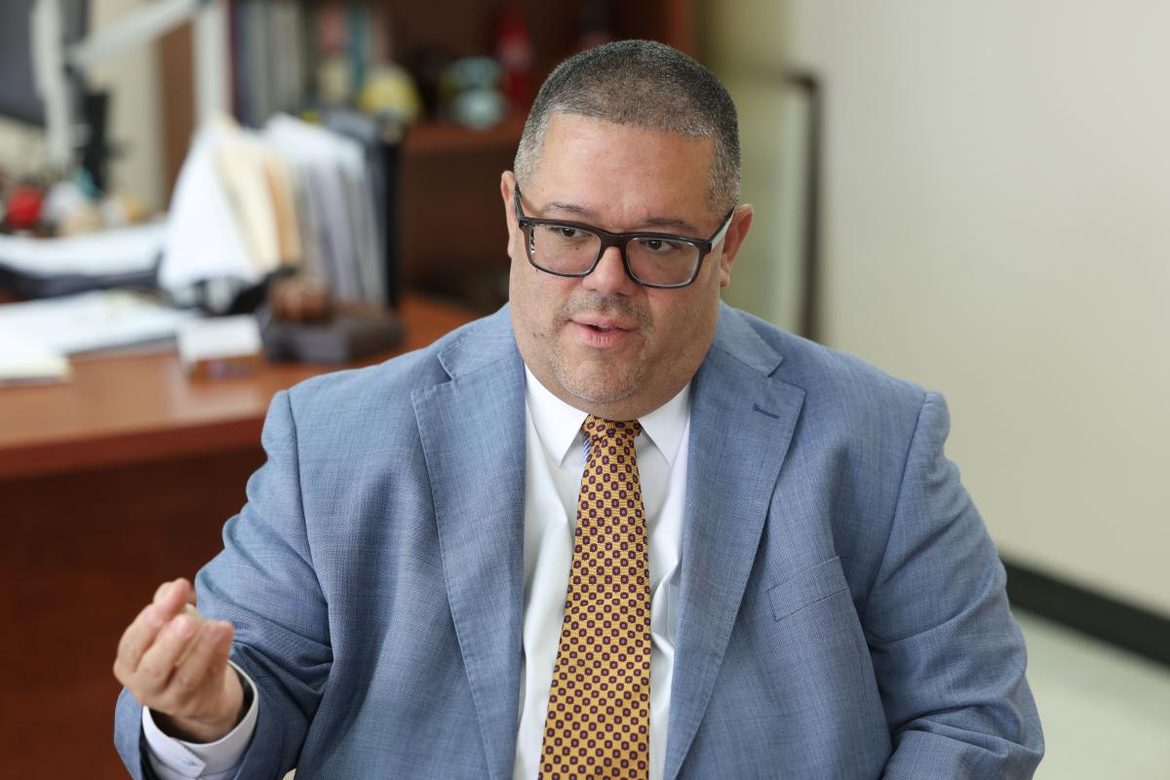
Photo by Brandon Cruz González | Centro de Periodismo Investigativo
The Supreme Court determines whether to refer a matter to ODIN for investigation. It can also refer complaints to the Office of the Solicitor General, which has the authority to request documents and interview individuals as part of its investigations.
When a notary dies, is suspended or ceases practicing, the notary’s records are kept in notarial archives for 60 years.
What to Do if You Suspect Fraud
Anyone who suspects that they purchased a property fraudulently or that someone else fraudulently sold their property should file a police complaint and seek legal advice to evaluate the possibility of bringing a court case to annul a deed or invoke protections such as the defense available to third-party purchasers who rely on the Property Registry, among other remedies.
A person may also file a complaint against an attorney if they believe the attorney participated in the fraud or acted negligently. To do so, they must complete a form or write a letter explaining the reasons for the complaint.
“You must swear to your complaint before a notary, at the clerk’s office of the court nearest your residence, or at the clerk’s office of the Supreme Court,” according to the Puerto Rico Judiciary.
Once sworn, complaints may be filed in person at the Supreme Court clerk’s office or sent by mail. They cannot be filed or processed by email.
This translation was generated with the assistance of AI and reviewed by our editorial team to ensure accuracy and clarity.