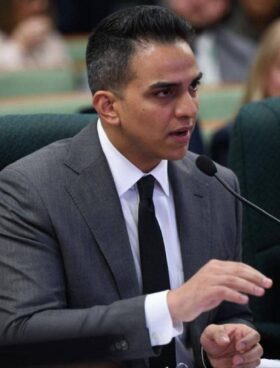


More than just a lawyer who has represented journalists at The New York Times for the past 24 years, David McCraw sees himself as an advocate for transparency, fighting for access to information. He views the renewed defense of press freedom as urgent — a principle that enables the public to make informed decisions and demand changes that improve their lives.
“There are too many people in power who do not want the scrutiny that comes with an independent press, who want a sleeping democracy, one in which the public never wakes up to uncomfortable truths,” McCraw warned before a packed auditorium at the Inter American University School of Law during the keynote address, “When the State Wants to Silence the Press.”
McCraw, who also teaches at Harvard Law School, recalled that 16 years ago the U.S. Congress voted unanimously to enact the Securing the Protection of our Enduring and Established Constitutional Heritage Act, or SPEECH Act, which protects journalists and authors from frivolous foreign libel judgments.
“The vote in the House of Representatives was unanimous; the vote in the Senate was, too. Every Republican. Every Democrat. Regardless of our political views, there was broad consensus in the United States on the need to protect the press so it could do its job,” he said.
By contrast, McCraw now sees officials and branches of the U.S. government focusing, almost daily, on attacking journalism itself or reporters directly. Still, he insists this is not the time to give in. Citing historian Timothy Snyder and his concept of “anticipatory obedience,” which drives citizens to censor themselves out of fear of retaliation, the attorney warned that an attitude of obedience only signals to those in power that they can get away with it.
McCraw is visiting Puerto Rico at the invitation of the Centro de Periodismo Investigativo as part of Sunshine Week, an initiative that underscores the importance of government transparency.
Recently, The New York Times, where McCraw serves as senior vice president, sued the Department of Defense and Defense Secretary Pete Hegseth, who is seeking to impose restrictions on press access to the Pentagon. The newspaper argues that the move is a clear violation of the First Amendment to the U.S. Constitution and that journalists have never endangered national security.
This is far from the only attack on the press since the start of President Donald Trump’s second term. The examples showing an escalating assault on press freedom have become too numerous to ignore: from barring The Associated Press from the White House for refusing to use the term “Gulf of America” instead of Gulf of Mexico; to the FBI raid on the home of a Washington Post journalist; to the arrest of independent journalist Don Lemon while covering protests against Immigration and Customs Enforcement (ICE), in Minnesota. More recently, Federal Communications Commission Chair Brendan Carr threatened to revoke the licenses of U.S. television networks because he disapproved of their coverage of the war in Iran.
Against that backdrop, McCraw underscored the need to “revive public support for the press,” because democracy benefits when journalists are free to go into the field, gather information and publish truths that people in power want to keep hidden, he said during the conference organized by the Centro de Periodismo Investigativo.
After hearing specific examples of attempts to intimidate the press in Puerto Rico, the speaker offered several final recommendations for news organizations and journalists on the island: strengthen alliances with law firms, academia and audiences; ask whether threats to sue reporters in order to obtain their records or identify their sources are aimed only at journalists, or whether they also pose a real danger to the public at large. Finally, McCraw urged the press to persist, not to surrender in the face of threats and attacks from officials and those in power.
Sunshine Week, now in its third decade, rallies news outlets, organizations, journalists and citizens around the public’s right to know. On Tuesday, the program will include a breakfast with McCraw and a webinar on how to file public records requests following the approval of amendments to Puerto Rico’s Transparency and Expedited Procedure for Access to Public Records Act. All of this week’s events are made possible with the support of El Nuevo Día, the Inter American University of Puerto Rico School of Law, the law firm Goldman Antonetti & Cordova, LLC, and Don Rafa Hotel Boutique.
This translation was generated with the assistance of AI and reviewed by our editorial team to ensure accuracy and clarity.