


Despite spending more than $50 million on contracts with private companies over the past two decades to reduce the loss of drinking water, the Puerto Rico Aqueduct and Sewer Authority (PRASA) has not lowered its rate of unaccounted-for water, which has hovered around 60% since at least 2004, an investigation by the Centro de Periodismo Investigativo (CPI) found. Truenorth Corporation has been the main beneficiary, receiving more than $34.9 million toward that goal.
The multimillion-dollar expenditure of public funds has failed to reduce water loss because of insufficient follow-up and oversight of contractors and because funding to complete later phases of some projects has fallen short, according to about 10 CPI sources connected to the public corporation, along with engineers and scientists experts in water management in Puerto Rico. Furthermore, Truenorth has been unable to meet a goal PRASA set in one of its contracts in 2011: reducing water loss to 25%.
To address the problem of lost water, PRASA created the Water Recovery Office (ORA, in Spanish) in 2014. It was previously called the Non-Revenue Water Management Office. The office is headed by agency executive adviser Arnaldo Colón, who oversees contractors because the unit has no PRASA employees of its own. Since its inception, the office has been managed almost entirely by Truenorth.
Since 2016, Truenorth has received $13.7 million in contracts from ORA to develop projects that include pressure management, leak detection and analysis of how much drinking water is produced, consumed and lost. The value of those contracts rose from just over $227,000 in 2016 to more than $1.9 million in 2025, without any reduction in the water-loss rate. The most recent contract, signed in early September, is worth $997,170 and expires in January 2027.
The CPI requested an interview and emailed a list of questions to Truenorth President Carlos Fernández Ferrer and Chief Technology Officer William Román. The CPI also went to the company’s offices, where no executives were available, and called the company, with the same result. No response had been received by the time of publication.
“We are well aware of what the problem [with water loss] is, but no steps are being taken to solve it, even when PRASA management itself has internally acknowledged that water losses are a serious problem,” said planner Félix Aponte Ortiz, who has served several times on PRASA’s Governing Board.
Aponte said the public corporation has invested too much money in private contracts devoted to diagnosing the problem of unaccounted-for water but has fallen short when it comes to implementing the solutions that the same private consultants recommend.

Photo by Gabriel López Albarrán | Centro de Periodismo Investigativo
PRASA Executive President Luis González Delgado said the millions the public corporation has invested in contracts to address the problem are only “the beginning of an initiative that we have to continue pursuing” and that it is a challenge that, “given the lack of maintenance over the years, has not been addressed.”
“PRASA has more than 20,000 miles of pipelines alone, and focusing on specific stretches does not address the full extent of the situation we face because of aging infrastructure,” González Delgado said in response to CPI questions about why the problem of unaccounted-for water has not been solved.
González Delgado also defended the hiring of Truenorth, arguing that it is necessary to “have field intelligence” to determine how initiatives to mitigate water loss should be carried out.
“First, we have to have a defined plan of priorities. That is done with field intelligence, and with the limited funds available, we can focus on priorities, and that is how we move forward until we can replace the pipes that are in fact causing problems and water losses in Puerto Rico,” González Delgado said.
However, field intelligence work, which refers to gathering data from infrastructure, has been conducted for years without translating into a significant reduction in the rate of unaccounted-for water. According to reports the CPI reviewed , PRASA carried out 18 initiatives that included field assessments between 2008 and 2020.

Photo provided | Centro de Periodismo Investigativo
According to engineer Carlos Pesquera, who Gov. Jenniffer González Colón appointed as special coordinator for drinking water stability in 2025, water loss remains a risk factor for the stability of water service despite the efforts and the millions of dollars in public funds spent.
Sources consulted by the CPI also pointed to a problem with management priorities, saying PRASA has opted for private contracting — a trend González Delgado said will continue — instead of training its own workforce and improving employees’ working conditions, which has led to a steady departure of personnel with technical expertise.
In addition to the $34.9 million in contracts with Truenorth to address water losses, the CPI identified another $14.5 million that PRASA has paid over the past two decades to seven other private companies contracted to measure, monitor and identify water that is produced but never billed, as well as to repair pipelines.
While clouds are seeded, prayers are offered for rain and water is rationed to residents, PRASA has not addressed the fundamental problem that could eliminate rationing.
The CPI documented more than 50 programs and pilot projects undertaken within PRASA to reduce water loss, many of them involving multimillion-dollar contracts and others carried out by in-house personnel, according to 12 reports PRASA commissioned from MP Engineering between 2010 and 2014 and Arcadis from 2015 to 2024. But none of the initiatives has reduced the 60% water-loss rate. Efforts have included replacing and installing flow meters at filtration plants, inspecting valves at pumping stations and carrying out maintenance to prevent overflows at storage tanks, among others.
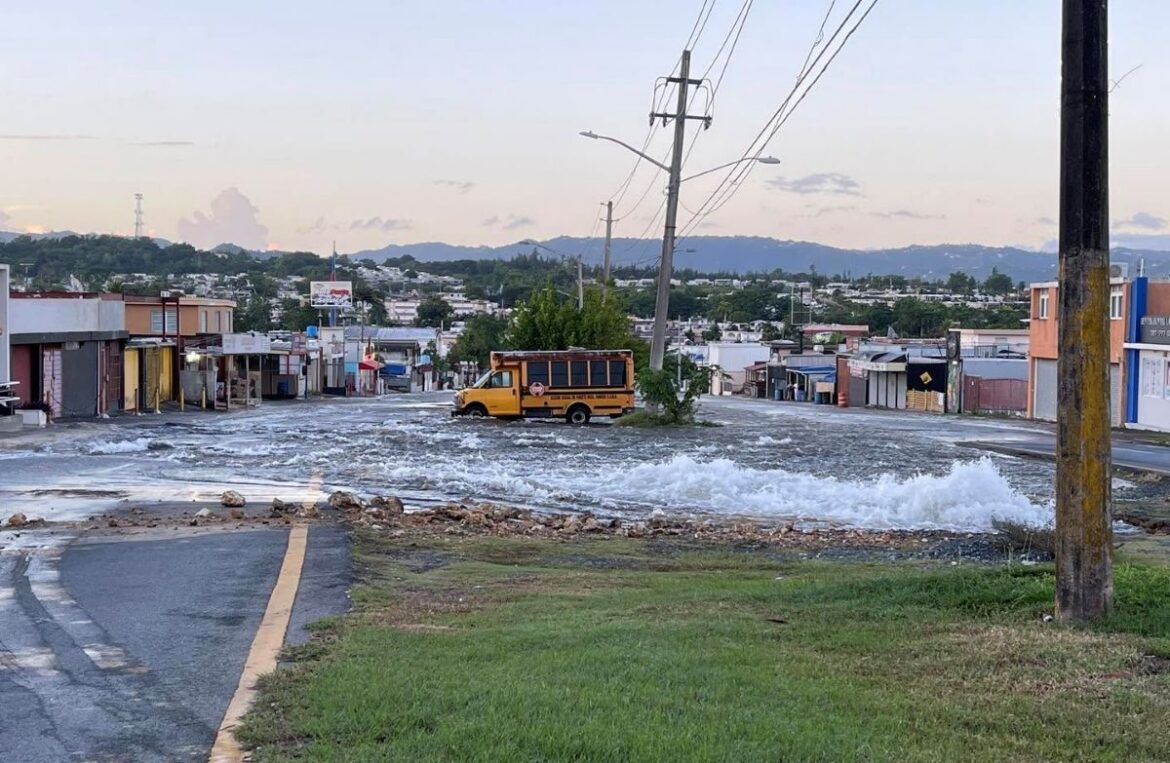
On average, during the two decades from 2004 to 2024, PRASA lost 417 million gallons of filtered water per day. The main causes of those losses can be grouped into two categories: apparent or commercial losses, which result from billing or metering errors and theft, and real or physical losses, which occur when water leaks or escapes through what are known in Puerto Rico as salideros, in part because of deterioration of the system’s infrastructure, Aponte explained. “Unaccounted-for water loss,” as PRASA calls it, is the calculation of drinking water that is produced and enters the system but generates no revenue.
Truenorth in Charge of Water-Loss Efforts
Since 2010, Truenorth has accumulated $172 million in contracts with PRASA, including additional agreements to maintain applications the company developed for the authority and for initiatives of the Project Management Office at the public corporation.
The company’s first contract for work related to water loss that is available in the Puerto Rico Comptroller’s Office registry dates to 2011, when then-Executive President José Ortiz Vázquez hired it for $10 million for revenue optimization initiatives. That amount increased to $21 million after an amendment to the contract.
Under that agreement, Truenorth was required to provide consulting services to PRASA to meet the goals of the unaccounted-for water reduction program, with a target of lowering the loss rate from 60% to 25% by 2018. That did not happen. Instead, the rate of unaccounted-for water began rising that year.
Truenorth Corporation’s contracts with PRASA increased between 2013 and 2016 during Alberto Lázaro’s tenure as executive president. Lázaro was unavailable for an interview with the CPI.
Only between 2013 and 2016, during Lázaro’s tenure, did PRASA report slight declines of between 1% and 5% in unaccounted-for water. During that period, the agency had contracts with Truenorth for revenue optimization, which included managing water theft. The decline also coincided with a water-rationing plan PRASA imposed in 2015 because of the drought Puerto Rico experienced that year, according to a 2016 Water Balance Report.

File photo | Centro de Periodismo Investigativo
Truenorth Corporation is a Puerto Rico-based technology company founded in 2001 by Gabriel and Carlos Fernández Ferrer that provides revenue management, technology, application development and project management services to private and government clients, according to its website.
Truenorth executives have donated to political campaigns of both the New Progressive Party (PNP, in Spanish) and the Popular Democratic Party (PPD, in Spanish). Carlos Fernández Ferrer has donated $21,924 to PNP committees, and Gabriel Fernández Ferrer has donated $40,323 to PPD candidates and the Puerto Rico Mejor Futuro political action committee, or PAC, according to data from the Office of the Electoral Comptroller from January 2019 through May 2026. Meanwhile, Román, the chief technology officer, has donated more than $36,000 to PNP candidates, and consulting director Marcos Fabián Fejgielman has donated $7,100 to PNP committees and $2,800 to the PPD.
A source familiar with the increase in Truenorth’s contracts told the CPI that the expansion of the company’s work stemmed in part from the government bankruptcy that began in 2015, because PRASA “did not have the financial capacity to pay competitive salaries to experts on the issue” who could “think through the entire process and design how [water] loss was going to be addressed.”
Truenorth’s most recent contract to manage ORA calls for advisory and support services in developing initiatives such as Master Meters, which seeks to improve measurement of the water produced; Pressure Management, which refers to controlling pressure in the system; Leak Detection, to identify leaks; and water-balance analysis, a calculation that measures the amount of water produced compared with the amount consumed or lost. According to the proposal attached to the contract, Truenorth’s team is divided into two groups: an office team that manages projects and supports the ORA director, and field personnel who perform on-site tasks such as measuring water flows.
“Many of the recommendations and assessments they have made have turned into pipe-replacement projects that are currently underway,” said González, PRASA’s executive president, who was unable to name any specific project that had resulted from Truenorth’s efforts when asked.

Photo by Noel Algarín | Centro de Periodismo Investigativo
In addition to its services for ORA, PRASA has also awarded Truenorth more than $135 million to provide services for the Revenue Optimization Program, which includes the Non-Revenue Water Reduction Program, which investigates water theft.
Isabel Szendrey, who led efforts to reduce water loss during the administration of Gov. Alejandro García Padilla (2012-2016), attributed the increase in Truenorth contracts to limitations within the public corporation in both staffing levels and the technical capacity of its workforce.
“PRASA definitely did not have the capacity in terms of the number of people needed, but also in terms of technical capacity. Some of these [tasks] involved new issues that had to be learned, and people had to be trained in those new techniques and concepts,” the engineer said, adding that hiring private consultants was the fastest and most effective way to address the problem.
Szendrey attributed the ineffective management of water loss to a lack of funding to carry out later phases of projects that had already begun.
“The amount of money devoted to that type of effort was not enough for the scale of the problem and the scale of the effort that has to be undertaken islandwide to address it,” the former PRASA official said.
She cited, for example, a pilot project to modernize large meters used by industries or hotels in the San Juan Metro Region. Its first diagnostic phase was completed, but the second phase — installing the remote-reading system that would actually reduce losses — was never carried out.
“That first phase began, and during the second phase we were negotiating the contract, the technical and legal matters. Then, suddenly, just as we were close to finishing those negotiations, the bankruptcy [announcement in 2015] came. There was no longer money to carry out that second phase, which was the one that would have had the impact, and produce the benefits from all the work that had already been done,” she recalled.
The project’s second phase would have entailed a $16.3 million investment over five years. However, signing the contract was put on hold “because of PRASA’s fiscal situation.”
A decade later, PRASA continues to contract with Truenorth to gather data, analyze it and evaluate strategies to help understand the problem of water loss. But it does not have the money to implement the solutions.
Yonaira Hernández, executive secretary of the Unión Independiente Auténtica (UIA), the union representing PRASA employees, disputed the contention that outsourcing is a response to an alleged lack of internal technical capacity, saying the issue could be addressed through training.
She also sees no justification for the continued water loss despite all the public money spent on contracting Truenorth. “There is no justification, let’s put it that way, because then [that means] they weren’t doing the work,” Hernández said.

Photo by Víctor Rodríguez Velázquez | Centro de Periodismo Investigativo
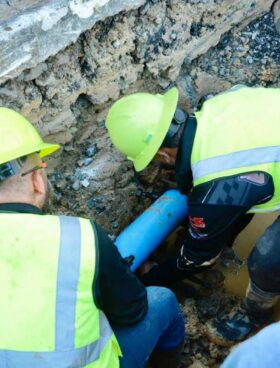
UIA President José Cajigas, meanwhile, said Truenorth’s ineffectiveness, specifically in repairing leaks and broken pipes, stems from subcontracted workers lacking the necessary expertise. That forces PRASA employees to go back to those jobs and correct work the subcontractors did not know how to perform, while water continues to be lost in the process.
“The problem with subcontracting is that you bring in workers who aren’t trained to repair those breaks. Many times, they do the work incorrectly, and PRASA employees have to come back afterward and fix the leak,” he said.
For Cajigas, subcontracted workers “cause more problems than they solve.”
“We have to train our employees from scratch and teach them those little details that only employees who have been working here at the Aqueduct and Sewer Authority for 30 or 35 years know. Many of these companies have employees who, although they know how to make repairs, do not have the expertise or knowledge of the details involved in an excavation to repair a pipe,” he insisted.

Photo provided
Hernández said the work Truenorth does is essentially the same work already performed by agency employees — including reading meters — and yet the problem of non-revenue water remains unresolved.
Hernández said neither Truenorth nor PRASA employees have managed to reduce water loss because management prioritizes deploying personnel to build new infrastructure instead of maintaining existing infrastructure.
“We have certain areas [of Puerto Rico] where PRASA is not delivering water, and then it undertakes new projects. But for those new projects, they don’t take into consideration how they are going to be maintained. In five or six years, that project will stop working because its maintenance was not taken into consideration,” she said.
In addition to PRASA, Truenorth has $189.5 million in contracts with 36 agencies dating back to 2008, including the Department of Education, the State Insurance Fund Corporation, the Office of the Commissioner of Financial Institutions, the Department of Health, the Municipality of San Juan and the Treasury Department, among other government entities.
PRASA Puts Water-Loss Work in Private Hands
For Aponte, who served on PRASA’s Governing Board until 2020, it is questionable to spend millions of dollars on private companies to continue diagnosing and proposing solutions to address the water-loss problem while PRASA’s infrastructure continues to deteriorate.
“My impression is that [the pipes] have many Band-Aids, many patches. There is an illogical backlog in addressing water loss. Sometimes, almost no money is allocated to solve pipe-break problems, which will continue because the pipes are becoming increasingly fragile,” Aponte said. At least three other sources confirmed this to the CPI.

Photo by Víctor Rodríguez Velázquez | Centro de Periodismo Investigativo
In addition to its contracts with Truenorth, PRASA has turned to private companies since 2010 for work related to water loss, including Gregory L. Morris Engineering, MP Engineers of Puerto Rico, Miya Puerto Rico LLC, Johnson Controls Inc., Salo Engineering LLC, Gama Engineering Corp. and CSA Architects & Engineers, which worked alongside Truenorth managing ORA programs until June of this year, when its most recent contract expired.
Like Truenorth, CSA has held contracts with PRASA for the past three decades. Since 2009, it has racked up more than $192 million in contracts with PRASA, according to the Puerto Rico Comptroller’s Office registry. Between 2020, under then-Executive President Doriel Pagán, and 2026, under González Delgado, the agency awarded six contracts totaling $6 million to multinational firm CSA Architects & Engineers to develop and implement initiatives to reduce water loss. CSA Architects & Engineers is part of a conglomerate with a presence in New York, Philadelphia, Washington, D.C., Florida and Panama.
A Contract for Work PRASA Could Do Itself
While the public corporation continues paying consultants who, according to four sources who spoke with the CPI, are draining it financially “without being accountable to anyone or showing their faces,” the few trained engineers who remain at the agency “have no real decision-making power.”
An audit report from the Puerto Rico Comptroller’s Office, published in August and covering July 2020 through June 2024, found that 264 people hired by a private company were performing duties like those of 19 positions that already exist at PRASA. It also concluded that the authority paid for services that properly trained in-house personnel could have performed.
The audit also found that there has been no transfer of knowledge from contracted personnel to PRASA employees. According to the report itself, PRASA acknowledged that it did not conduct “an economic analysis to determine the advisability of using contracted personnel,” although it argued that the law does not require one.
The audit does not identify Truenorth by name, but the CPI found that the audited contracts match those PRASA awarded the company during the period examined in their dates, amounts and descriptions of the work.
According to Hernández of the UIA, in addition to the duplication of tasks, PRASA itself provides Truenorth with much of the equipment and tools it needs to operate, from the meters the company installs and repairs to the office space used by some of its administrative personnel.
“In the central building of the Aqueduct and Sewer Authority, on the third floor, there is an area where Truenorth office employees work; they work with systems. Who provides the facilities, air conditioning, desks, printers? The Authority,” she said. The same is true of field personnel, she added, because “the tools they use in the field are also provided by PRASA.”
In a 2025 letter, the Financial Oversight and Management Board approved with observations a nearly $2 million contract between PRASA and Truenorth and questioned the company’s influence within the public corporation.
In the letter, the board stressed that PRASA must take “affirmative steps” to recruit personnel and eliminate or limit its dependence on contractors. It also noted that there had been no competitive process for procuring the services and urged that, if the services were needed in 2026, they be obtained through a competitive process.
Jorge Rodríguez Ruiz became PRASA executive president in May 2004, as the agency was emerging from the failed Ondeo privatization, and in that position dealt directly with Truenorth.
Unlike other people interviewed by the CPI who described the company as a parallel power center within the public corporation, Rodríguez insists that Truenorth’s contracts established PRASA oversight of its work from the outset.
“Those people [Truenorth] do not work on their own and do not do whatever they please. They are directed and supervised by PRASA,” Rodríguez said. The former PRASA chief also defended the firm’s extensive knowledge of the public corporation after years of working with it and said, in his view, “they have been instrumental in keeping PRASA from being worse off than it could have been.” According to Rodríguez, when PRASA first hired Truenorth during his tenure, the company was required to meet performance metrics and undergo ongoing validation.

Photo by Ana María Abruña Reyes | todaspr.com
The terms of the most recent contract state that Truenorth must submit a monthly report detailing the month’s accomplishments; a schedule and status report; tasks performed; next steps; outstanding requests awaiting resolution; the development, review and monitoring of performance metrics and their impact on billing; cash receipts; a critical-situation report with recommended actions; and any other management report requested by the authority.
Since August, the CPI has requested invoices and reports on work performed by Truenorth over the past three years, but PRASA has failed to provide them.
This translation was generated with the assistance of AI and reviewed by our editorial team to ensure accuracy and clarity.