
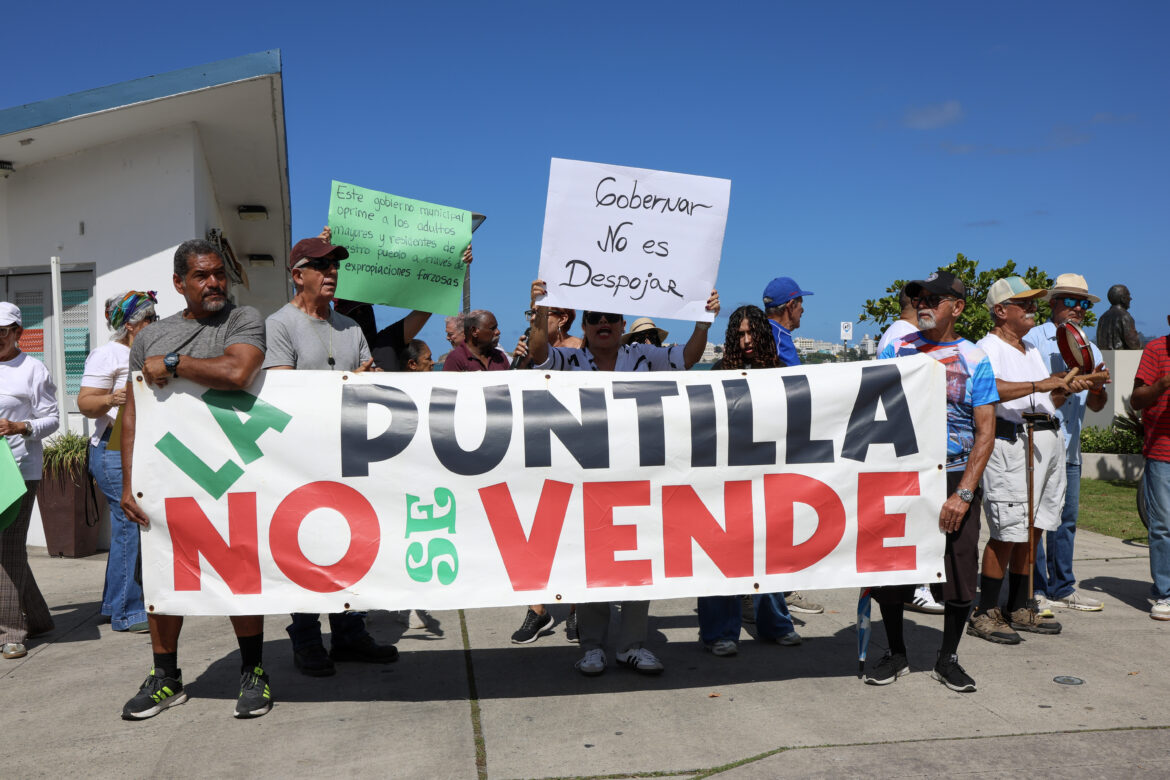


The chamber of Cataño’s Municipal Legislature filled with residents from La Puntilla and Avenida Las Nereidas neighborhoods. On the night of Jan. 27, 2026, the 12 legislators present weighed whether to approve ordinances authorizing Cataño Mayor Julio Alicea Vasallo to initiate the expropriation of eight properties in those two areas of Barrio Pueblo.
Most of the people in the room did not own the properties the Municipality of Cataño wants to take. But they were residents who suspected the expropriations discussed that night marked the beginning of a plan to push people out of Las Nereidas and La Puntilla neighborhoods to make way for tourism and commercial development, they told the Centro de Periodismo Investigativo (CPI) and Rayos X (Telemundo).
In the chilly municipal chamber, residents listened as the vote was finalized: nine in favor, three against and one absent. Many stood up and left the meeting amid murmurs, expressions of dismay and angry complaints.
According to the mayor, the expropriation authorized for a house in Las Nereidas would clear the way for a public restroom to serve visitors to the Edwin Rivera Sierra boardwalk. The house is closed but not abandoned. It belongs to Eliseo Mena Adorno, 76, a New York resident who opposes the seizure, he said.
The other seven properties, in La Puntilla — designated in Puerto Rico as a “Special Community,” a status created to protect historically marginalized neighborhoods — would be turned into public parking lots as part of Cataño’s Waterfront Development Master Plan. The nine legislators approved the ordinance promoted by the mayor without consulting the community, as required under Puerto Rico’s Special Communities law.

Photo by Brandon Cruz González | Centro de Periodismo Investigativo
“On average, a Saturday and Sunday out here draws 4,000 people. The boardwalk has only two restrooms,” Alicea Vasallo said. “Do you think that’s enough for 4,000 people? The house [on Las Nereidas] is in a tourist area, and we’re going to expropriate it. For what? For bathrooms — good, attractive public restrooms.”
Residents in Cataño fear that the new construction tied to the proposed economic and tourism development along the waterfront will displace people in the municipality’s poorest neighborhoods — communities that also happen to sit on some of Cataño’s most coveted coastal views. More than 20 residents from La Puntilla and Avenida Las Nereidas, along with minority-party municipal legislators, described that concern in interviews.
As the municipality moves forward with expropriations, dozens of La Puntilla families have run into a troubling discovery: Homes that have been in their families for nearly a century appear in the Municipal Revenues Collection Center (CRIM, in Spanish) under other people’s names. One of those names is Juan Iván Orengo Guerrido — a friend of the mayor, a political donor and a boxing promoter — who, either personally or through one of his corporations, owns 12 other properties in the municipality, an investigation by the CPI and Rayos X found.
Coveted properties
For residents of Avenida Las Nereidas and La Puntilla, the expropriation ordinances approved in late January are only the beginning. They believe the next measures will target the other occupied homes in a row of houses directly facing the Cataño boardwalk, with a privileged view of Old San Juan across the bay.

Photo by Brandon Cruz González | Centro de Periodismo Investigativo
Griselle González Carmona, a Las Nereidas resident, recalled that the cluster of homes where she lives was once slated for expropriation under the administration of the late Edwin “El Amolao” Rivera Sierra, to make way for a statue of Christopher Columbus. Although that project ultimately did not move forward there — and was instead built in Arecibo — the municipality did purchase a lot in the area.
González Carmona said she and her neighbors have received offers to buy their homes for commercial development along the coast.
“People from the municipality — and people who aren’t from the municipality — have come to tell us they want to buy the houses, asking if we’ll sell, if we’ll rent,” González Carmona said. “That alone is worrying, because if you look around, many of us are older. And it isn’t easy to leave your home — the one you’ve fought for and sacrificed so much to keep.”
La Puntilla residents alarmed by discrepancies in CRIM records
Amid buyout offers along Cataño’s urban waterfront — and forced expropriations meant to advance the municipality’s tourism and economic development plan — at least 25 La Puntilla residents discovered that in CRIM’s Digital Cadastre, their properties, located on separate lots, appear largely grouped under parcels listed in the names of Juan Iván Orengo Guerrido, Manuel Vargas and Benjamín Ocasio González — people with no ties to their families.
Some of these La Puntilla residents do not have formal deeds. Their properties are not recorded in the Puerto Rico Property Registry, nor are they registered with CRIM. Many are relatives of the original owners who acquired the land in what was once a mangrove area owned by the Government of Puerto Rico dating back to the 1920s, when the commissioner of the Interior — a position that later evolved into the secretary of the Department of Public Works — sold the lots under Act 55 (1923) and Act 44 (1925).
Both laws required that property titles be issued to purchasers of the land or to those who had made improvements or drained the mangroves to reclaim the terrain.

Photo by Brandon Cruz González | Centro de Periodismo Investigativo
Residents of La Puntilla realized their homes were listed under other people’s names when one neighbor searched the agency’s website while trying to update the ownership records for the house where she lives — and then alerted others. Luz Pérez has lived in the home that belonged to her late parents-in-law on Canal Street in La Puntilla for years. Yet the property appears on CRIM’s map as if Orengo Guerrido were the owner.
“The deed is in my in-laws’ name [in the Property Registry]. We wanted to put it in my children’s name, and that’s when you find out,” Pérez said, referring to the discrepancy in CRIM’s records.
Luz’s case prompted neighbors to start checking other properties in the area — and they realized the same thing was happening elsewhere. Their homes appeared under other people’s names and, in some cases, showed purchase-and-sale transactions they knew nothing about. That led them to fear the houses may have been sold fraudulently.
“The concern is that it shows up [in CRIM] as if these houses were sold for amounts we can’t explain, because none of the people here — or any other neighbor — has gone out to sell their home,” said Viviana Maldonado Morales, the daughter of one resident, Providencia Morales Flores. “And many of these houses still have deeds in the names of the original owners.”
Morales Flores owns a home on Canal Street 14 in La Puntilla that she inherited from her parents, José Julio Morales and Carmen Flores. Her daughter showed the CPI and Rayos X documents in which the Department of Public Works certified, in 1960, the assignment and transfer of the lot to her grandfather, José Morales. The Puerto Rico Planning Board certified the ownership, and it was recorded in the Property Registry that same year. Yet in CRIM’s digital cadastre, the listed owners are Manuel Vargas and Benjamín Ocasio González — people neither woman knows — along with Laura Esther Concepción, a La Puntilla resident who has since died and lived in a different part of the neighborhood.
Maldonado Morales said they have not submitted the documents proving ownership to CRIM because they do not trust government processes.
“Corruption in this [government] is so widespread that we didn’t want to go to any of these institutions, because these are precisely the institutions where all of this is coming from,” Maldonado Morales said. “What are they going to tell us when we go to CRIM? Probably nothing. Probably that it was an ‘error in the system.’”
Elvira Fuentes Fardonk is another La Puntilla resident whose property appears under Orengo Guerrido’s name in CRIM records. She has lived there for 60 years, since her then-husband, Jorge Ramos Cardona, bought the lot where their home was built. The land was never formally submitted or recorded under her name in the Property Registry. In 1969, her ex-husband requested the title from the Department of Public Works, but the effort appears to have stalled there, and Fuentes Fardonk does not have a document establishing ownership.

Photo by Norenid Feliciano Ramírez | Centro de Periodismo Investigativo
Although the Property Registry, housed within Puerto Rico’s Department of Justice, is the official entity that validates ownership — not the CRIM — residents remain alarmed that their homes appear under other people’s names in CRIM’s Digital Cadastre.
For Ariadna Godreau, executive director of Ayuda Legal Puerto Rico, these discrepancies in CRIM’s records don’t just sow confusion; they leave low-income residents even more vulnerable.
If someone doesn’t realize CRIM has no legal authority to determine who owns a property or structure — and then discovers their home is listed under another person’s name — they may conclude they have no rights to the property and hand it over to someone else out of uncertainty and lack of guidance, she said.
Godreau also noted that not all properties are recorded in the Property Registry because doing so is not required under Puerto Rico law. As a result, many people do not have formal titles.
She emphasized that registering a property can be complicated, cumbersome and expensive, which leads many residents to forgo the process. That reality became especially clear during the recovery from Hurricane Maria, when the Federal Emergency Management Agency (FEMA) eliminated the title requirement for people receiving assistance in Puerto Rico.
Although CRIM staff initially spoke with the CPI and Rayos X to explain how the agency’s digital map works, the agency’s executive director, Javier García Cintrón, later declined to be interviewed about the specific inconsistencies appearing in Cataño. He also did not answer questions about the specific findings, offering only general responses that did not clarify the situation.
In a written statement, García Cintrón said CRIM’s database undergoes “continuous cleaning and updating processes,” and that the agency has strengthened that work “in recent years through the use of technology, as well as initiatives aimed at encouraging taxpayers to go to CRIM to register” their properties. He said it is the taxpayer’s responsibility to update property information. He reiterated that property ownership is established through the Property Registry, not CRIM.
The Property Registry did not respond to an interview request and did not answer written questions about discrepancies between its database and CRIM’s. Three sources told the CPI there is no communication between the two information systems — a gap that could otherwise prevent errors and omissions.
“Semilleros” parcels that fuel confusion
In January 2026, the CRIM announced an initiative to identify, across Puerto Rico, owners of homes that appear in the Digital Cadastre as “John Doe” — meaning no owner is listed — and to urge them to visit the agency to register their properties.
The agency also said it will work to register, on an individual basis, so-called “semilleros” — properties that appear grouped under a single owner or cadastral number even though they are separate units.
According to CRIM, these “semilleros” are often tracts of land that once belonged to a single person and, over time, were subdivided into smaller parcels with different owners. Yet in CRIM’s records, they still do not appear as segregated or separately listed.
The mayor says his friend is not benefiting
In Cataño, just about everyone knows who Orengo Guerrido is. Locals call him “Yomi.” He was born there y and is described as someone with influence at City Hall because of his friendship with the mayor and his role as an active businessman in Cataño.
He has promoted reggaeton and boxing, and he owns several entertainment businesses along Cataño’s waterfront. He also manages short-term rentals and plans to develop three hotels in the municipality, he told the CPI and Rayos X in an interview.
In addition to the nearly dozen properties that appear under his name in CRIM records, even though they are not his, Orengo Guerrido owns at least 13 properties in the downtown area and in La Puntilla. He has purchased most of them since 2017, and the value listed at the time of purchase totals $1,167,000. Some are in his name, while others are listed under his company, J.F. Fresh Productions Corp. In 2022 and 2024, the businessman donated $4,500 to the Cataño mayor’s political committee.
“He’s a personal friend,” Alicea Vasallo said. “My friends — in good times or bad — I don’t deny them. I’ve known him for many, many, many years. He has money, and he’s buying properties. He’s investing in properties in Cataño.”
The mayor rejected the idea that the expropriations in La Puntilla and along the waterfront are intended to facilitate the business interests of Orengo Guerrido or other merchants, or that the seized properties would be sold to the promoter.
“Juan [Orengo Guerrido] has never approached me about buying this house or that house,” Alicea Vasallo said, insisting that neither Orengo Guerrido nor anyone else influences his decisions. “The only one who influences me is God — and that little Virgen del Carmen you see back there,” he added, referring to the town’s patron saint.

Photo by Brandon Cruz González | Centro de Periodismo Investigativo
Alicea Vasallo also maintained that he has not sold the building that once housed the former Head Start program in La Puntilla — one of the structures that appears under Orengo Guerrido’s name in CRIM records. After the interview with the mayor, the CPI noted that the properties now also appear under the Municipality of Cataño’s name in CRIM.
Have you been able to see this structure in CRIM? Because that structure appears under someone else’s name — a private individual — he was asked.

In CRIM’s Digital Cadastre, nearly a dozen homes appeared grouped under the name of Juan Iván Orengo Guerrido as the owner, even though the address listed did not match the location shown on the map. The former Head Start structure was part of that group.
Screenshot
In early February, CRIM added the Municipality of Cataño as the owner over the same outlined set of properties, without specifying that it owns only the former Head Start structure.
Screenshot

“I know what your concern is. I know where you’re going,” the mayor said. “As a matter of fact, today [Feb. 2, 2026] I met with CRIM’s director because there are some errors in the cadastre. They have to correct certain incorrect demarcations. That structure belongs to the municipality, even though it appears under someone else’s name.”
He then contradicted himself, saying that this mismatch in property identification was not part of his conversation with CRIM officials. “No, no, no — it didn’t come up,” he added.
He said that, like the former Head Start building, the other parcels in La Puntilla that appear under Orengo Guerrido’s name — and under other people’s names — are also the result of an error in CRIM’s digital cadastre map. He said he went door to door to explain that directly to residents in the sector. Fuentes Fardonk said that, at least in her case, he had not come to her home — even though the mayor mentioned her specifically.
“Anyone who lives in La Puntilla can be sure and stay calm that this is their home — that there’s an error that has to be worked out with CRIM,” the mayor insisted.
Orengo Guerrido also denied any role in the Municipality of Cataño’s property acquisitions and blamed CRIM for attributing to him parcels that do not belong to him in La Puntilla. He said he owns two properties and two lots located on San Antonio Street and San Fernando Street (formerly Canal Street and Prolongación Tren Street).
“That problem is CRIM’s — they don’t do things right and this happens,” he said. “In La Puntilla, yes, I have four properties. I’m not the only one with this issue — someone else has it, too. The problem is CRIM’s. Let them fix it!”
“I have my projects in Cataño. Everyone knows it,” the promoter told the CPI and Rayos X, and said he plans to build several hotels in town using structures he has acquired in recent years.
Orengo’s company, J.F. Fresh Productions Corp., has held contracts with the municipalities of Cataño, Fajardo, Bayamón and Manatí, as well as with the Puerto Rico Tourism Company, to sponsor boxing cards and Puerto Rican League basketball tournaments held in those towns’ stadiums and arenas. The company has also contracted to lease arenas and parks. One contract with the Municipality of Fajardo covered production of a 2024 Administrative Professionals Day event that included lunch service, massages and live music.
A formula for acquiring properties
Vilmarie Domínguez Lozada, a municipal legislator from the Puerto Rican Independence Party (PIP), said she has identified a pattern aimed at pushing residents out of La Puntilla, the waterfront and Cataño’s downtown area. According to her, the approach has been to first pressure owners to sell their properties to third parties — and if a sale does not happen, the municipality then moves to expropriate them.
“We’ve received testimony from residents, and we’ve found that in every case it’s the same pattern,” Domínguez Lozada said. “They approach people, they ask [if they want to sell], the owners refuse — and a few weeks later, the Legislature is handed the forced-expropriation bills.” She said the same playbook appears in all 21 expropriation ordinances approved since last year.

Photo by Brandon Cruz González | Centro de Periodismo Investigativo
The pro-independence legislator said expropriation proposals arrive at the Municipal Legislature without any effective effort to locate the owners. Lawmakers are told the houses are abandoned, she said, but when she investigates, she finds the owners — and in most cases, they do not owe back taxes to CRIM.
Domínguez Lozada and two Popular Democratic Party (PPD) legislators, Betzaida Bauzá Marrero and Jennifer Rojas Cruz, were the only members who voted against the eight expropriations in late January.
Before the Municipality of Cataño began the forced expropriation process this year for the home in Las Nereidas 1, its owner, Mena Adorno, said he received multiple offers from private individuals to buy or rent the property. He said the proposals came from people who wanted to set up businesses along this stretch of coastline facing Old San Juan.
Mena Adorno said the modest home has been on the municipal administration’s radar for years. In 2023, he found a “public nuisance” notice sign posted on his property. And in 2025, he was warned that he supposedly owed more than $8,000 in property taxes — a debt that, if unpaid, could lead to expropriation. In both cases, he said, the municipality eventually acknowledged it was mistaken.
Despite that prior contact with the municipal administration, Mena Adorno said he learned in early January 2026 — from third parties, not the municipality — that his house would be expropriated.
“No, they never notified me,” he said. “I found out by accident. They have ways. Other times, they’ve called me and sent me emails from the municipality. I don’t know why they didn’t notify me about this, which is far more important,” Mena Adorno told the CPI and Rayos X.
The mayor, however, said the municipal administration tried to reach him but was unsuccessful.
“We’ve been trying to get in touch with don Eliseo for more than a year. He doesn’t answer his phone, he doesn’t answer his cellphone — and now he comes and says he’s going to spend his final years here in this house? I don’t believe that,” Alicea Vasallo said. Mena Adorno said he bought the property to restore it and use it as his primary residence during retirement, which began this year.
Cataño’s mayor said it bothers him to see the home “every day [from] my balcony or from my window [at City Hall] … empty, in good condition, but empty. That property — that man bought it in 2011, and from 2011 on, nobody has lived in that house. Nobody means nobody.” Alicea Vasallo argued that Mena Adorno’s objection to the expropriation is not justified because it is not his only property.
Jorge Rodríguez Valentín, a resident of Avenida Las Nereidas, sued the municipality for closing the street that leads to his home and blocking access to his main entrance. Rodríguez and his son, who shares his name, are convinced the closure is a strategy aimed at driving neighbors out of their homes — properties in a coveted row facing the San Juan Bay.

Photo by Norenid Feliciano Ramírez | Centro de Periodismo Investigativo
Mayor uphold expropriations
Cataño’s mayor said the expropriation of the eight properties approved last month serves two purposes: to build infrastructure for public use and to protect the community from investor speculation.
Although he could build the restrooms on a nearby municipal lot next to Mena Adorno’s property, the mayor said he plans to use that parcel for a dog park instead.
On that municipal land, there will be “a project — specifically mine — because I love, I love pets,” the mayor said.
Alicea Vasallo said the municipality also wants to control the type of commercial activity that has proliferated in La Puntilla.
“La Puntilla has become a place where third parties buy up land for Airbnbs, for restaurants, for bars — and I’m tired of bars, dancing, and the happy-go-lucky attitude. I’m done. The bars that we already have are enough,” Alicea Vasallo said. “Either the Municipality of Cataño acquires these properties for a public purpose or to protect the La Puntilla sector, or we leave them in investors’ hands so they can do whatever they want with the community,” he added.
He did not identify which investors he was referring to. He said anyone with money and an interest in development could do it. Although he said no one has approached him about projects in the area, he said he knows properties in La Puntilla are being purchased for short-term rentals and tourist lodging, among other uses.
The mayor said he discussed the proposed expropriations with the current and former presidents of La Puntilla’s community board — José Miguel Molinary and Braulio Rojas — and that both leaders agreed. But Puerto Rico’s Special Communities law requires consultation with the entire community and approval from 75% of residents. Then, for the formal forced expropriation process to begin in court, Puerto Rico’s Legislature must have approved a joint resolution authorizing it.
The mayor said that the community consultation process will now begin — after the ordinances authorizing the expropriations were approved — and will be led by the Puerto Rico Office for Socioeconomic and Community Development (ODSEC in Spanish), which he said is overseeing the process.
“I’m going to do what the community tells me,” Alicea Vasallo said. “If the community tells me, ‘Mayor, there won’t be parking lots there,’ then there won’t be an expropriation. They’re the ones in charge there. They’re the ones who live there.” He also left open the possibility of considering other uses for the lots, such as passive parks, green space, or play areas for children or older adults.
Godreau said the Municipality of Cataño reversed the proper order of the expropriation process. In her view, the city should have consulted La Puntilla residents before approving the expropriation ordinances.
If an ordinance uses directive language stating that expropriations are already a decided matter, Godreau said, the process stops being consultative and becomes informational. And if the mayor has suggested the community will have the final say, she said, residents will have to trust that he keeps his word — and that he returns to the Municipal Legislature with the community’s decision.
“What would have been preferable is to convene a community assembly and then proceed with the expropriation process,” Godreau said. “In that case, if the mayor intends to honor his word — and you always hope for the best in people, not the worst — then he should return to the municipal assembly with the community’s determination.”
Where is the updated master plan?
For Cataño’s mayor, the development of tourism and gastronomic venues is essential to stimulating the town’s economy — and he says it has already produced results, pointing to what he described as a tourism “boom” in Cataño. He said that surge is reflected in the municipality’s operating budget, which he said rose from $37 million in 2021 to $45 million in 2026.
“We have to take advantage of this. These opportunities won’t always be there. Cataño keeps growing, and I’m looking at Cataño toward the future,” he added.
Since last year, the Puerto Rico House of Representatives has sought to create a Gastronomic Tourism Zone along Cataño’s waterfront, extending to La Puntilla. Although the first bill introduced for that purpose (House Bill 335) was vetoed by the governor in October, Reps. Pedro Santiago Guzmán and Ángel Morey Noble introduced a new measure with the same intent (House Bill 913), which became Act 24 of 2026.

Photo by Norenid Feliciano Ramírez | Centro de Periodismo Investigativo
In 1995, under then-Gov. Pedro Rosselló’s administration and with the backing of Norma Burgos, then president of the Puerto Rico Planning Board, the Master Plan for the Development of Cataño’s Waterfront was approved. Its goal was to expand commercial and tourism activity in Cataño and La Puntilla and turn the area into a commercial and tourism district “through private capital investment.” At the time, residents warned that the plan would have “detrimental impacts on the sector’s ecosystem and environment.”
Asked whether communities would be affected by development in the area, Alicea Vasallo said the master plan was amended under former Mayor Félix “El Cano” Delgado, who was convicted of conspiracy for accepting bribes in exchange for contracts. Alicea Vasallo did not specify what changes were made.
The CPI and Rayos X asked Alicea Vasallo for a copy of the updated plan. Although he said he would provide it, he had not done so by the time this investigation was published. The master plan on file with the Puerto Rico Department of State, however, is still the 1995 version. The Puerto Rico Planning Board announced last September that the plan would be repealed.
“I want Cataño to have good buildings. I want money from CRIM to come into Cataño, and the only way is by developing these lots. We’re tired of industry, we’re truly tired of warehouses — we’re looking to a future where Cataño moves forward,” the mayor said. He added that he plans to pursue the expropriation of land acquired by the company Colón Gerena under the administration of Pedro Pierluisi, to build hotel rooms and apartments.
This translation was generated with the assistance of AI and reviewed by our editorial team to ensure accuracy and clarity.