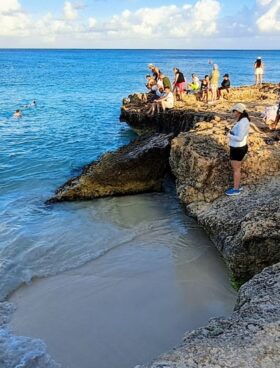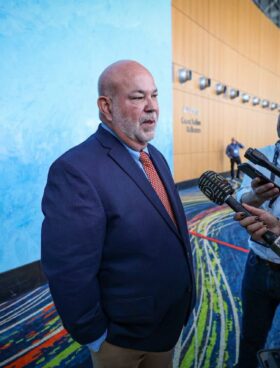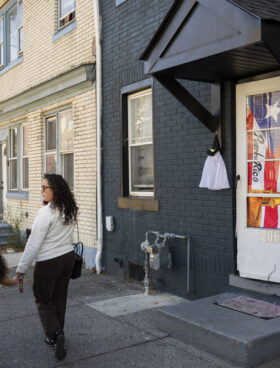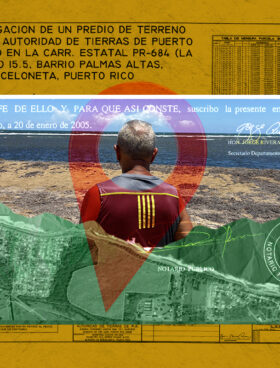

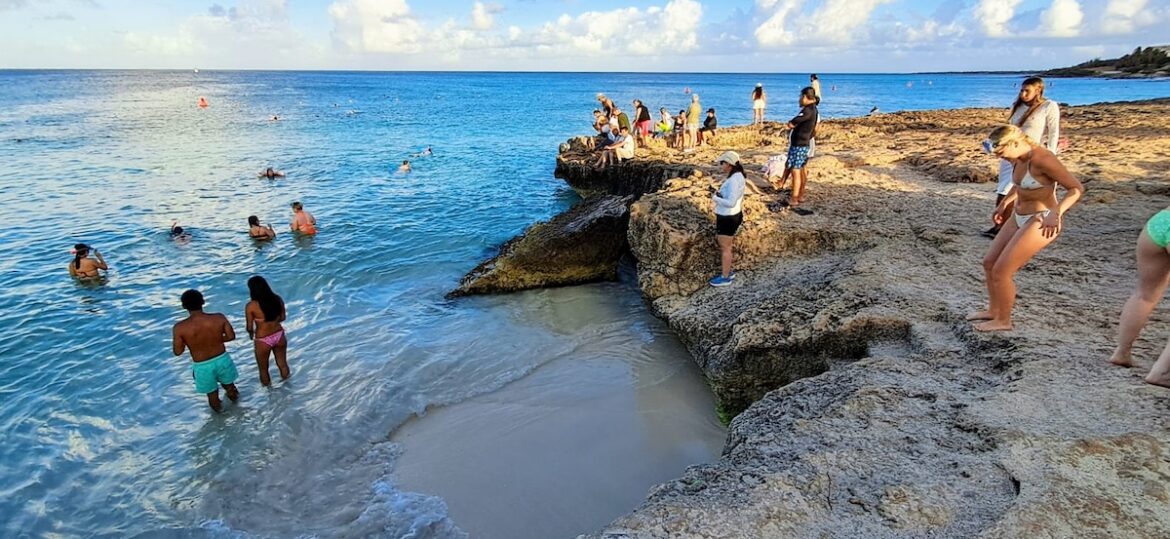
Chanting “Nos kier nos lama!” (“We want our beaches!”), Aruban residents gathered at Basiruti Beach in 2025 for the first of several protests against tourism development. In the background, Puerto Rican artist Bad Bunny’s track “Lo que le pasó a Hawái” played alongside Aruban songs.
“Thеy want to take my river and my beach too
They want my neighborhood and grandma to leave
No, don’t let go of the flag nor forget the Lelolai
‘Cause I don’t want them to do to you what happened to Hawaii.”
For Rhakeem Samuel, who joined the protests, the song resonated with him. Although he had never been much of a Bad Bunny fan, hearing the lyrics gave him goosebumps.
“I thought, ‘Wow, he’s telling us not to let what happened to Hawai‘i happen to us,’” Samuel says. “It felt as if he was speaking to us.”
In the song “Lo que le pasó a Hawái”, from his 2025 album “Debí Tirar Más Fotos”, Bad Bunny draws parallels between Puerto Rico and Hawaii, warning against the displacement of local communities and the loss of cultural identity. The lyrics speak of residents losing access to their land, beaches and neighborhoods.
The references to a grandmother being forced from her home, holding on to the flag and not forgetting the lelolai, a refrain also heard in the tambu music of Aruba and Curaçao, particularly struck him. “I could relate to it. I listened to it again recently, and it touched my soul.”
For Samuel, the connection goes beyond the song.
“We are not only losing our beaches, but also our identity and what it means to be Aruban. That is connected to our nature. It is part of who we are,” he says. “That is why I started protesting, and why I will continue to protest.”
The demonstrations at Basiruti, located along Palm Beach on the northwestern coast of Aruba, were not the first expression of resistance to tourism development. In 2018, the political movement RAIZ gathered 5,000 signatures in less than two weeks for a petition demanding a legal moratorium on new hotels, timeshares and condominiums.
In 2023, activist Nigel Maduro was arrested after spray-painting the words “No More Hotels” near Eagle Beach, another beach on the west coast of the island. His arrest sparked outrage on social media and drew support for his message, helping fuel the “Land Back” movement among young residents. The movement went on to organize demonstrations and gatherings known as “beach parties” focused on protecting land and the natural environment.
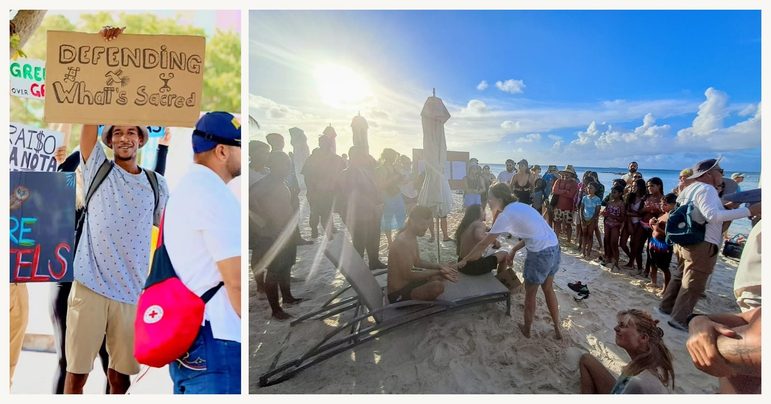
Photos by Melissa Stamper | Centro de Periodismo Investigativo
But the concerns extended beyond those taking part in protests. A 2024 survey by the Aruba Tourism Authority (ATA) found that while most residents continued to recognize tourism’s economic importance, concerns about its impact on everyday life had become more prevalent compared with 2018. Housing affordability, the cost of living, environmental damage and pressure on infrastructure were among the issues raised.
A year after the Basiruti protests, disputes over the use of Aruba’s coastline have taken on new dimensions. Conflicts over commercial activities along the island’s northern coast have reached the court of justice, while tour operators have also taken to the streets to protest restrictions affecting their businesses. Meanwhile, the government has announced plans to revise beach regulations, introduce a registration system for short-term vacation rentals and consider changes to its spatial development framework.
For Jourella Arends, the growing pressure of tourism is felt in everyday routines she once took for granted. She used to swim for exercise once or twice a week and spend her weekends at the beach. Now, she says, even early on weekday mornings, finding a parking spot can be difficult. Before reaching the water, she sometimes has to make her way past 50 to 75 tourists, by her own estimate. A small cove on the northern coast like Tres Trapi, once among her favorite spots for swimming and snorkeling, has become so crowded that she rarely visits anymore.
“I don’t blame the tourists,” she says. “But Aruba is no longer the same place to live as it used to be.”
Beach access
Aruba’s beaches have long been considered public space, a principle dating back to the early development of the island’s tourism industry. When the government adopted its beach management policy in August 2014, it reaffirmed that beaches should remain equally accessible to residents and visitors.
Permit conditions issued to hotels in 2018 explicitly stated that palapas, open-sided beach cabanas with thatched roofs, situated on public land belonged to the government and were available on a first-come, first-served basis.
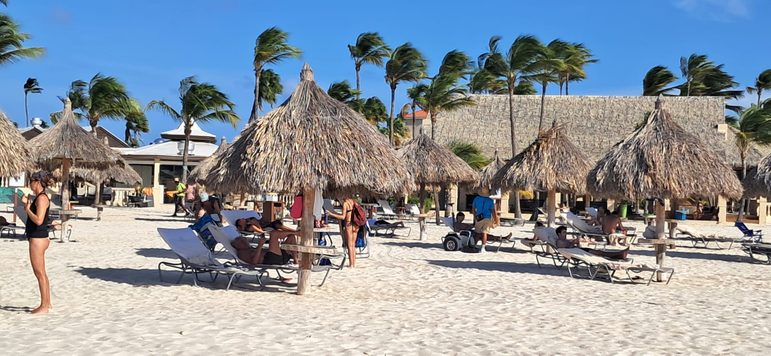
By Melissa Stamper | Centro de Periodismo Investigativo
In February 2026, Tourism Minister Wendrick Cicilia reiterated that commitment, declaring that no beach in Aruba would ever belong to a hotel. Yet temporary guidelines introduced just two months later allow hotels with valid permits to assign palapas to their guests, even treating them as occupied when no guest is physically present.
While the guidelines maintain that the beaches themselves remain public, they give hotels greater control over who can use the shade structures on them.
An island at crossroads
For Maduro, Hawai‘i offers a warning about Aruba’s future. “Aruba is the Hawai‘i of the Dutch Kingdom”, he says. “We have the symptoms of becoming Hawai‘i.”
Maduro recalls speaking with a Native Hawaiian participant during a climate conference. “He warned me to stop this right now,” Maduro says. “Aruba is still in the early stages of what happened to Hawai‘i.”
Aruba and Hawai‘i have different colonial histories and political statuses today. Hawai‘i was once an independent kingdom before its monarchy was overthrown in 1893 and the islands were annexed by the United States in 1898. It became the 50th U.S. state in 1959. Aruba, formerly a Dutch colony, gained autonomous country status within the Kingdom of the Netherlands in 1986. Yet their economies tell a similar story. Both islands have come to rely heavily on tourism, attracting visitors with white sandy beaches, crystal-clear waters, water activities and distinct cultural traditions.
What worries Maduro is not tourism itself, but the possibility that an island increasingly built around visitors becomes less accessible to the people who call it home.
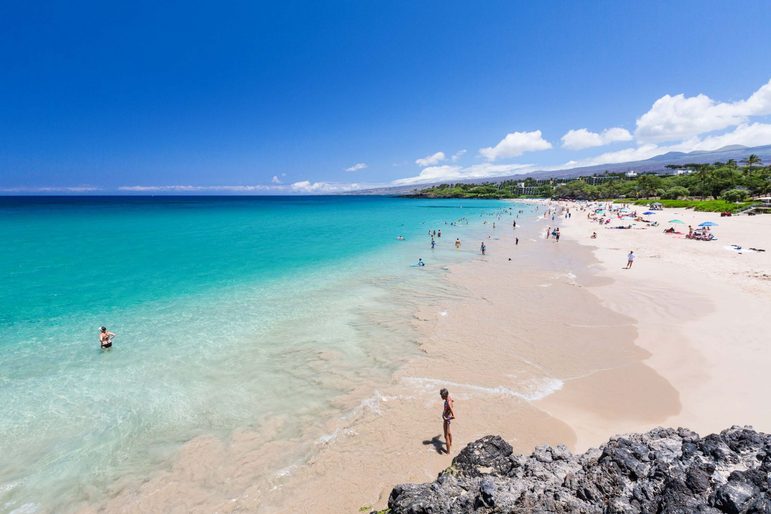
Photo by Hawaii Tourism Authority | Tor Johnson
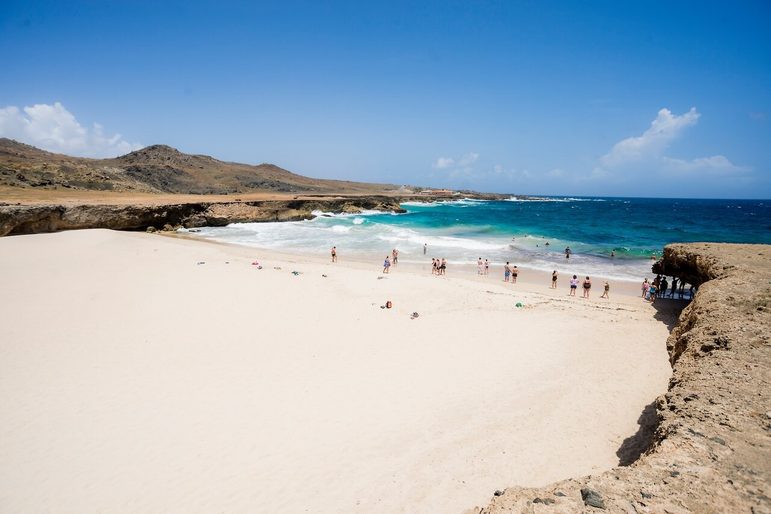
Photo by Aruba Tourism Authority
It is a concern that resonates with residents on both islands, even as most continue to recognize tourism’s economic importance. According to the Hawai‘i Tourism Authority’s 2025 Resident Sentiment Survey, 72% viewed tourism favorably. Yet 66% believed their island was being run for tourists at the expense of local people, while 80% felt the economy was too dependent on tourism.
Aruba’s tourism authority, ATA, found a similar tension. In its 2024 Local Sentiment Survey, 68% of respondents expressed a positive view of tourism. Yet residents also raised concerns about the rising cost of living, unaffordable housing, pressure on infrastructure, environmental damage and how little of the revenue generated by tourism reaches local people.
The housing market shows how these pressures are playing out. In Hawai‘i, the median single-family home sold for $950,000 in 2024, a price fewer than one in four households could afford, according to the University of Hawai‘i Economic Research Organization. Its 2025 Housing Factbook identified around 34,000 short-term vacation rentals, or 6% of the state’s housing stock, rising to 41% in West Maui. In December 2025, Maui lawmakers approved a phased ban on thousands of vacation rentals to help return housing to residents.
On Aruba, more than 3,800 families were waiting for social housing, according to housing foundation Fundacion Cas pa Comunidad Arubano 2025 annual report. At the same time, an inventory commissioned by the ATA estimated that 3,748 short-term vacation rental units, 9% of the existing houses, were operating on the island at the end of 2023. More than 60% of these rentals were concentrated in Noord and Tanki Leendert, two areas that include residential neighborhoods.
In October 2026, nearly three years after that inventory, the Aruban government approved an action plan requiring existing vacation rentals to register. Minister of Kingdom Relations, Education, Youth, Innovation and Sport Gerlien Croes acknowledged that short-term vacation rentals had expanded for years without adequate regulation or government oversight, while describing the sector as almost indispensable to Aruba’s economy.
“This initiative is intended to bring greater clarity, structure and legal certainty to a sector that has become an important part of the island’s tourism economy,” said Minister of Finance, Economic Affairs and Primary Sector Geoffrey Wever. The registration process is intended to establish a clearer picture of the sector and assess whether individual properties comply with existing regulations. But it does not establish a cap on vacation rentals or address how their growth affects the availability of housing for residents.
The ATA has also called for more restrained visitor growth. Its CEO, Ronella Croes, has identified housing, infrastructure and residents’ quality of life as pressing concerns. She outlined a target of limiting growth in stay-over arrivals to 1.4% in 2027, alongside a strategy to attract higher-spending visitors, limit cruise arrivals and tighten regulation of vacation rentals. But the target is not a binding cap, and ATA does not control the permits or development decisions that determine how much additional tourism accommodation is built.
The hotel industry is also calling for limits. The Aruba Hotel and Tourism Association (AHATA) advocates caps on flights and cruise arrivals, stricter regulation of vacation rentals and a moratorium on new hotel and condominium developments. Yet the association represents an industry in which further hotel expansion is already planned.
In response to a question from the Centro de Periodismo Investigativo (CPI) about how thousands of planned tourism accommodation units could be reconciled with studies indicating that Aruba had already exceeded its carrying capacity, AHATA did not address the planned developments directly. Instead, it called for political action to curb cruise ships and flights.
A draft tourism transformation plan dated August 2026 became public in September. The Ministry of Tourism’s proposal calls for major new accommodation developments not to worsen Aruba’s housing shortage and outlines a housing and mortgage assistance program for residents. But no concrete measures have emerged from the plan, leaving unanswered how the government intends to manage tourism growth and its mounting pressures on the island.
Hawai‘i’s tourism authorities are pursuing a similar shift toward higher-spending visitors and greater attention to tourism’s impact on local communities. But for both destinations, the question is whether a strategy focused on attracting different visitors can address the pressures created by continued tourism development.
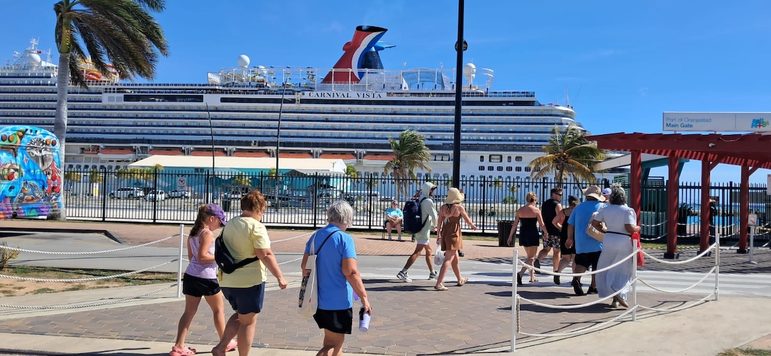
Photo by Melissa Stamper | Centro de Periodismo Investigativo
Whose island is it?
Tourism’s reach across Aruba continues to grow. Between 2022 and 2025, stay-over arrivals increased from 1.1 million to more than 1.5 million, while visitor nights rose
from 8 million to 10.3 million. In 2025 alone, Aruba recorded nearly 14 stay-over visitor arrivals for every resident on the island. Cruise passenger arrivals also climbed, from around 610,000 in 2022 to more than 970,000 in 2025. According to the ATA, alternative accommodations accounted for 39% of visitor nights that year.
For Carolyn Rasmijn, that expansion is visible in her neighborhood. She describes more traffic, late-night disturbances and homes being used for tourism-related businesses. Near her house, a residential property has been converted into an office for a car rental company, she says, with vehicles parked throughout the neighborhood. “The infrastructure isn’t designed for that many cars,” Rasmijn says.
Along Aruba’s coast, resident Lara Kuiperi worries about the impact of recreational tourism. She describes boats anchoring near coral reefs, potentially damaging marine life and endangering swimmers, as well as UTVs (Utility Terrain Vehicles) driving close to cliff edges above areas used by beachgoers.

Photo by Melissa Stamper | Centro de Periodismo Investigativo
The question of who Aruba is being developed for also extends to its culture. For Aruban singer and Go Cultura Foundation co-founder Edjean Semeleer, who has worked in the island’s arts sector for more than thirty years, tourism has influenced what local musicians perform. International songs are often favored over Aruban compositions, he says, although he understands why performers who depend on paid work adapt to their audiences.
But Semeleer questions whether tourists necessarily prefer familiar international music. During a drive through the Palm Beach area with his cultural initiative, Paranda Nacional di Dande, he brought Aruba’s traditional end-of-year music to tourists walking through the area. Some stopped to listen and join in, even though the tradition had not been adapted for them.
“What concerns me is when economic decisions carry so much weight that we risk losing influence over how our own island develops,” he says.
Maduro sees that tension reflected in how Aruba presents itself to visitors. “You don’t really see our own traditions reflected anymore,” he says. “Celebrations like Dera Gay, a traditional Aruban harvest festival celebrated in late June, are rarely visible in hotels or shops. But you do see Fourth of July celebrations.”
Who decides how much is too much?
The pressures residents describe did not emerge overnight. Marisol Lopez-Tromp, who served as Minister of Social Affairs and Infrastructure from 2001 to 2009, recalls questioning hotel expansion and its consequences for housing and migrant workers.
“For whom are you building?” she remembers asking.
Aruba had been debating the limits of tourism growth long before Lopez-Tromp entered government. As early as 1977, the island government discussed a moratorium on additional hotel rooms, citing concerns about infrastructure, employment and the pace of development.
But hotel construction accelerated after Aruba became an autonomous country within the Dutch Kingdom in 1986. According to urban planner Sam Cole, approximately ten new hotels, adding some 4,000 rooms, were built between 1985 and 2000.
By 1994, Aruba’s government had concluded that the tourism industry had reached its physical limits for further expansion. In the governing pact that year, it pledged to introduce an indefinite moratorium on new hotel construction.
In a January 1997 letter to the Dutch Parliament, the Kingdom government acknowledged growing pressure on Aruba’s labor and housing markets, as well as concerns about environmental limits. The letter also revealed that the Aruban government had promised to introduce a legally binding moratorium on the construction of hotel rooms and apartments but had not followed through. Although the moratorium was described as being in effect in practice, it had never been established in law.
Former Tourism Minister Otmar Oduber questions whether Aruba can define overtourism without an agreed benchmark, blaming successive governments for inadequate investment in infrastructure and enforcement, despite having served as Minister of Tourism, Transportation and Labor from 2009 to 2016 and Minister of Spatial Development, Infrastructure and Environment from 2017 to 2019.
“You can call it overtourism, but what have we done as a country to grow along with our only economic pillar?” he asks.
But Aruba had already examined the limits of tourism growth. In 2018, the Aruba Tourism Authority developed a carrying-capacity assessment with environmental, social and economic thresholds. It compared a volume-driven scenario involving more than 4,000 additional accommodation rooms with a higher-value, lower-impact model involving approximately 934 rooms. Several indicators, including tourism’s contribution to GDP and employment, already exceeded the study’s thresholds.
Economist Arjen Alberts concluded in his 2020 doctoral research that Aruba and Sint Maarten had already exceeded their tourism carrying capacity. Alberts is now conducting a new assessment commissioned by the Aruban government and funded by the Netherlands as part of the ‘Landspakketten’ reform program.
“Turista”
For former Nature Minister Ursell Arends, who served from 2021 to early 2025, the consequences are already visible. He points to wastewater infrastructure struggling to keep pace with development, environmental degradation and growing pressure on public space. “We are dealing with problems that have been there for decades,” he says. Arends rejects the suggestion that Aruba lacks evidence of its limits. “There are so many reports pointing to this,” he says. “You would have to be ignorant not to see it.”
While Bad Bunny’s “Lo que le pasó a Hawái” has become a warning about what tourism can do to an island, Arends draws a parallel with another song from the same album, “Turista”, about someone who enjoys a place without seeing the suffering beneath its surface.
“In my life, you were a tourist.
You only saw the best of me and not how I was suffering.”
For Arends, that is the Aruba many visitors never see.
During his time in office, Arends intervened in plans to construct a beach in front of the Embassy Suites hotel. In June 2023, he ordered work to stop after protected seagrass was disturbed. Inspectors subsequently documented machinery removing the seagrass, and a court prohibited further beach construction without the required nature protection exemption. The developer challenged the restrictions in court, but subsequent rulings overturned the beach construction permit. In March 2026, a court dismissed a further appeal concerning the required nature protection exemption because it had been filed too late.
Arends also sought to strengthen environmental protection through a proposed constitutional amendment recognizing the rights of nature and the human right to a healthy environment. The draft was published for public consultation in March 2024, but no further action has been taken to advance the proposal since then.
Despite repeated calls to limit tourism growth, development plans point to thousands of additional accommodation units across Aruba.
A review of tourism development data identifies 4,231 planned units for the period 2024–2027, with nearly three-quarters allocated to projects scheduled for 2026 and 2027. Much of the planned expansion is concentrated along Aruba’s western and northwestern coast, particularly in Noord, including the popular tourist areas of Palm Beach and Arashi, as well as nearby Eagle Beach. Other projects are planned in Oranjestad, the island’s capital, and near Baby Beach in San Nicolas, on Aruba’s southeastern coast.
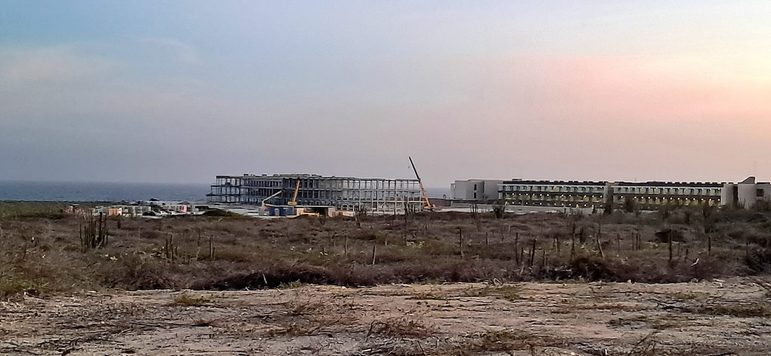
Photo by Melissa Stamper | Centro de Periodismo Investigativo
The figures reflect planned development rather than confirmed construction or completion. Even so, the scale of the plan raises questions about how Aruba intends to reconcile further tourism expansion with longstanding warnings about the island’s carrying capacity.
The government has announced a new registration initiative for vacation rentals, presenting it as a step toward greater oversight of a sector that has expanded for years with limited regulation. But the announcement does not establish a cap on vacation rentals or specify new enforcement measures to limit their growth.
Aruba has already set limits on some forms of tourism development. Under zoning regulations adopted in 2021, the centers of Oranjestad and San Nicolas are allowed a combined maximum of 100 new tourist accommodation units. But Housing, Infrastructure, Interior Affairs, and Telecommunications Minister René Herdé acknowledged that the government’s development ambitions for the two city centers exceed what the current regulations permit.
Rather than proposing a new ceiling, the government says it first wants to establish how many tourist accommodations already exist and how many more are planned before deciding how much further growth to permit.
Minister of Kingdom Relations, Education, Youth, Innovation and Sports Gerlien Croes acknowledged the pressure vacation rentals place on housing, but said the government wanted to mitigate those effects without “standing in the way of economic development.”
Minding the gap
“No, don’t let go of the flag or forget the lelolai
Because I don’t want them to do to you what happened to Hawai‘i.”
– “Lo que le pasó a Hawái,” Benito A. Martínez Ocasio (2025)
For cultural anthropologist Gregory Richardson, the resonance of Bad Bunny’s Lo que le pasó a Hawái goes beyond tourism. The song’s warning about losing one’s flag and lelolai speaks, he says, to a deeper fear of losing cultural identity.
“It’s a vibe, a cultural essence that cannot easily be measured or captured in policy,” Richardson says.
For Aruba, the question is not simply how many more visitors the island can accommodate. It is who gets to decide how the island develops, whose needs those decisions serve, and what might be lost along the way.
This story was made possible by a grant from the CPI Instituto de Formación Periodística.