



The list of “voices moving Caribbean AI forward,” as the Caribbean AI Summit described its speakers on its website, included some of Puerto Rico’s best-known politicians: Pablo José Hernández and Carlos “Johnny” Méndez.
Puerto Rico’s resident commissioner and the speaker of its House of Representatives participated in the opening session of the summit, held Oct. 9-10 at the Convention Center in San Juan. Addressing a large audience, the officials highlighted the economic potential of artificial intelligence, as well as some of its challenges. In separate interviews with the Centro de Periodismo Investigativo (CPI), both agreed on one point about the technology: “It needs to be regulated.”
“I firmly believe in the potential of artificial intelligence for Puerto Rico’s economic development and, obviously, in balancing that potential with the safeguards we need to put in place for these new technologies and the island’s future,” Hernández said after participating in a discussion titled “AI in Puerto Rico and Beyond.”
The participation of these two politicians in the Caribbean AI Summit, along with proposed legislation under consideration, reflects the growing role of artificial intelligence in Puerto Rico’s public discourse and political agenda.
Among the issues being discussed in the public policy arena are the economic opportunities the technology promises, its integration into government agencies and public services, and the possibility — and risks — of attracting data centers to the island.
Less than a week after the Caribbean AI Summit, three New Progressive Party (PNP, in Spanish) representatives who did not attend the event — Jorge “Georgie” Navarro Suárez, Jerry Nieves Rosario and Luis J. Jiménez Torres — introduced House Bill 1523. Filed Oct. 15, the measure seeks to establish the “Puerto Rico Computing and Artificial Intelligence Infrastructure Development Act” to attract data centers and encourage the expansion of existing facilities through tax incentives and special permitting procedures. The bill was referred to the House Government Committee.

Photo provided | Caribbean AI Summit
While Puerto Rico is beginning to discuss how to promote this industry, debates and controversies over the impact of data centers, which are essential to AI operations, have already had electoral consequences in the United States. According to a Ballotpedia tally, during the Nov. 3 midterm elections, voters in communities across 10 states weighed in on 41 ballot measures related to data center development. In 40 of those votes, residents favored limiting development or expressed opposition, either by approving restrictive measures or rejecting proposals that supported it.
Data centers are massive facilities that house servers that store and process digital information, including the systems used to train and operate AI models. Their construction and operation have sparked disputes in several U.S. cities over their heavy electricity and water consumption, the public incentives their developers receive and their effects on surrounding communities.
“The public is concerned about rising electricity rates caused by data centers. They are concerned about the enormous water use that data centers require,” Ben Green warned in April. Green is an assistant professor in the University of Michigan School of Information and Public Policy and a faculty associate at the Berkman Klein Center for Internet & Society. “They’re concerned about public handouts in the form of tax breaks that are going to data center developers, and they’re also aware that data centers don’t bring meaningful economic development, especially in the form of jobs.”

The overwhelming opposition to data centers was not the only setback the technology industry suffered in the midterm elections. Voters also favored virtually every Democratic Party candidate who advocated measures to regulate data centers and the expansion of AI, despite the hundreds of millions of dollars that billionaires such as Elon Musk spent supporting Republican candidates whose positions aligned with their companies’ interests.
Against this backdrop, numerous U.S. news outlets identified AI, data centers and technology executives among the biggest losers of the midterm elections. The list also included one of their staunchest supporters: President Donald Trump.
Although it is still too early to know how prominent the discussion about AI will be in Puerto Rico’s 2028 election campaign, the U.S. midterm results foreshadow some questions for local politicians: What real benefits, if any, will this industry bring? Who will bear its costs? And how will it be regulated?
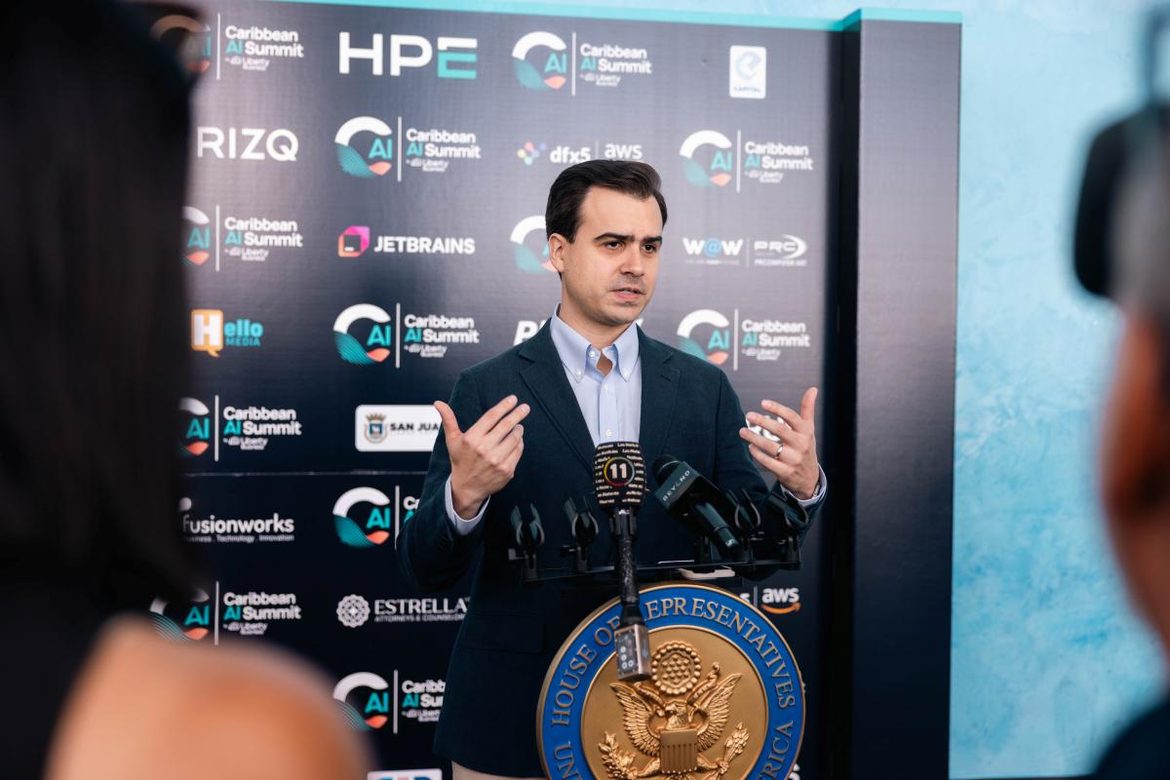
Photo provided | Caribbean AI Summit
Time to Slow Its Expansion?
Hernández and Méndez participated in the Caribbean AI Summit just over three weeks before the U.S. elections. There, in response to questions from the CPI, both expressed support for establishing safeguards and regulating AI development, although they emphasized different reasons for doing so.
“We need to create legislation that is precise and specific,” Méndez said. “I’ve never liked leaving room for ambiguity in legislation. It needs to spell out from beginning to end how [AI] will be handled, because if you leave room for interpretation, that’s where things can slip through the cracks. And when it comes to oversight, that’s how it needs to be.”
Méndez’s position clashes with that of the U.S. president and leader of the Republican Party, which the PNP lawmaker also belongs to. Since returning to the White House in 2025, Trump has insisted that his administration does not need to intervene to slow AI development, arguing that doing so would put the United States at a disadvantage against its closest competitor in the race to develop the most sophisticated and powerful AI: China.
“It needs to be regulated, period. End of story,” Hernández said when asked about Trump’s position. Hernández, who is the president of Puerto Rico’s Popular Democratic Party and caucuses with Democrats in the U.S. House of Representatives, maintained that the government should promote safeguards related to AI use to protect children, minorities and other vulnerable populations.
“We need cybersecurity measures for the government and businesses. We need measures that protect against discrimination. For example, if you decide to use artificial intelligence in the Police Department, you have to make sure that the AI — as has been the case in other jurisdictions— is not harsher on racial minorities or immigrants. Those are the kinds of safeguards we need to consider,” the resident commissioner said.
Puerto Rican attorney José David Torres, co-founder of the Puerto Rico AI Community, the nonprofit organization that organized the Caribbean AI Summit, also supported establishing safeguards. He compared the responsibility of developers of the most advanced AI models to the requirement imposed on automakers to install seat belts. In his view, products should reach users with protections already built in.
For Puerto Rico, Torres suggested starting with a bill of rights establishing basic guarantees regarding AI, drawing on policies designed to protect populations such as children and older adults.

Photo provided | Caribbean AI Summit
Torres also identified privacy as an issue that should be part of the local discussion about possible safeguards for AI technology.
“The constitutional right to privacy exists in Puerto Rico, so we have to look at how to strike that balance. That’s a discussion that hasn’t taken place yet, and it will be interesting to see how it develops in the future,” he said.
The Economic Promise and Data Centers
Hernández argued that Puerto Rico should use AI to strengthen economic activities in which it has already demonstrated knowledge and expertise.
“Artificial intelligence is, as I described it [during the discussion], a performance-enhancing drug — something that helps you do even better what you already do well. So, we have to identify what Puerto Rico does well — manufacturing, pharmaceuticals — and how we can improve those things using artificial intelligence to capitalize on that competitive advantage, along with the other incentive structures we have, such as not paying federal taxes, and so on,” he said.
However, Hernández distinguished those opportunities from the possibility of building large-scale data centers in Puerto Rico like those that have sparked protests and debates in the United States.
“I worked in the data center industry, so I know very well what kind of infrastructure it requires. Puerto Rico doesn’t have the capacity for data centers like the ones generating so much controversy in the states. And when I say it doesn’t have the capacity, it’s because we don’t have the land area, we don’t have cheap, reliable electricity, and construction costs here are too high,” said Hernández, who worked as a public policy manager at Meta, the parent company of Facebook, Instagram and WhatsApp, from 2019 to 2023.
House Bill 1523 itself acknowledges that these facilities could worsen Puerto Rico’s electricity problems. To prevent that, it would require new data centers with higher electricity demand to generate or contract for their own power to meet their needs during shortages or emergencies. Those receiving incentives as qualified computing centers would also have to maintain an additional power reserve to supply electricity to Puerto Rico’s grid.
The bill also proposes restrictions on the use of potable water for cooling, although it leaves the Puerto Rico Aqueduct and Sewer Authority (PRASA) responsible for setting the limit. Its statement of legislative intent also acknowledges that the fiscal impact of the incentives has yet to be estimated.
The measure was referred to the House Government Committee for evaluation.

Photo provided | Caribbean AI Summit
A More … Transparent Government?
Speaking with reporters after his remarks in the summit, Méndez discussed some potentially useful applications of AI in government, including audits and the review of contracts, although he insisted that final decisions must remain in human hands.
“We can’t let a machine tabulate proposals for us because it can make mistakes,” he said.
As for legislation being developed to address the impact and adoption of AI in government, Méndez said that “a lot of it has already become law.”
“Many [laws] have been passed covering electoral processes, audits and the handling of information from citizens seeking services at government agencies. Some agencies are using artificial intelligence, and certain criteria must be met,” he said. Several laws enacted between July and September of this year incorporate elements of AI or amend previous laws to adapt them to the use of artificial intelligence.
Méndez also said AI could make it easier for citizens to access public information about development projects, their proponents and the investments involved. When the CPI asked whether he thought AI could also speed up the release of public documents and transform the Transparency Act, he said it would be a matter of time.
“They can be transformed. I think so. Eventually, that will happen,” he replied.
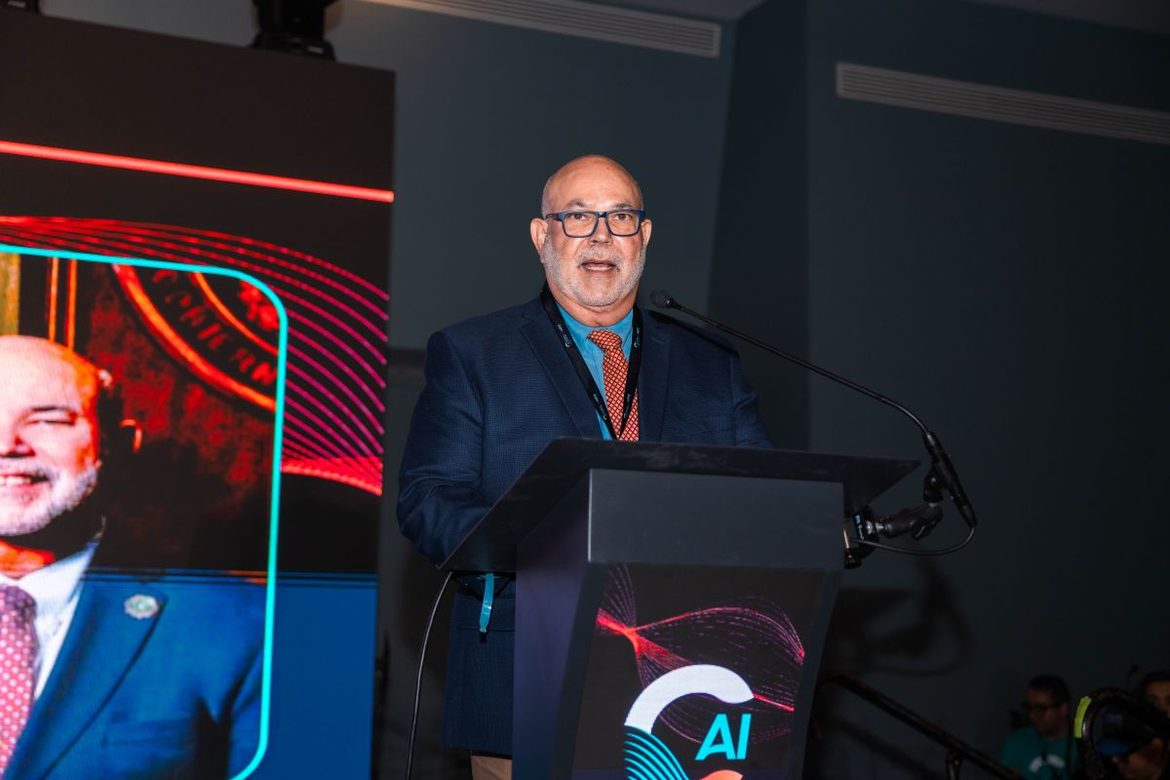
Photo provided | Caribbean AI Summit
“Don’t Let a Machine Speak for You”
Asked how knowledgeable members of the Legislative Assembly are about AI, Méndez described himself as “a novice” but noted that some of his colleagues have a greater command of the technology and even use it to prepare speeches.”
“I have colleagues who do all kinds of things with artificial intelligence, and I criticize some of them because even the speeches they give there (in the Legislature) are created by artificial intelligence, by ChatGPT and things like that. And I tell them, ‘Hey, speak for yourself. Don’t let a machine speak for you,’” Méndez said.
When the CPI asked Méndez how he could assure constituents that his remarks were written by a human rather than a machine, he replied: “Because I review them. I make my own notes and make a lot of corrections, and I make a lot of changes … a lot.”
This translation was generated with the assistance of AI and reviewed by our editorial team to ensure accuracy and clarity.