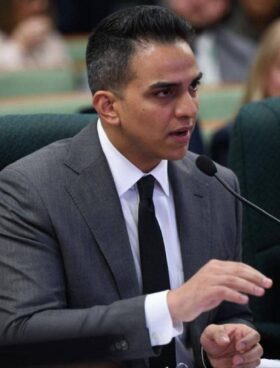


In his 21 years as a senior vice president and lead attorney at The New York Times, David McCraw said he has never seen a presidential administration that welcomes press scrutiny — only some that are better at concealing their irritation than others.
But he draws a bright line for when that irritation becomes a dangerous violation of press freedom: when governments use their power to silence journalists and interfere with their work.
McCraw wrote the book “Truth in Our Times,” which is largely about his experiences as a lawyer defending journalists during President Donald Trump’s first administration, from 2017 to 2021. Yet, difficult as that period was for the press, he said the second Trump administration has pushed abuses of power into unfamiliar territory.

“It was a very clear sign that this administration was going to play very differently from others,” he said, recalling a move weeks ago in which the Federal Bureau of Investigation raided the home of Washington Post reporter Hannah Natanson as part of an investigation into the leaking of government information. He also called unprecedented the personal lawsuits Trump has filed against multiple media outlets — including the Times — seeking damages and demanding billions of dollars in compensation.
“He is turning the machinery of government into a weapon against the press and free expression,” McCraw said. He also pointed to actions by the Federal Communications Commission targeting television comedy programs for criticism of the president, and to the Federal Trade Commission’s investigation of Media Matters over its reports on how X placed ads from major brands alongside pro-Nazi content.
That escalation comes as the press has lost something that still existed during Trump’s first term: a united front. Now, major media corporations such as Paramount and ABC News — along with content platforms like Meta and X — have chosen to settle with Trump out of court rather than fight his lawsuits. Those cases alone, he said, have added up to $63 million in payments to the president.
“The fight for press freedom is more solitary than it once was,” McCraw said in an interview ahead of his participation Monday and Tuesday, March 16-17, in two events presented by the Centro de Periodismo Investigativo (CPI) as part of Sunshine Week, the annual initiative focused on government transparency. On Monday afternoon, he will deliver a keynote address, “When the state seeks to silence the press.” On Tuesday morning, a breakfast and conversation — “A behind-the-scenes look at the legal fight for press freedom under Trump” — will offer a more direct opportunity to engage with the attorney.
Authoritarian actions are not the exclusive domain of the U.S. presidency. They happen in Puerto Rico, too — and both the Times and the Centro de Periodismo Investigativo have had to turn to the courts to push back against efforts to punish the press by limiting access to places where news is made.
Two weeks ago, lawyers argued the Times’ lawsuit over new Pentagon coverage rules that effectively drove every established news organization out of the agency’s press room after they refused to accept them. The rules include revoking press credentials if a reporter speaks with anyone other than an official spokesperson. In practice, McCraw said, the message is that “asking questions can be punished by the government — and that’s just wrong.” The government tried to justify the policy on national security grounds, but, he added, “the press has been at the Pentagon since the day they built it, and there has never been an incident where a member of the press has endangered national security — and they admit that.”
In the CPI’s case, Superior Court Judge Iris Cancio González ruled last month that barring CPI reporters from the governor’s news conferences because they lack a certification from the Puerto Rico Department of State violates their freedom of the press. The certification’s only purpose, she noted, is to authorize special press license plates. The government has said it will appeal the decision.
For McCraw, who has been closely following that case and other challenges facing the press on the island — including recent amendments to Puerto Rico’s Transparency Act that make it harder to obtain public records — the threat of continued litigation is senseless.
“You would expect the government to understand there are more important things than winning a lawsuit,” he said. “What this ruling asks them to do isn’t harmful in any way — it’s simply to recognize that reporters have a right to be there. … Officials need to do a better job of remembering they work on behalf of the public.”
In his experience, there is still reason for optimism: judges — liberal and conservative alike — have generally protected the bedrock principles of free speech and a free press. But McCraw did not hide his concern that a sustained barrage of government attacks on journalism could erode that tradition.
“Judges are the last line of defense against government overreach,” he said. “Every government will try to take advantage of the power it has, and the judge becomes the safeguard that prevents that. I would tell them to take this very seriously — these cases matter.”