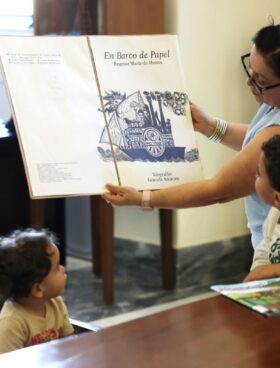


The eyes of a dozen children, all just 4 years old, remain fixed on En barco de papel, the book Santia Bauzá Santiago is reading to them in the Eugenio María de Hostos Room at the Puerto Rico National Library.
They have come from a nearby preschool in Puerta de Tierra, a San Juan neighborhood, and wait eagerly for the storytelling performance of La travesía de Martina in the Children’s Literature Room. There, Teresa Marichal Lugo has arranged her props: several books, a record player, a model of Martina’s house and a kamishibai, or paper theater.
As part of National Library Week, the puppeteer and playwright welcomes the children, who immediately settle onto a foam mat covered with colorful letters and numbers.
Six years ago, reading and storytelling activities like these would have been unthinkable during the COVID-19 pandemic. Instruction was confined to computer and tablet screens, deepening early-grade reading gaps that had already been documented for years. The Puerto Rico Department of Education has known about the problem since at least 2018, when it was identified in a study by the Puerto Rico Institute of Statistics and Flamboyán Foundation.
The problem is not unique to Puerto Rico. The U.S. public education system entered a “learning recession” as early as 2013, according to a recent study by researchers at Stanford, Harvard and Dartmouth universities.
“In reading, the average annual decline in achievement before the pandemic, from 2017 to 2019, was just as large as it was during the pandemic, from 2019 to 2022,” the report said. “Afterward, math achievement immediately began to recover. … In reading, however, achievement continued to decline through 2024.”

Photo by Brandon Cruz González | Centro de Periodismo Investigativo
“The curtain opens,” and Martina appears, stretching in front of the balcony after waking up. At Teresa’s urging, the children call out their greetings. Each time Martina rejects a suitor, some point upward with their index fingers and chant, “No, no, no.”
Others begin to lose interest in the story and play with the letters and numbers on the mat, but everyone applauds the wedding of Martina and Pérez. At the end, the storyteller places Martina’s little house in the center of the room, and the children crowd around to look inside. After examining the house, only two turn to the books beside the record player.
Activities like this are among the efforts outside the classroom intended to strengthen reading skills during the earliest stages of education.
Reading proficiently by the end of third grade is associated with students’ future academic success. That benchmark is critical because, beginning in fourth grade, classes become more technical and focus on specific subjects with increasingly complex vocabulary.
Several experts interviewed for this story said children who enter fourth grade without strong reading comprehension will probably struggle, making it difficult for them to demonstrate academic achievement or progress.
In Puerto Rico, the Education Department began administering reading assessments only four years ago. Private schools are not required to give the tests, making it difficult to compare scores and determine which strategies work best.
Another Flamboyán Foundation study, for which the organization administered tests to public and private school students in San Juan during the 2016-17 academic year, found that “public school students faced substantial disadvantages in family income and parental education compared with their private school counterparts,” placing them at high risk of falling behind in reading.
Today, 78% of Puerto Rico’s elementary and secondary school students attend public schools, according to the latest available estimate from the U.S. Census Bureau’s American Community Survey.
The Education Department evaluates basic reading skills in first through third grades through reading mechanics assessments made up of seven subtests. The assessments do not measure reading comprehension.
According to Flamboyán Foundation’s assessment guide, reading comprehension involves “interpreting and constructing meaning through written language.” The nonprofit organization promotes reading proficiency among students beginning in the earliest grades.
Results from three years of testing, from 2022 through 2024, show that public school students made only minimal progress in reading. An analysis by the research firm Datos en Perspectiva concluded that “student performance shows sustained improvement.” But the annual rates of change reflect rapid initial progress followed by a moderate decline.
Results on the reading fluency subtest remained nearly unchanged across all grades between 2023 and 2024. In 2025, only 14% of first graders met the Education Department’s standard of reading at least 50 words per minute, compared with 13% in 2024.
“I have had first-grade students who basically don’t speak,” said Marielena Arrillaga, who has worked for five years as a guide in Taller 1, the Montessori program for first through third grades, at La Nueva Escuela Montessori Juan Ponce de León in Guaynabo. “How can I expect them to read and write when they don’t speak? Exposure to language has to happen at home as well as at school.”
In second grade, only 20% of students met the 80-word-per-minute reading fluency standard in 2024, compared with 21% the year before. Among third graders, 39% met the 90-word-per-minute standard in 2025, compared with 40% in 2024.

Photo by Brandon Cruz González | Centro de Periodismo Investigativo
Regina Silva, who has worked for 26 years as a guide in Taller 2, the Montessori program for fourth through sixth grades, at La Nueva Escuela Montessori Juan Ponce de León, said she has seen “a little improvement in reading mechanics over time.”
“They can decode what the text says, but I see them falling behind in reading comprehension — in how they process and connect what they are reading,” Silva said.
“At the Asociación de Maestros de Puerto Rico, we view the reading deficit as an educational and national emergency,” said Raúl González Colón, vice president of the teachers union.
An Inconsistent Focus on Reading at the Education Department
“As long as we emphasize mechanics rather than comprehension, Puerto Rico will always have problems with reading,” said Ruth Sáez Vega, a professor in the University of Puerto Rico’s School of Education at the Río Piedras campus.
“The education secretary changes, and suddenly the curriculum changes, the approach changes and the priorities change,” she said. “But reading must always be a priority — period. I suspect that if we administered reading comprehension tests, we would do worse.”
Beginning in the 2023-24 school year, the reading assessment included a retell subtest to determine whether Education Department students understood what they read, said Julián Laboy, an industrial psychologist and co-founder of Datos en Perspectiva.
“You read something, and then we see whether you can retell it,” Laboy said. “The assessment scale runs from 1 to 4.”
On the first retell subtest, which measures whether students can narrate, paraphrase or recount in their own words what they have just read, first graders did not reach even half of the maximum score of 4. Third graders averaged 3.2. During the 2024-25 school year, the average for third graders remained unchanged, while the second-grade average declined and first graders showed a slight improvement.
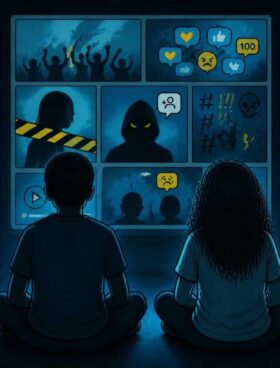
“Our children are being overstimulated by technology and excessive screen use. They don’t want to read,” said Metzarie Pérez Díaz, who has taught kindergarten and first grade for four years at Luis Muñoz Rivera School in Las Piedras.
“I think about the older grades, when they start assigning novels,” she said. “If the novels are on YouTube, do you think they are going to read them?”
Two years ago, the Netherlands banned smart devices in schools and subsequently saw improvements in students’ concentration and academic performance, according to a government-commissioned study of 317 secondary schools.
Since last year, Swedish elementary schools have not been required to use digital tools or devices. Meanwhile, parent and teacher movements in the United States have successfully pushed four states to reduce screen time.
Florida banned students from using cellphones in school in 2023. By the end of 2024, students had improved their scores on standardized math and reading tests compared with the exams they took a year before the law took effect.
Since Act 185 was enacted six months ago, Puerto Rico has prohibited public school students through eighth grade from using personal electronic devices on school grounds. The use of those devices for instruction, however, remains permitted.
Jessica S. González Hernández, senior director of Flamboyán Foundation’s K-3 Reading Program, said the sectors that make up the education system lack a shared commitment to sustaining and defending literacy as a priority.

Photo provided
“When all sectors understand that literacy is important, they create pressure on the government to direct funding appropriately toward that priority,” González Hernández said. “But if today’s priority is STEM — science, technology, engineering and mathematics — tomorrow’s is bilingual education, the next day’s is entrepreneurship and the following year’s is something else, then the funding will keep shifting with those priorities.”
A 2018 study by Flamboyán Foundation and the Puerto Rico Institute of Statistics on literacy learning in the early grades of Puerto Rico’s public schools recommended that the Education Department “create a comprehensive and integrated system for assessing reading progress in grades K-3.”
But the reading mechanics assessments were not introduced until five years later, in 2023.
In addition to launching the assessments that year, the Education Department established the DE Leer initiative through a circular letter. The program sets aside one hour for reading every Wednesday during homeroom to “develop and refine reading proficiency.”
In late 2024, the department formally recognized literacy as a priority by publishing a manual to promote reading. In 2025, it published a series of workbooks and a guide to continue the effort.
“There have been efforts to set aside periods during the school day for reading, but what happens during those periods will not necessarily help students become better readers,” Sáez Vega said.
“It is not simply a matter of designating a period,” she said. “You have to make sure that the best-prepared professional is working with those children during that time and that the activities have been planned with a clear purpose.”
González Colón, the union vice president, agreed.
“We cannot say the department has made no adjustments, but we need measurement and transparency,” he said. “The goal is not to single out the schools that are doing the worst, but to see how we can compare and improve those specific results.”
Proposed Reading Proficiency Act Has Languished
The Popular Democratic Party caucus in the Puerto Rico House of Representatives introduced legislation in August 2025 that would make the development of reading proficiency among public school students a public policy priority.
That same month, House Bill 812 was referred to the House Education Committee, where it has remained stalled for nearly a year.
Three days before House Bill 812 was introduced, Education Department Deputy Secretary for Academic Affairs Beverly Morro Vega told the Senate Committee on Education, Art and Culture that “reading is already an institutional priority established under Act 85 of 2018 and reinforced through various academic initiatives.”

Photo provided
The public hearing at which Morro Vega testified was held as part of an investigation by the Senate Education Committee. The committee concluded that “the progress achieved in reading mechanics is relevant but insufficient” and recommended “declaring reading and writing proficiency in grades K-3 a priority public policy and the organizing principle of the curriculum.”
House Bill 812 would also prohibit schools from promoting students to fourth grade if they have not demonstrated the reading ability expected at their grade level, based on the Education Department’s reading assessment results.
“If a student does not know how to read in first grade, that student should remain in first grade,” said Pérez Díaz, the teacher from Las Piedras. “By third grade, the gaps are already there.”
Silva, however, said a test result “shouldn’t be the only criterion used to determine whether a child remains at that level.”
“When a child is held back at the same level or grade, we may be punishing them for something that is not even their fault,” she said.
Puerto Rican Independence Party Rep. Nelie Lebrón Robles questioned the Education Department’s work on reading.
“What has happened that previous generations reached third grade knowing how to read, and now they don’t?” she asked.
Lebrón said much of what House Bill 812 proposes “is already covered by the Education Department’s enabling statute.”
“For example, students aren’t supposed to be promoted to fourth grade if they don’t know how to read,” she said. “The question we have to ask is why they are being promoted.”
Department policy states that students in first through fifth grades who fail two or more subjects must repeat the grade. A D is a passing grade.
What Teachers Have to Work With
All kindergarten-through-third-grade classrooms in Puerto Rico’s public school system have the materials and texts needed to promote reading, Indhira Castro, manager of the Education Department’s Early Childhood Education Program, told Centro de Periodismo Investigativo.
But Pérez Díaz said she did not receive textbooks or storybooks this year, unlike in previous years.
On the first and fourth Wednesdays of each month, she dedicates an hour to reading, as recommended by the DE Leer initiative.
Three school principals consulted by Centro de Periodismo Investigativo said the DE Leer policy is being followed. They said it is reflected in teachers’ weekly lesson plans and in the activities incorporated into school calendars.
González Colón said the materials the department sends to schools must be accompanied by instructional initiatives.
“It cannot be a matter of distributing material just for the sake of distributing it,” he said. “What are we going to do with it? What will the follow-up be? How will we measure it? All of that has to be included and planned.”
“Otherwise, it’s just a matter of buying materials and saying, ‘Today we spent this much money on this,’ without following up.”
Arrillaga, the guide at La Nueva Escuela Montessori Juan Ponce de León, received books and texts this year that “we can use in connection with the curriculum.”
“But when it comes to storybooks, there’s a challenge,” she said. “They can be requested, but they don’t always arrive.”
Arrillaga, who works at the first public Montessori school in Guaynabo, said the texts do not always have “a context that is relevant to the student, so they don’t spark interest.”
Her colleague, Silva, said her students “had a very basic reading level,” and the novels assigned for Taller 2 were too difficult for them.
“We bought a set of simpler novels ourselves so they could participate in literature circles,” Silva said.
At Juan Ponce de León School, the literature circles are organized so that “each classroom has its own novel, and we rotate them.”
“If I read La niña que llegó del mar this year, for example, I pass it on to another classroom, and they lend me La gaviota y el gato que le enseñó a volar,” Silva said.
In her “environment,” the Montessori term for a classroom, Arrillaga sets aside an hour every afternoon for literacy.
“During that period, they read or write,” she said. “It might be group reading, where I read a story and then we do an activity, or individual reading followed by a writing activity. It creates a really wonderful dynamic among them.”
Arrillaga has seen how students between the ages of 6 and 8 “are patient with one another, applaud one another and help one another.”

Photo by Tatiana Díaz Ramos | Centro de Periodismo Investigativo
Current teacher training programs do not guarantee mastery of the essential practices needed to teach reading in the early grades. So, the Senate Education Committee recommended amending the Teacher Certification Regulations to require university-level training and demonstrated proficiency in evidence-based practices.
The committee, chaired by New Progressive Party Sen. Brenda Soto, also recommended establishing “mandatory annual professional development for K-3 teachers.”
All the teachers interviewed by Centro de Periodismo Investigativo said they were open to certifications or professional development that could improve their teaching. They agreed, however, that the workshops offered by the department do not always meet expectations.
“We attended one on literacy that was excellent, extremely relevant and gave us many new strategies,” Silva said. “But I can also tell you that some of the department’s contractors can be the stuff of horror stories.”
“I cannot say I have ever left a workshop thinking, ‘Wow, I learned so much,’” Arrillaga said.
González Colón said that even when teachers receive training, “real change happens when they can consistently carry out their lesson plans.”
Morro Vega said teachers who specialize in early childhood education as part of their bachelor’s degree already complete requirements in reading instruction and professional practice, making an additional requirement or certification unnecessary.
In a telephone interview with Centro de Periodismo Investigativo, she also noted that about 1,939 kindergarten-through-fifth-grade teachers participated in the Literacy Academy between 2023 and 2025, earning certification in essential practices for teaching reading.
The academy is an initiative of the University of Puerto Rico, Flamboyán Foundation and the multisector coalition ¡Todos a leer!
Castro said the Early Childhood Education Program will launch the federally funded “Apoyo al maestro promotor de lectura,” or “Support for Teachers Who Promote Reading,” project in August. The program will assign reading-specialist tutors to support teachers. The grant is subject to annual renewal for up to three years.
Puerto Rico Education Secretary Eliezer Ramos Parés was unavailable for an interview by phone or in person but provided a statement saying he considers the assessment results positive and that they “demonstrate the effectiveness of the initiatives the Department of Education has been implementing.”
He acknowledged, however, that there is room for improvement.
“We recognize that challenges remain, and we’re addressing them comprehensively through academic strategies, teacher training and support programs designed to strengthen reading skills at every level,” Ramos Parés said.
He also said “strengthening the collaboration with the ¡Todos a leer! coalition has been a valuable tool in continuing to advance initiatives that promote a culture of reading in our schools.”
This translation was generated with the assistance of AI and reviewed by our editorial team to ensure accuracy and clarity.