
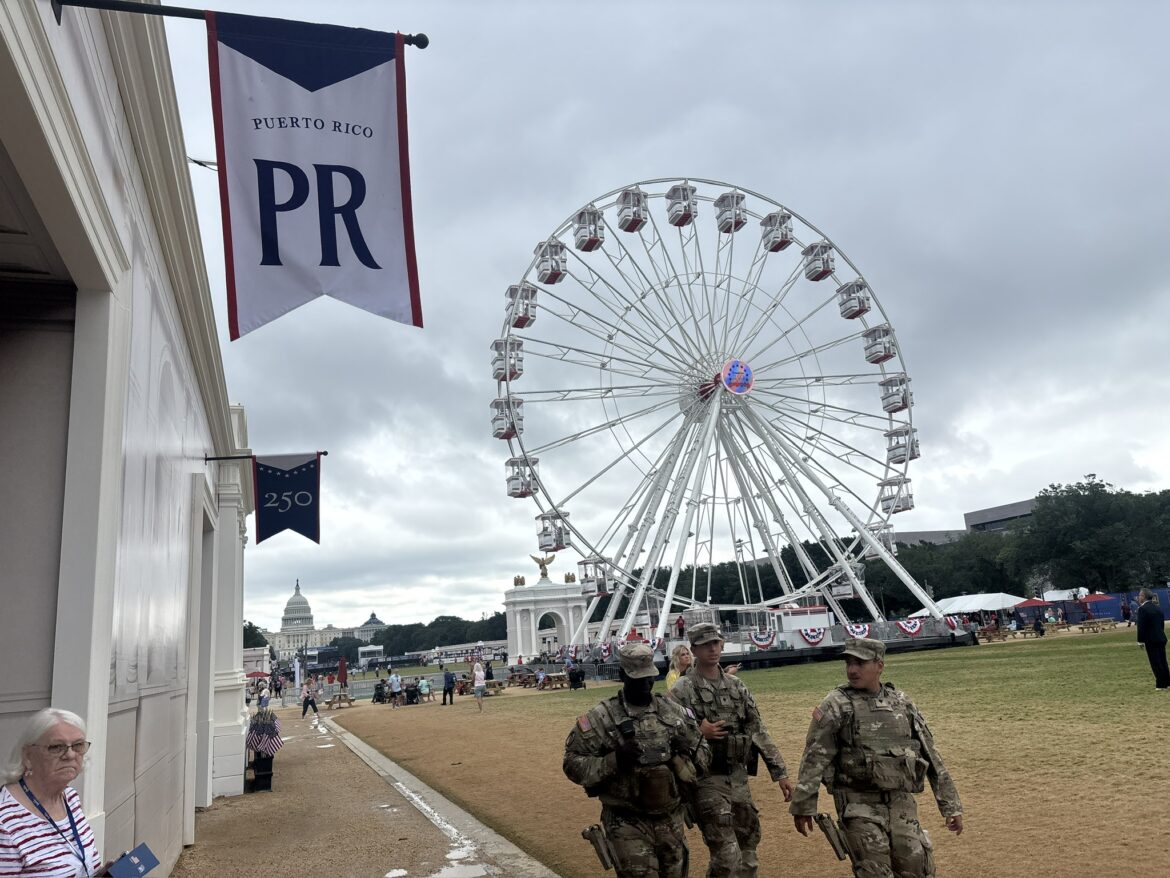

On July 9, the next-to-last day of the Freedom 250 Great American State Fair, visitors make their way along the National Mall in Washington, D.C., usually in family groups. The Trump administration organized the theme park-style fair to commemorate 250 years of U.S. independence. The sky is clear, there is barely a breeze, and the temperature will climb to 84 degrees Fahrenheit. At the fair, each of the 50 states and several U.S. territories has a pavilion — a space roughly the size of a two-car garage — showcasing what they believe makes them unique within the United States.
The Puerto Rico government allocated $272,891 through the Puerto Rico Tourism Company to participate in the fair, the agency confirmed to Centro de Periodismo Investigativo (CPI). At least 10 states, meanwhile, declined to participate, partly because of the cost.
Massachusetts, Connecticut, Maine, Rhode Island, Vermont, Illinois, North Carolina, Oregon and Washington declined to take part, according to Newsweek. American Samoa, the U.S. Virgin Islands and the Northern Mariana Islands — territories under U.S. political control that were invited to participate — neither sent delegations nor operated pavilions, CPI found.
In some cases, the fair became a display of political resistance: Every state that stayed away has a Democratic governor. In addition to the cost, Democratic politicians such as Pennsylvania Gov. Josh Shapiro cited the Great American State Fair’s partisan and politicized nature as a reason for not participating.
A Group of 21 Government Employees Sent to the Pavilion
At least 21 public employees from Puerto Rico government agencies staffed the island’s pavilion. They included Gabriella Boffelli, executive director of the Puerto Rico Federal Affairs Administration, known as PRFAA, and César Marín Massini, PRFAA’s public relations director.
The officials assigned to the pavilion came from agencies as varied as the Automobile Accident Compensation Administration, the Puerto Rico Electric Power Authority, the State Insurance Fund Corporation, the Department of Transportation and Public Works, the Puerto Rico Highways and Transportation Authority, the Puerto Rico Department of State, the Institute of Puerto Rican Culture and the Puerto Rico Tourism Company.
Arturo Garffer, secretary of the Puerto Rico Department of Public Safety, also visited the pavilion. Garffer was already in Washington attending other official meetings, so the Tourism Company did not incur any expenses for his trip to the city, the agency told CPI.
Verónica Ferraiuoli, executive director of the Puerto Rico Convention District Authority and the Puerto Rico government’s efficiency coordinator, was another government official who visited the pavilion. She was not included on the Tourism Company’s list, provided to CPI, of Puerto Rico government employees who participated.
Ramón Díaz, a “sommelier and ambassador” for Rums of Puerto Rico, a program of the Puerto Rico Department of Economic Development and Commerce, is shown speaking from the pavilion in a video posted to PRFAA’s Instagram account. Díaz also does not appear on the list of government employees or guests sent to the pavilion.
The CPI asked the Tourism Company whether the budget allocated for the pavilion covered the travel, payroll, per diem and lodging expenses of the public employees who participated in the fair, but the agency did not respond.

Photo by Joel Cintrón Arbasetti | Centro de Periodismo Investigativo
“Puerto Rico’s participation in this event is intended to promote and highlight the island’s principal contributions to the United States and raise its profile among thousands of visitors from around the world,” Marín Massini told CPI.
PRFAA’s main objectives at the fair, Marín Massini added, were to promote Puerto Rico as a tourist destination, highlight Puerto Rico’s contribution to the U.S. military and showcase its pharmaceutical industry as “America’s Medicine Cabinet,” emphasizing its strategic role in producing medications essential to the United States.
Another goal was to “promote Puerto Rico’s rum industry as one of the island’s leading exports and a fundamental part of its cultural and economic identity, and to showcase Puerto Rico’s historical, cultural and artistic wealth to visitors.”
Puerto Rico in the American South
Judging by the order of the side-by-side pavilions, if Puerto Rico were a state, it would be part of the American South. It would also be the poorest state by median household income. Under that logic, it seems entirely fitting that Puerto Rico’s pavilion shares a wall with Mississippi, the poorest state by median household income, which in turn shares a wall with Louisiana.
Puerto Rico’s pavilion is the first in the row of Southern states, and it bears no emblem distinguishing it as a country, colony or territory. At the fair, then, the statehood movement’s dream of equal integration into the American nation comes true, at least for some.
Puerto Rico presents itself as just another state at the Freedom 250 Great American State Fair, a grandiose temporary world of simulations. Its visitors confirm as much: They see nothing unusual about a Caribbean island appearing there among the Southern states.
Even some children and teenagers recognize it. They point up at the white banner above the entrance and excitedly call out, “Puerto Rico!” in American accents. As though the island itself were really behind that door. Or the tropical paradise they imagine.
Here, it is clear that Puerto Rico is a global brand in vogue, even among this crowd, some of whom wear Donald Trump T-shirts and clothing associated with the Make America Great Again, or MAGA, movement.
A Military Deployment with Puerto Rican Support
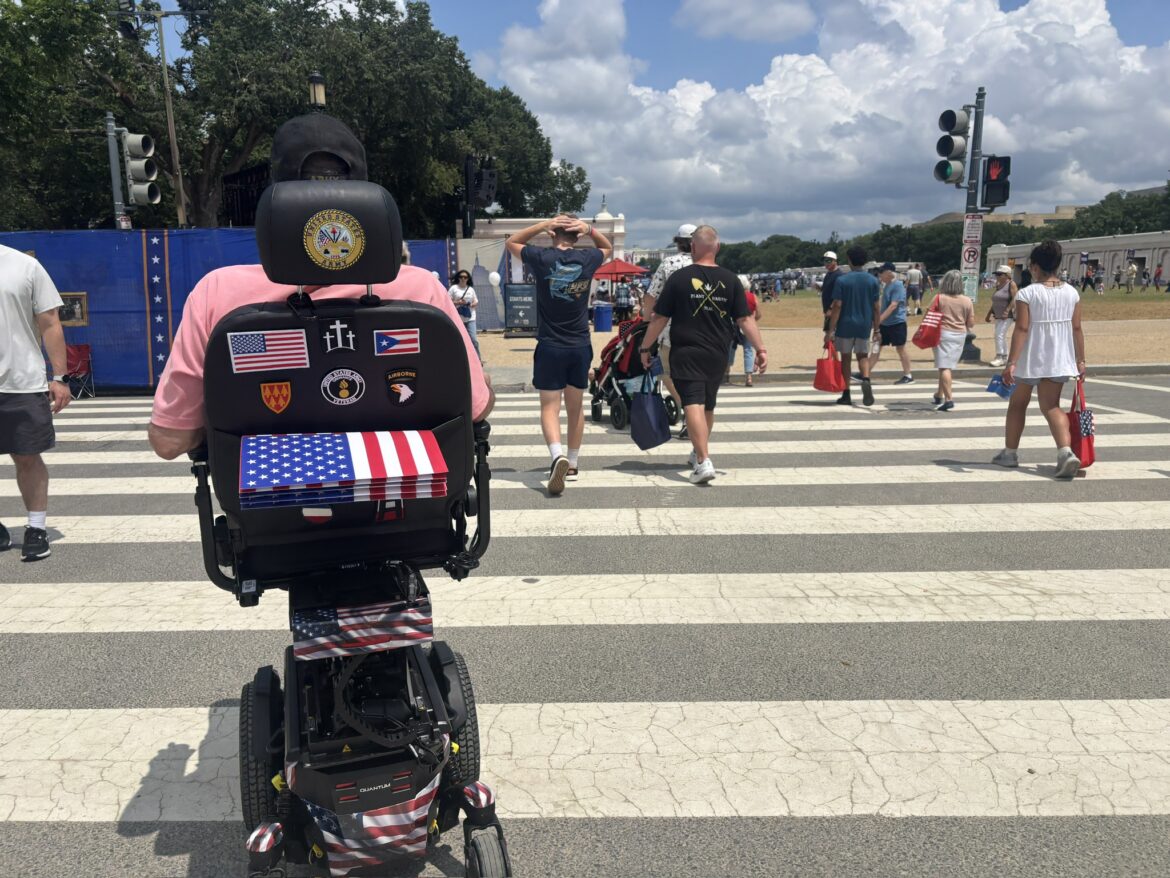
Photo by Joel Cintrón Arbasetti | Centro de Periodismo Investigativo
I arrived in Washington by train from Philadelphia, the city where the U.S. Declaration of Independence was signed in 1776 — the event this fair commemorates. During the 20-minute walk from Union Station to the National Mall, I see streets blocked by armored military trucks and National Guard members.
They monitor the sidewalks as office workers and large groups from summer camps pass by. A woman in military uniform yawns beside a food truck. The man beside her grips the camouflage bulletproof vest he is wearing with both hands.
The urban military deployment now appears to be part of the Freedom 250 Great American State Fair’s scenery. But these troops have been here since before the fair opened June 25. They are among the more than 4,500 military personnel deployed in the city by the Trump administration under the “D.C. Safe and Beautiful Mission.” “More than 150 Puerto Rico National Guard soldiers” are participating in the operation, PRFAA told the CPI.
Several government officials took advantage of the military spectacle and the fair’s staging to record videos and pose for photos that they later posted on social media. Garffer, Puerto Rico’s public safety secretary, spoke with several soldiers on the street during a June 29 visit to the fair.
Someone photographed him, and the image was posted to the agency’s Facebook page with this message: “The secretary, who is participating in the Great American State Fair, recognized the soldiers’ commitment, discipline and service as they contribute to the safety and well-being of the communities where they are called to serve.”
Garffer, wearing jeans, a plaid shirt and a cap commemorating the 250th anniversary of U.S. independence, also recorded a video from Puerto Rico’s pavilion. Boffelli, PRFAA’s executive director, introduces him in the video. Her agency was responsible for managing the pavilion. Ferraiuoli, executive director of the Convention District Authority and the Puerto Rico government’s efficiency coordinator, also appears.
“We’re here supporting PRFAA, the executive director and all the Puerto Rico government employees who are here showing the thousands and thousands of people who have passed through what Puerto Rico is all about,” Ferraiuoli says in the video posted to PRFAA’s Instagram account.
Freedom 250: A Fair Tailored to Trump’s Taste
The fair runs the length of Washington’s iconic landscaped park, with its green lawn, Reflecting Pool and, in the distance, the Washington Monument, that towering white obelisk. Farther back on the horizon, through the summer haze, is the dome of the White House.
The state pavilions line the edges of the path, standing wall to wall. They are prefabricated cubicles finished in a faux neoclassical — or fake neoclassical — architectural style. They look like a cheap imitation of neoclassical design: white facades made to resemble marble. Their Greek columns are merely images printed on vinyl wall coverings, wrinkled in places in ways that betray the artificiality of this theme park devoted to the America imagined by U.S. Republicans.
A decade ago, in a bipartisan effort, Congress created America250 to plan the nation’s anniversary. But the Trump administration abandoned that entity and created the nonprofit Freedom 250 in December 2025. Freedom 250 received $68.3 million in public funding through the National Park Foundation, of which it is a subsidiary, the CPI confirmed through https://www.usaspending.gov/.
The event’s website says that, in addition to public funding, Freedom 250 received corporate donations from UnitedHealth Group, Lockheed Martin, Palantir and Boeing, companies that hold contracts with the Trump administration.
Freedom 250 financed the fair’s overall operations, including its infrastructure. Each state was responsible for the interior design and exhibits in its pavilion, as well as employee travel expenses and salaries, CNN and NPR reported.
The fairgrounds on the National Mall are fenced off. Visitors must pass through a security checkpoint to enter. Backpacks are prohibited. So are pens and pencils, which apparently are considered potential weapons at the Freedom 250 Great American State Fair.
The man at the security checkpoint, who was Black, like nearly everyone else guarding the fair’s entrance, took my pen and tossed it from a distance into a trash can, using the same motion a basketball player uses to shoot the ball into the hoop.
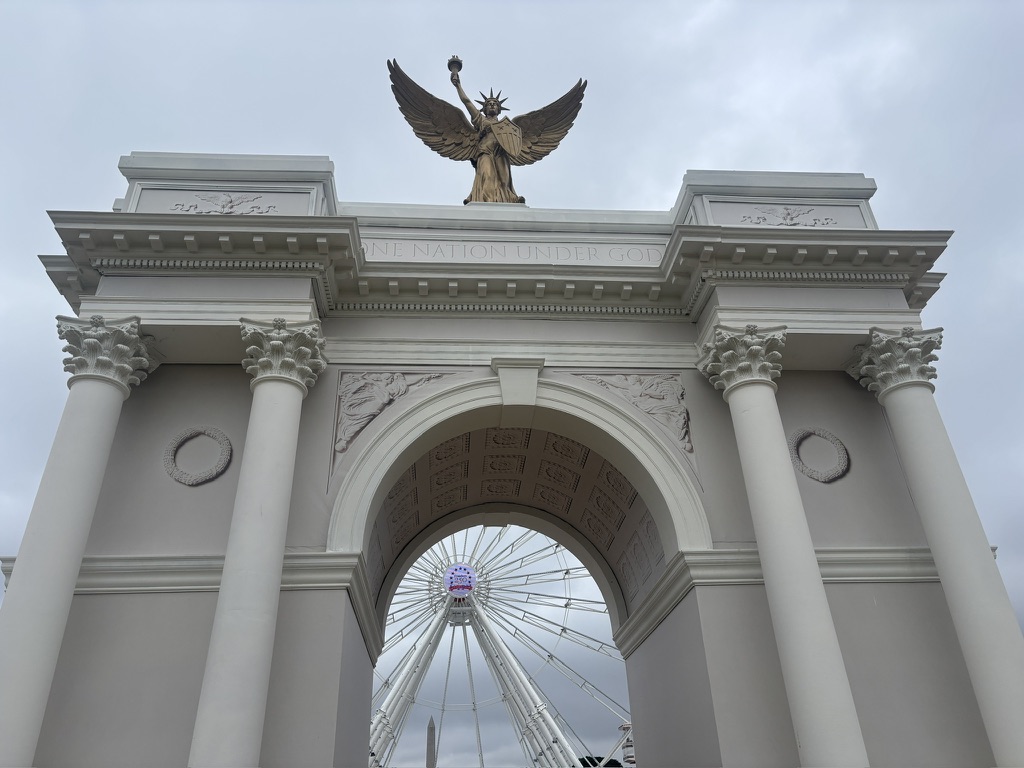
Photo by Joel Cintrón Arbasetti | Centro de Periodismo Investigativo
The first thing that catches the eye upon entering the fair is a replica of an Arc de Triomphe-inspired monument that Trump commissioned in 2025 to celebrate the 250th anniversary of U.S. independence. The fair’s replica is a scaled-down version of the proposed monument, which is expected to stand 250 feet tall — about 50 feet shorter than the Statue of Liberty — and would be erected in Lady Bird Johnson Park, an island in Washington’s Potomac River. At the top of the arch is a gold-colored statue of an angel resembling a winged Statue of Liberty, flanked by two eagles.
Passing beneath the arch leads to an avenue visitors must cross to “enter the United States” — that is, the pavilion area.
Larger than the arch replica is the Ferris wheel, an enormous ride that immediately evokes the striking spectacle of Coney Island in New York. Here, however, the Ferris wheel lacks the glow it has at Coney Island, other fairs and Puerto Rico’s patron saint festivals. The Freedom 250 Great American State Fair’s Ferris wheel is a monotonous white circle, unlit and devoid of charm. The people waiting to ride it do not look excited.
Those who do appear excited and expectant, despite sweating in the heat, are the dozens of people forming the longest line at the entire event, outside Florida’s pavilion. The reason for the commotion is that visitors receive a small, free, alligator-shaped plush toy when they enter.
Curious though I was, the long line kept me from entering Florida, the state with the largest Puerto Rican population. But I was able to visit other Southern states, including the “unincorporated territory” of Puerto Rico.
Jenniffer González’s Image Dominates the Pavilion
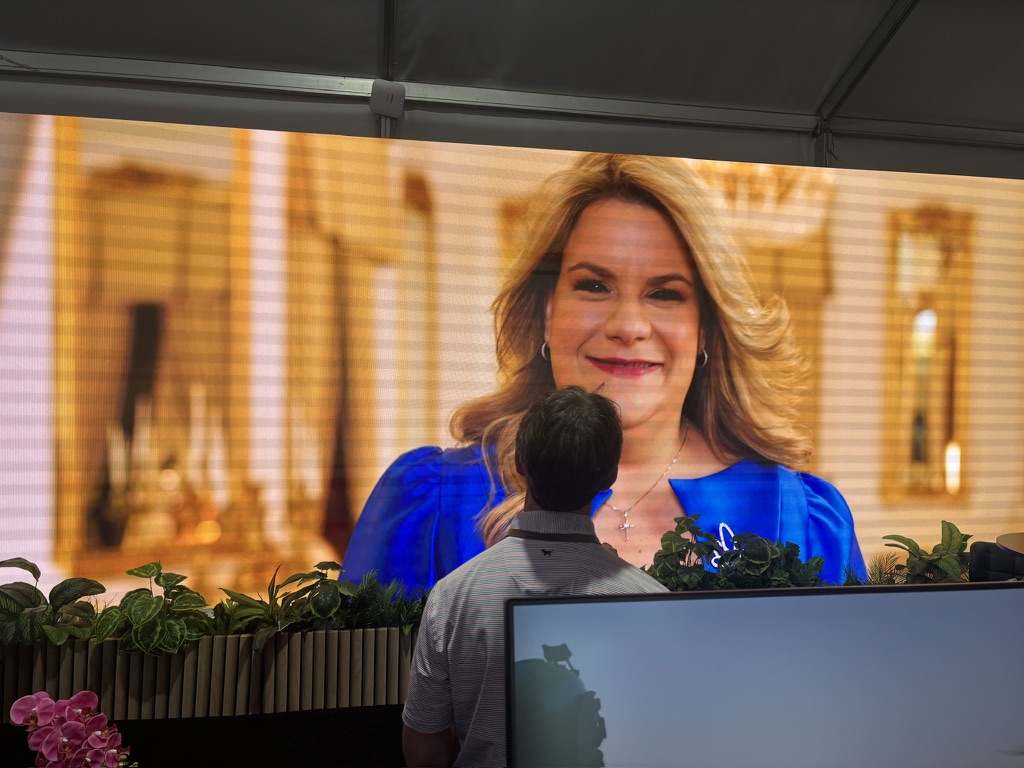
Photo by Joel Cintrón Arbasetti | Centro de Periodismo Investigativo
The first thing I see upon entering Puerto Rico’s pavilion is an image of two service members carrying long guns as they run along a rugged trail. The footage is part of a video playing on a giant screen at the back of the room.
After the military training footage comes a rapid sequence of high-definition images showing the wind turbines in Santa Isabel and scenes of agricultural, industrial, pharmaceutical and port activity. They are followed by San Juan’s Golden Mile financial district, the Tren Urbano rail system, the José Miguel Agrelot Coliseum, known as the Choliseo, natural landscapes, culinary arts, El Morro fortress, the sea and people snorkeling.
Gov. Jenniffer González Colón appears repeatedly between those images. She is shown in close-up, wearing a blue suit and walking through La Fortaleza, the governor’s official residence. Then she appears in a medium shot outdoors, smiling.
The governor again, this time smiling alongside other officials, holding scissors and cutting a blue ribbon bearing the Puerto Rico Tourism Company’s logo. The governor in profile, delivering a speech at the Capitol. An image of a cellphone streaming live video from a Jenniffer González account. On its screen, the governor is giving a speech.
Video by Joel Cintrón Arbasetti | Centro de Periodismo Investigativo
The two side panels that form the pavilion’s walls feature navy blue squares displaying Puerto Rico’s coat of arms. Beneath them are the words: “Government of Puerto Rico, Jenniffer González Colón, Governor of Puerto Rico.”
At the fair, I have already visited the pavilions of Mississippi, Alabama, Louisiana, Georgia, the territory of Guam, Kansas, Nebraska, Nevada, North Carolina, North Dakota, Oregon, South Dakota, Tennessee, Texas, Utah and Wyoming. I saw no images of their governors in any of them. Their names appear nowhere.
Many are picturesque pavilions that showcase their industries, tourist attractions and cultural contributions in an amusement park-like setting. Puerto Rico’s pavilion, by contrast, feels more like a cross between a propaganda room at La Fortaleza and a souvenir shop at Luis Muñoz Marín International Airport.
Nothing here is for sale except an image of the island: productive, supplying troops, athletes and labor to the industries of the American nation.
In the middle of the pavilion, three computer monitors sit atop pedestals, displaying favorable data about Puerto Rico’s economy and other aspects of the island. Four employees assist visitors. I ask one whether she works for PRFAA or the Tourism Company. She smiles but does not answer.
A No. 21 Roberto Clemente jersey — Clemente played for Pittsburgh — and a military fatigue uniform hang side by side on one wall. Beneath them is a shelf holding a photograph of Clemente, a box of Bacardí rum and packages of Gustos coffee. Farther down is a cabinet containing bottles of Advil and Tylenol beside medical devices manufactured in Puerto Rico.
Olga Tañón’s song “Es mentiroso” plays at full volume in the background. Visitors keep streaming in, and their favorite pavilion attraction is a virtual salsa lesson displayed on a vertical screen resembling a wall mirror. They stand in front of the screen, read the instructions and try to follow the movements of the woman dancing in the video. A glitch freezes the image for several seconds, interrupting the rhythm of the dance.
Meanwhile, other visitors use their phones to record the giant screen displaying the Puerto Rico imagined by the government and the governor. They appear surprised — and convinced — by the idyllic image presented to them. Some may eventually visit Puerto Rico to escape winter for a while.
I sit on a black leather couch inside Puerto Rico’s pavilion. I watch people viewing the video and imagine what other images of Puerto Rico could be projected on the giant screen: people waiting in line to fill buckets with water; a student reading by candlelight during a blackout; news reports about corruption scandals; footage from the summer 2019 protests, with the streets around La Fortaleza in flames; San Juan’s broken sidewalks and streets.
Perhaps the mug shot of Francisco Domenech, the governor’s former campaign director and former chief of staff, after his arrest on domestic violence charges; Senate President Thomas Rivera Schatz insulting reporters at news conferences; the abandoned building that once housed the Department of Justice in Miramar; older adults sleeping in inhumane, clandestine care homes; hurricane devastation; and a mass brawl in La Placita de Santurce — all while “Politiclón,” a song by the punk band La Experiencia de Toñito Cabanillas, plays in the background.
This translation was generated with the assistance of AI and reviewed by our editorial team to ensure accuracy and clarity.