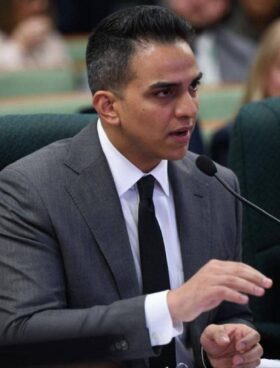


It is nearly noon, and New Progressive Party Rep. Jorge Navarro Suárez has to rush out of the Capitol for his other job at TeleOnce, the television station where he plays the entertainer in a segment that fields calls from viewers. On the program, he seeks to serve as a liaison between constituents and government agencies — a role similar to the one he is expected to perform from his legislative seat, for which he earns $73,775 a year.
Navarro’s television “performance” earned him more than $27,000 in 2025. That is more than the annual government salary of a receptionist, a Head Start teacher assistant, or an admissions and filing officer, for example. Because his television income exceeded 35% of his legislative salary, the maximum allowed, Navarro had to repay $1,179 to the House of Representatives, as required by Act 97 of 1968.
The New Progressive Party lawmaker told the Centro de Periodismo Investigativo (CPI) that he plans his schedule “so I can keep up with everything: the House public hearings, the TV program, the community visits.”
The option to earn outside income is a benefit that representatives and senators wrote into law in May 2013, when lawmakers lost the per diem payments and transportation reimbursements they received for carrying out their legislative duties.

Screenshot
Fellow New Progressive Party Rep. Fernando Sanabria Colón also combines his legislative work with performing onstage. When he is not at the Capitol, he sings and dances with Junte Hermanos Sanabría, a group made up of him and his brothers, at private parties or on stages sponsored by municipalities. He said he does not handle contracts with municipalities; Sanabria Events, a production company owned by his brother Alfonso, arranges those.
The lawmaker and performer did not disclose how much he earns from that work, either in the sworn statement he submitted to the House of Representatives or when the CPI contacted him. In the sworn statement, Sanabria says only that his earnings did not exceed 35% of his legislative salary.
New Progressive Party Rep. Wanda del Valle Correa, whose district includes Canóvanas, Carolina and Trujillo Alto, reserves her evenings for teaching at Northbridge University. She told the CPI that her one-hour classes begin after 8 p.m. so they do not conflict with her schedule at the Capitol. She added that she teaches one or two accounting courses per academic term, enough to earn $14,950 a year in outside income. To generate that amount, she would have had to teach about eight courses during the year.
“I can’t stop teaching. If I don’t teach, I can’t make ends meet,” she told the CPI.
Popular Democratic Party Rep. Swanny Vargas Laureano had social media posts with enough reach to be monetized or generate audience-based revenue, although the earnings were modest: just $26.85. Her sworn statement did not specify the amount, but her press officer, Ángel Raúl Matos, provided the figure to the CPI.
Act 97 of 1968 sets lawmakers’ annual salary at $73,775. The vice presidents of each legislative chamber earn $84,841 a year, as do the chairs of the Finance and Government committees and the floor leaders of the party caucuses. The house speaker and senate president each earn $110,663 annually.
Information Kept Hidden
In all, 12 representatives earned outside income in 2025. The CPI obtained the information only after it sued House Speaker Carlos “Johnny” Méndez to get the records. The documents contradict House Secretary Alberto León Ayala, who told the CPI that only one representative had received outside income.

Photo of the certification
In early May, the CPI asked the House of Representatives for copies of the sworn statements in which lawmakers report this type of income. The house secretary sent a signed certification stating, “that Rep. Jorge Navarro Suárez was the only one to declare that he had received outside legislative income in excess of that allowed by law.”
The CPI responded that its request covered all lawmakers, not only those whose outside income exceeded the 35% limit allowed under the law governing salaries and emoluments for members of the Puerto Rico Legislative Assembly. After the CPI pressed the issue, León Ayala again said Navarro Suárez was the only one of the 53 representatives who had received compensation in addition to his legislative salary. The House did not provide the 53 requested sworn statements for more than a month, until the CPI served it with legal process after filing the lawsuit. The House provided the documents on July 3.
“During the review process conducted by the Secretariat’s staff, the distinction that was identified went unnoticed. I fully accept responsibility for the error, with the sense of responsibility and commitment that characterize me,” León Ayala said when the CPI asked him about the inaccurate information he had both stated verbally and certified with his signature.
After learning about the lawsuit against the house speaker to get the sworn statements of every member of the chamber, the Puerto Rican Independence Party delegation in the House provided the CPI with the sworn statements of its three members: Denis Márquez, Adriana Gutiérrez and Nelie Lebrón. According to their statements, none of the three earns outside income.
Business Owners, Consultants, Influencers
Ángel Morey Noble, a New Progressive Party representative for a district that includes Guaynabo, Cataño and Bayamón, reported to the House that in 2025 he received $4,383 “for practicing my profession as a consultant.” In an interview with the CPI, he said he provides services to Nationwide Planning Associates, a New Jersey investment firm to which he sold the client portfolio he had built as a financial adviser before taking office in 2021.
New Progressive Party Rep. Edgar Robles Rivera of Arecibo has an ownership interest in Boster Pest Control & More and performs work for the company, according to his disclosure. He earned $6,000 from that interest in 2025. The company was registered in February 2025, one month after he took office.
Fellow New Progressive Party Rep. Joel Franqui Atiles received benefits from Learn and Grow Therapy Group LLC, a company headed by his wife, Irelis Pérez Cintrón. This year, the House of Representatives honored Pérez Cintrón twice: once for publishing a cookbook and again in May as an outstanding businesswoman. Franqui disclosed that in 2025 he received compensation for providing administrative consulting to his wife’s company. His compensation consisted of the use of a company-owned vehicle and payment of transportation expenses.
Popular Democratic Party Deputy Floor Leader Domingo Torres García earned $12,875 in addition to his legislative salary as a professor at Universidad Ana G. Méndez. Torres García told the CPI that he teaches one class a week in the university’s accelerated program. The human resources courses are held at night for master’s students and are almost always taught in person, he said. To earn the amount he cited, he would have had to teach about seven courses during the year.

Photo provided
Popular Democratic Party Rep. Ramón Torres Cruz also taught social sciences at Inter American University of Puerto Rico’s Metropolitan Campus in 2025. His sworn statement does not state how much he earned for that work. Torres Cruz, who is also an attorney, told the CPI that his outside income was $1,625. He said he taught the course in person from noon to 1:30 p.m. He is not teaching this year, he added.
Meanwhile, New Progressive Party Rep. Lourdes Ramos Rivera received $14,800 in 2025 from renting out an apartment she owns in El Combate, Cabo Rojo.
New Progressive Party Rep. Luis J. Jiménez Torres states in his sworn statement that he received $1,942 from the Puerto Rico Department of Education but does not describe what services he provided. According to his biography on the House of Representatives’ official website, Jiménez Torres holds a master’s degree in special education from Universidad Central de Bayamón. The CPI left a message at his office and emailed him but had not received a response by publication time.

Photo provided
In his sworn statement, New Progressive Party Rep. Félix Pacheco Burgos says he received outside income that did not exceed 35% of his legislative salary, but the document does not specify how much he earned or where he provided the services. Pacheco Burgos, a police officer, told the CPI that he received approximately $6,000 in overtime pay in 2025 for police work he performed in 2024.
He also estimated that he received an additional $18,000 to $20,000 for services he provides to Hogar de Paz as a caregiver for older adults. Pacheco Burgos said his work includes organizing medications, bathing older adults and assisting with other aspects of their care. He said his duties can also include providing care in a hospital during emergencies.
“I do it in my free time,” said the representative for Toa Alta and Bayamón.
According to Pacheco Burgos, he provides about 15 hours of services a week to the home, at any time during the week when he does not have legislative sessions, meetings or hearings to attend.
Per Diem $$$
Three other New Progressive Party lawmakers — Luis Pérez Ortiz, Pedro “Pellé” Santiago Guzmán and Emilio Carlo Acosta — reported that they received no outside income in 2025. None receive a salary from the House of Representatives because they are retirees, but they receive $150 or $162 in taxpayer-funded per diem payments for each day they report to work.
Between January and October 2025, the period the CPI analyzed, Pérez Ortiz received $15,900 in per diem payments, averaging $1,590 a month. In his sworn statement, he reported receiving a monthly pension of $3,689 from the government retirement system and $2,194 from Social Security. According to his biography, Pérez Ortiz worked for the Municipality of Bayamón from 1985 to 1987. In 1988, he won the House seat representing that municipality’s district.
Santiago Guzmán said in his statement that he receives a Puerto Rico government pension and Social Security income, but he did not specify the amounts. He received $14,100 in per diem payments from the House of Representatives between January and October last year, averaging $1,410 a month in addition to his salary.
Carlo Acosta reported receiving Social Security benefits and a pension as a retired member of the U.S. Army. His sworn statement did not specify how much he received from those sources. Between January and October 2025, he accumulated $10,494 in House per diem payments, averaging $1,049 a month.
This translation was generated with the assistance of AI and reviewed by our editorial team to ensure accuracy and clarity.