


During academic year 2025–2026, the University of Puerto Rico (UPR) will admit more students from private schools than from the public system, a shift not seen in the past two decades, according to official data available since 2006 and analyzed by the Centro de Periodismo Investigativo (CPI).
About 20 years ago, 59% of new students came from public schools, while 39% were from the private sector. However, for the upcoming cycle starting this August, only 47% of those admitted are expected to come from the public education system, compared to 50% from private institutions.
The number of students admitted from public schools decreased from 7,331 in 2006 to 4,544 in 2025, according to official data. In contrast, the admission of students from private schools remained almost unchanged, from 4,823 to 4,809 during the same period.

Although this trend is not uniform across all UPR campuses, data from the Río Piedras campus shows that students admitted from private schools have outnumbered those from public schools since 2006. In the Mayagüez and Bayamón campuses, for example, students from private schools have surpassed those from public schools for seven and five years, respectively.
Jocelyn Géliga Vargas, who served until last month as co-coordinator of the University Access Center (CUA in Spanish) — a program at the Mayagüez University Campus (RUM in Spanish) that offers tutoring and support to public school students starting in seventh grade — believes this shift in student composition undermines the public university system’s mission.
“At RUM, more students are admitted from private schools than from public ones. That was not the University of Puerto Rico’s purpose. The University should continue to be the equalizer of that promise of social mobility for the most marginalized sectors, as my parents experienced, as I experienced, but which is questionable for current generations,” she stated.
“They’re ripping away our dream of going to college”
Keyra Alexandra Mojica Rodríguez, 18, will begin her Business Administration studies at RUM in August. Her journey there was not guaranteed. Since she was 12, she has moved between Peñuelas, Yauco, Ponce, and now Mayagüez, constantly rebuilding her teenage life due to circumstances beyond her control: poverty, hurricanes, earthquakes, bullying, and family instability, which she prefers not to relive.
“One is not born to keep changing places,” she said. Yet, she views these experiences as lessons in adapting to changes and the pressures of being a student in times of economic and social challenges.

Photo by Brandon Cruz | Centro de Periodismo Investigativo
She now lives with her grandmother in Mayagüez, where this past May she completed her senior year at Eugenio María de Hostos High School while working two jobs to make ends meet.
“They tell you that you have to have your future clear, good grades, a social life, a good College Board score, get along with your family, work… and if not, they make you feel like a failure,” she reflected.
In her home, college was not discussed as a future option. So, Keyra thought the most viable path was to enroll in an institute and pursue a short vocational career, lasting one or two years. That changed when she discovered the services offered by the CUA in 2023.
For Keyra, without the support and tutoring she received at the CUA, she probably wouldn’t have aspired to attend the UPR. The day she received her acceptance letter, she was with her program peers and mentors, who shared her joy and achievement as if it were their own.
“Thanks to them [the CUA team], we learned a lot about the RUM. Thanks to them, I had the opportunity to enter the campus… The day I received the letter, I was crying, I was a mess… I couldn’t stop crying. We all started crying, and it was very beautiful, like a family,” she recalled.

Photo by Brandon Cruz González | Centro de Periodismo Investigativo
Keyra is concerned that public policies promoted by U.S. President Donald Trump against diversity programs could lead to the disappearance of the CUA and, by extension, that other young people from disadvantaged communities in Mayagüez might lose the opportunity to learn what a university is and all it can offer them.
“Like the CUA, there are many more programs that rely on federal and state funds. It’s sad because they are aids for students and the youth of Puerto Rico. It’s not that they are wasting money or throwing it away for fun; they are educating and helping homes that truly need it, households that may not receive education, because everyone portrays that there’s no poverty in Puerto Rico, but in reality, there is poverty,” she warned.
As an example, Keyra mentioned classmates who, although they dream of going to college, will not be able to do so due to a lack of resources and support.
“It’s sad that they take away many people’s dreams, that they snatch them from their hands because of a simple whim of the high ranks of the government,” she concluded.

Photo by Brandon Cruz González | Centro de Periodismo Investigativo
What keeps low-income youth away from the UPR?
According to Géliga, diversity should be understood beyond racial or gender categories and include academic background, often linked to factors such as social class, access to resources, and educational opportunities.
Sociologist César Rey, who led the Puerto Rico Department of Education from 2001 to 2004, explained that the UPR is no longer perceived as a viable path for social mobility, especially for low-income youth who need to quickly enter the labor market to improve their economic conditions.
Although public school students maintain an interest in entering the UPR, the combination of poverty —which forces them to seek shorter academic options or quickly join the labor market— and the structural inequalities of the public education system, which affect their preparation to meet admission standards, contribute to their lower likelihood of entering the public university compared to their private school peers, Rey explained.
“We are talking about young people who cannot afford to wait four or five years to complete a degree due to the poverty rates affecting public school students. Therefore, the role of private universities becomes more attractive because they offer short courses and their marketing strategies project trendy offerings,” said Rey, a retired professor from the Río Piedras Campus of the UPR.
He added that this context in public higher education might be “undermining the capacity of those students.”
However, he pointed out that it should not be assumed that all private schools offer competitive training.

Photo by Dennis A. Jones | Metro Puerto Rico
Admission data shows that many public-school students fail to be admitted to the UPR, but Rey warned that attributing it solely to their lack of preparation might be unfair.
“I have examples of public schools where education is top-notch, beyond the specialized ones,” he noted.
For Rey, more than a lack of individual capacity, what affects public school students is the structural instability of the Puerto Rico Department of Education. In 20 years, there have been multiple changes of Education Secretaries, over 600 schools have been closed, there have been constant curriculum revisions, modifications in standardized tests, textbooks, and educational philosophy, in addition to the pressures of federal policies, he said. The structural debacle and the confidence crisis the Department of Education has faced in recent years worsened with the corruption convictions of Secretaries Víctor Fajardo and Julia Keleher, who led the agency between 1994 and 2000, and between 2017 and 2019, respectively.
Since 2006, most UPR admission applications came from public school students, but starting in 2022, the gap began to close, and in the last two years, graduates from private schools have surpassed those from public schools in the number of applications. This trend occurs even as the number of private schools has decreased in the past five academic years. From the 668 private institutions and church schools registered in the 2019-2020 academic year, 640 remain in 2025, according to data from the Department of State available only since 2019.
Although applications and admissions to the UPR decreased in both sectors, annual data show that in the last eight years, public school applicants achieved a proportionally higher admission rate than their private school peers. However, when observing the accumulated data from 2006 to 2025, 46% of private school applicants who aspired to the UPR were admitted, compared to 44% of public school applicants who managed to enter.
For Géliga, this reality causes “more affluent students to enter the public university, while less affluent students are opting for short courses, institutes, or no higher education at all.”
Meanwhile, anthropologist Rima Brusi, co-founder of the CUA, assured that those who manage to enter from public schools encounter a “disconnect” between the school offering and the University’s expectations.
“At the UPR, there are professors who complain that students don’t arrive ‘ready,’ instead of adapting their methodologies to guide them toward academic rigor. That’s why we see, for example, students admitted from public housing facing a strong clash between their path of improvement and the institutional message that makes them think they don’t belong at the UPR,” said Brusi, who is a professor at Northern Arizona University.
The anthropologist recalled the case of a RUM student who, despite having excellent grades in school, began to fail at the university due to a lack of academic support. Brusi warned that after overcoming the stigma of coming from a housing project and reaching the university, “many young people face a gap between that idea of triumph and the university reality, leading them to question: ‘Maybe I’m not university material, and this going to university is something I made up? Better I leave, get a job, whatever.’ That causes that sense of lack of belonging,” she explained.

Photo by Víctor Rodríguez Velázquez | Centro de Periodismo Investigativo
This insecurity is exacerbated by the prejudices and jokes circulating at the university about people from public housing.
“Some students told me they heard jokes about [people] from public housing projects, without anyone suspecting they came from there. They felt uncomfortable until one of them reacted: ‘Look, I’m from a housing project,’ and the guy was all confused,” Brusi said.
For the professor, these experiences do not reflect a lack of student capacity but insecurity in the new environment. “Many of these students are extraordinary. The vulnerability they show is not inherent to their personality but a reaction to the university environment that does not recognize or support them,” she emphasized.
The CUA amid uncertainty
The trend toward a student body at the University of Puerto Rico that is less representative of the island is being worsened by threats to tutoring and support programs in public schools aimed at reversing that exclusion—a situation that could intensify under federal policies promoted by the U.S. president to limit diversity, equity, and inclusion initiatives at universities, UPR professors warned in interviews with the CPI.
One of the programs directly affected by this adverse climate is the CUA, which, since 2007, has worked with public school students —especially those aspiring to be the first college-bound generation in their families— to promote their access and permanence at the UPR through mentoring, guidance, and academic support.
During its 18 years of existence, the CUA has reached over 1,200 students from public schools and vulnerable communities in Puerto Rico. Although initially, in 2007, it received financial support from the UPR, for the past five years, the program has survived almost entirely thanks to funds from the National Science Foundation (NSF) awarded to the RUM in 2021, of which just over $300,000 was allocated to the CUA for its operation over five years. With Trump’s measures, the NSF has cut funds to university projects and research focused on diversity, equity, and inclusion.
“The grant from the NSF was for five years, and we only have funds left for two. So far, we haven’t been told anything about whether it will be discontinued or renewed. Neither yes nor no… we’ve received no word about the funds,” Géliga said.
Other public university access programs are at risk
Between 2015 and 2017, the CUA model expanded to the Bayamón, Carolina, Cayey, Humacao, and Río Piedras campuses, through funds granted by the UPR Central Administration and the Francisco Carvajal Foundation. But that growth stopped in 2018 when institutional funds ended following the cuts imposed on the UPR by the Fiscal Control Board (JCF, in Spanish).
Federal cuts have also affected the Puerto Rican Humanities Foundation (FPH), which gave the CUA $20,000 to develop a book in which program participants recounted the impact that hurricanes Irma and María in 2017, the 2020 earthquakes, and the COVID-19 pandemic had on their lives and educational processes.
According to Géliga, the CUA will not have a renewal of funds granted by the FPH.
Due to all these cuts, today the CUA receives less than half the students it served at its peak: from 105 per semester between 2008 and 2018 to just 40 in 2025.
For Sandra Soto, a professor in the English Department at RUM and CUA coordinator, this decline reflects a lack of institutional vision regarding the access of disadvantaged students to the public university.
“The CUA replicas in other campuses worked. We know they were a way to attract more student population to the UPR,” she said.

Photo by Brandon Cruz González | Centro de Periodismo Investigativo
However, she questioned that while the University seeks to increase admission numbers, at the systemic level, the necessary time and effort are not invested to work cohesively with public schools and ensure that more young people see themselves in the university system. She recalled testimonies from participants who are now pursuing graduate studies but who in high school “passed by the RUM every day and never thought this was a place where they could study.”
UPR President Zayira Jordán Conde, who took office on July 1, acknowledged that the decline in the admission of public-school students is contrary to the UPR’s historical mission as a vehicle for social mobility. She assured the CPI that her administration will seek to address this imbalance by creating support programs from early grades and campaigns directly targeting public school students. However, when it was mentioned that such an initiative already exists, for example, through the CUA, Jordán admitted she was unaware of that project.
“I didn’t know about the [CUA] program, but it seems to me that the new Vice President of Student Affairs, Jonathan Muñoz Barreto, who comes from the RUM and has actively participated in those initiatives, is well-positioned to replicate them in all campuses, if possible,” she said.
But then she took a step back.
Is there an opportunity to inject funds into the CUA?
“The reality is that the University’s budget is already heavily committed,” said Jordán.
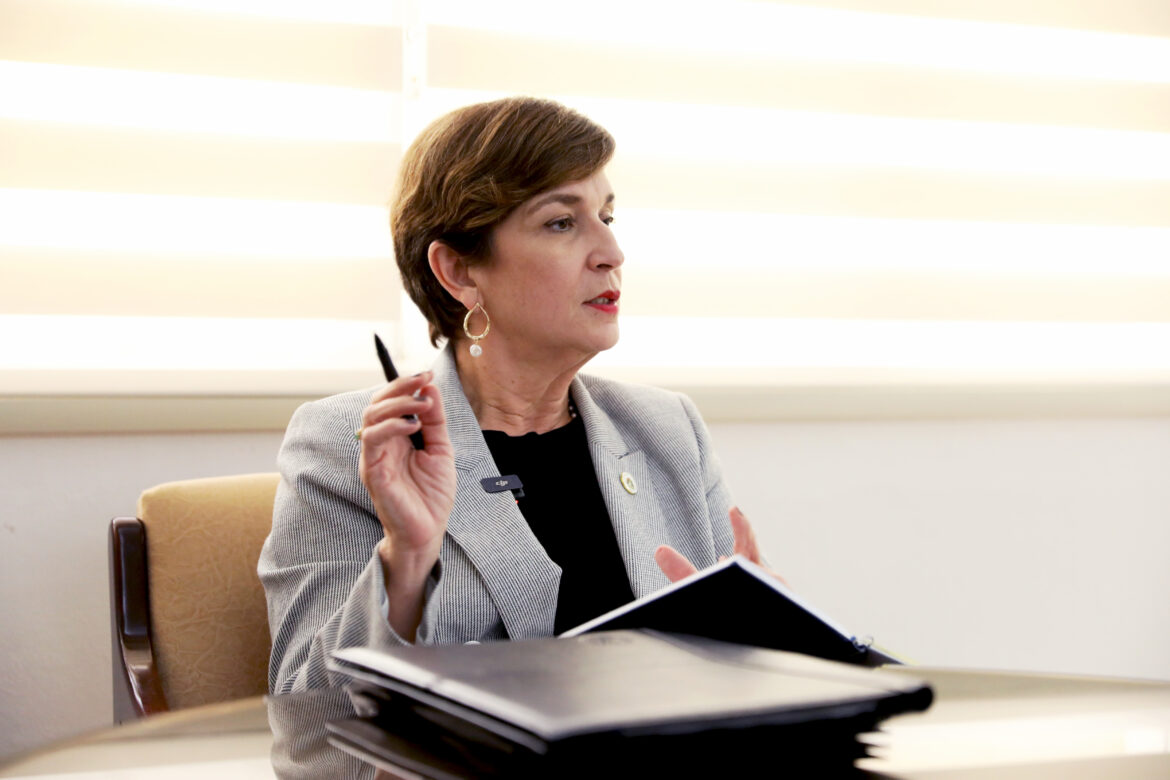
Photo by Brandon Cruz González | Centro de Periodismo Investigativo
She also proposed launching campaigns targeting public school students by “getting into schools” or joining recruitment events, something the UPR already does. Jordán also stated that she would support the expansion of short-term academic programs as a strategy to address the economic realities faced by the student body.
Another program that would also be hit by federal funding cuts is Talent Search, which has been operating at the Río Piedras Campus since 1989, with an annual grant of $603,480 awarded by the U.S. Department of Education. This program offers educational services and guidance to students from sixth grade who come from 15 public schools in Río Piedras, Hato Rey, Santurce, Fajardo, and Vieques.
The Talent Search program will not have funds in the 50 states and US territories starting from the 2026-2027 academic year, warned José Vargas Figueroa, director of the Río Piedras Campus chapter.
“President Trump, in the budget for 2026-27, allocated zero funds for the programs. It’s part of the initiative to eliminate the federal Department of Education,” he said.
Vargas explained that at the end of July, the U.S. Senate recommended restoring the budget, but the measure still needs to be considered by the U.S. House of Representatives, so uncertainty persists.
“If the programs disappear, funds will have to be identified within the UPR, but perhaps not with the same strength, because we know the University’s financial limitations,” added Vargas, who has directed the program for three years.
Of the 213 high school seniors who participated in Talent Search in 2024, 173 entered a postsecondary institution, and of those, 65 opted for the UPR. The program supports low-income youth with the potential to become the first university generation in their families, aiming for them to complete postsecondary studies.
“Although we are within the UPR, we work with a program that stems from a federal law specifying that we cannot promote the institution we are affiliated with as the only option. The option is given to the student to choose. For example, students from Fajardo and the island municipality of Vieques tend to choose the Inter American University in Fajardo and, perhaps, the Humacao campus of the UPR,” he explained.
A recent effort to expand the presence of low-income students at the RUM also encountered obstacles, but this time within the university administration itself. A source with direct knowledge of the efforts told the CPI that the campus dean, Agustín Rullán Toro, refused to support a proposal to incorporate low-income students into engineering programs, arguing that granting course releases —assigning professors to the new initiative instead of their regular classes— was “a costly investment” that would have required $1.4 million in RUM funds the campus does not have.
The dean later agreed to an amendment to the proposal that reduced the number of participating professors from eight to five, who together would receive a total course release of 26 credits per year. This would represent a total investment of $800,000 for RUM over the six-year duration of the project. The proposal was submitted to the NSF in February of this year, but they are still awaiting a response.

Photo provided
Rullán told the CPI that, in his opinion, the NSF fund request would not be affected by the federal government’s restrictions against diversity, equity, and inclusion initiatives, as the program’s focus does not fall within those categories.
“This program is to promote studying engineering, meaning it has nothing to do with diversity, inclusion, or equity. It’s to promote more students participating in engineering within certain parameters, for example, economic ones, but not that they were from public schools, as far as I know,” he declared.
However, he said that the RUM has other initiatives to promote the entry of low-income students, such as a pilot project funded with $110,771 by the Azmat A. Assur Foundation, which will offer pre-university math courses and benefit 30 high school students.
In addition to the risk to access programs, in March, the UPR Governing Board — the body that oversees university public policy — eliminated its Accessibility, Diversity, and Inclusion Committee, created in 2021 to identify better balances of social representation within the system. The elimination of the Committee responded to the Trump administration’s threat to withdraw federal funds from universities that promote explicit diversity initiatives on their campuses.

Photo by Víctor Rodríguez Velázquez | Centro de Periodismo Investigativo
Isar Godreau Santiago, a researcher at the Interdisciplinary Research Institute of the UPR in Cayey, noted that the current political climate not only hinders the creation of inclusive programs but also perpetuates a system that discourages young people from aspiring to university degrees beyond technical or short-term programs.
“This political climate under Trump makes it harder for the University to have the resources and programs needed to ensure that diverse populations can access and engage with the institution,” said Godreau, who coordinated the CUA chapter at the Cayey campus.
The problem is not just the lack of students, but access
For Professor Géliga, one of the problems highlighted by the application versus admission statistics is that the UPR has not adjusted its admission standards to the precarious academic reality faced by public school students in Puerto Rico. A study by the Puerto Rico Higher Education Council (now the Board of Postsecondary Institutions) warned in 2004 that the anticipated decline in university study demand by public school graduates would be caused by income inequality in the population, the increase in university credit prices, changes in federal financial aid, which cause more students to have to apply for student loans, and the incidence of teenage parents.
Professor Géliga added that the current student body is a product of various socio-environmental crises that have interrupted their school education processes.
“The periods of school interruption caused by the 2020 earthquakes and the transition to online education due to the COVID-19 pandemic shortly thereafter dealt a devastating blow to their educational processes, as well as their motivation to study and learn,” she stated.
Professor Soto, for her part, also pointed out that the economic crisis has transformed access patterns to higher education, affecting even middle-class families who previously could afford private schools and universities in the United States. “There are other populations in the private school system that achieve admission because they have that support and guidance network that many times our [CUA] participants do not have,” she said.
Automatic admission: a half-solution?
In June, the Puerto Rico Legislature approved a bill to create the “Automatic Admission to the University of Puerto Rico Act,” promoted by Senate President Thomas Rivera Schatz. The measure proposes that any eleventh-grade student from a public or private school who is within the top 20% of their class be automatically admitted to the public university system.
Former Secretary of Education César Rey considered that the proposal could work, but if implemented experimentally for at least three years, as in addition to having a good average, it would be necessary to evaluate the deficiencies, if any, of the students.
“The project should come with support for those students who arrive through that formula, with tutoring, if necessary, and understanding what skills need to be complemented. There should be a professional team in charge of the entry of those students,” he said.
In his opinion, allowing the UPR to have preferential access to the best-performing students could represent a “lifeline” in the face of the enrollment decline caused by the inversion of the sociodemographic pyramid and the reduction of the young population in Puerto Rico.
Although Senator Rivera Schatz’s project seeks to increase student entry, particularly from the public system, the project does not allocate new resources to the University to implement this change.

Photo by Ana María Abruña Reyes | Centro de Periodismo Investigativo
The approval of the measure comes at a time when the federal government is evaluating changes in the requirements to access the Pell Grant, a fundamental economic aid for low-income students. Since a significant portion of the UPR’s budget comes from federal funds linked to these grants, any modification in their access could have a direct effect on the institution’s budget, especially if enrollment increases without a local budget allocation to support it. Rey warned that the discussion about increasing student entry to the UPR system must also consider the One Big Beautiful Bill Act, promoted by the U.S. president, which changes the distribution of federal funds, loans, and student debts, especially in graduate studies.
Yarimar Rosa Rodríguez, director of the Educational Research Center of the School of Education at the Río Piedras Campus, stressed that the bill does not consider that poverty does not disappear upon getting into college, but often worsens.
“The student disconnects from a family environment, loses the roof, the food, when relocating to (UPR in) Río Piedras,” she pointed out. She highlighted that this reality must be addressed while automatically admitting these students.
“How can I consider an institution that will not shelter me for being diverse, but will make me poorer?” she questioned.
Since 2017, the UPR has lost half of its budget because of the fiscal cuts imposed by the JCF.
This decline has weakened its operational capacity, so the institution does not have enough staff or infrastructure to handle a significant increase in the demand for academic services, warned Professor Géliga.
Raúl Santiago Bartolomei, coordinator of the Puerto Rican Association of University Professors (APPU), explained that although the organization supported the bill, it did so with reservations. In particular, he is concerned that the initiative does not include a specific estimate of how many more students would join the university system because of the bill.
“We have stated that one aspect that should be reconsidered is that the bill does not estimate how much enrollment would increase, to know what resources are necessary to ensure that there is quality education for the students who will enter, such as, for example, that there are enough professors, sufficient library resources, or that the physical plant is in order, and that this does not cause the opposite: that there is a reduction in the University’s graduation rate,” said the professor of the Graduate School of Planning.
Increasing enrollment without allocating more resources would imply a greater burden on the system: more need for professors, security, maintenance, and basic services such as water, electricity, and internet, among other essential expenses for the operation of the campuses, he added.
Although in her interview with the CPI the UPR president acknowledged that she had not read the bill—later clarifying that she was referring to the final version—she indicated that she has reservations she hopes to discuss with the Governor. She noted that the measure does not include a funding allocation to cover the increased costs associated with more students, additional faculty, new course sections, and higher expenses for services such as electricity, water, security, and internet.
“We’ll see if the Governor signs it. Then, we would see if we can claim new legislation or amendments to the bill to see if we can enable funds that allow us to prepare for automatic admission and to finance the remediation structures that we will need,” said Jordán.
Santiago Bartolomei anticipated that if the UPR Presidency truly demands an amendment to the bill to ensure the allocation of additional funds, the APPU could evaluate supporting that claim.
Rey insisted that approving a measure without ensuring its economic viability is condemning it to failure.
“That’s the big problem with public policy in this country: ideas are proposed, but there’s no funding. That’s how failures are anticipated,” he stated.
For the proposal to work, Rey added, the University, the JCF, and the House of Representatives budget committee must commit to securing the necessary funds.
This story is possible through a collaboration between the Centro de Periodismo Investigativo and Open Campus.
This translation was generated with the assistance of AI and reviewed by our editorial team to ensure accuracy and clarity.


Love your journalism but wish you would’ve gone deeper. Going to public school doesn’t mean you’re low income. As more public schools are closing, people are moving to private schools. Personally I was moved to private school as recommendation from a therapist, and my family is low income. I also met friends there that barely had money for one uniform, and their moms cooked the same meals every day because of low income; their payment was always late.