

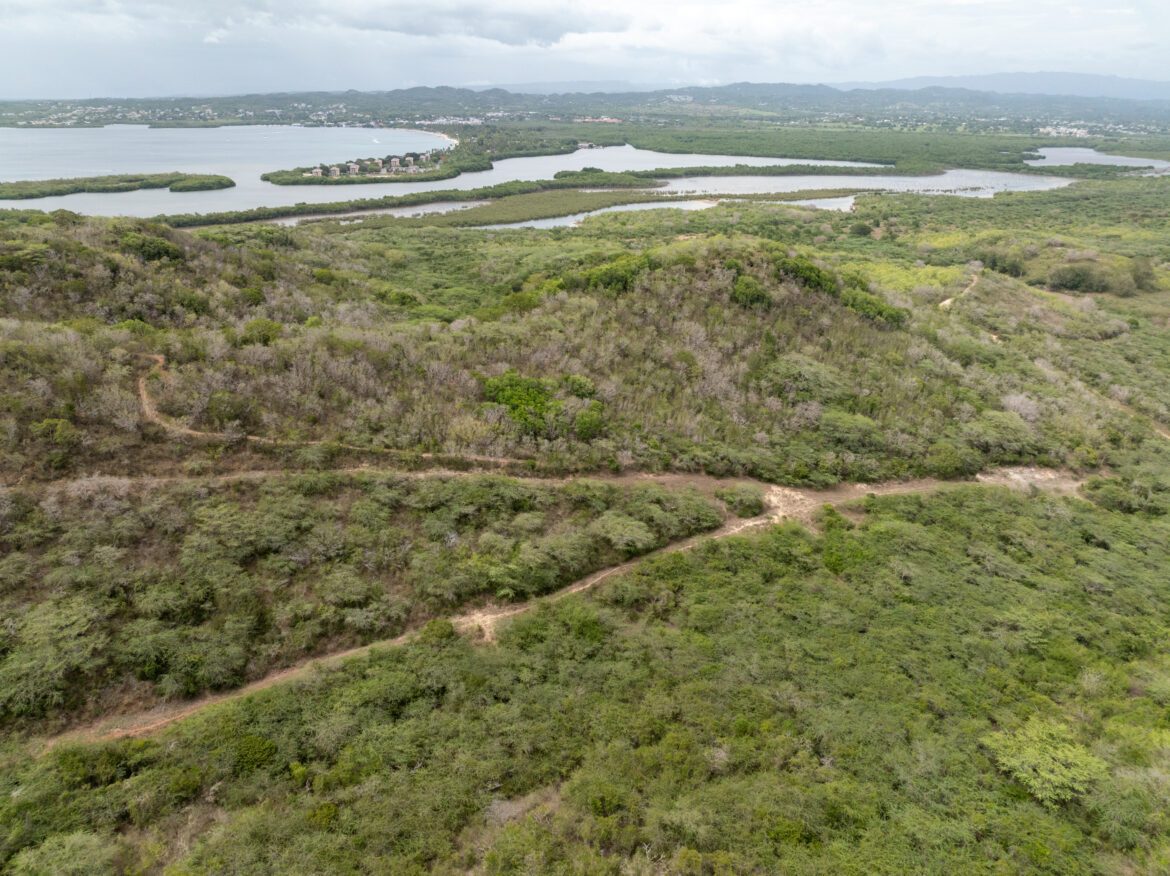

Access to Los Pozos beach in Cabo Rojo isn’t easy. You have to walk a long, muddy stretch. But seeing its crystal-clear water and the sight of waves breaking against the rocks and mangroves makes the trek worth it. Hikers in the area know this treasure that most Puerto Ricans don’t even realize exists. Just a few yards from Los Pozos lie the lands where Reuben Brothers and Three Rules Capital have proposed Esencia, an exclusive residential and tourism complex.
One of the more comfortable, though also one of the longest, routes into Los Pozos is through the Boquerón Wildlife Refuge. The roughly four-hour hike is lined with mangroves and wetlands. Crossing the natural reserve takes you past Rincón Lagoon, a nursery for more than 20 commercially valuable fish species and for endangered Caribbean manatees. According to guides from the Hiking Valiente group, which conducted tours of the areas slated for the Esencia development, the body of water is regenerating. This regeneration follows the increase in salinity caused by Hurricane María’s passing, which led to significant mangrove loss.
The Wildlife Refuge was established in 1964 in response to the deterioration of Guánica Lagoon and Laguna Cartagena in nearby Lajas caused by agricultural development in the Lajas Valley during the 1950s. Spanning 463 cuerdas (roughly 450 acres), the refuge is home to bird species such as the San Pedrito, Reinita, Mariposera, Juí Blanco, and Turpial, as well as several endangered ones, including the Mariquita and the Chorlito Blanco.
For Esencia, the developers seek to build 1,132 residences and 520 hotel units. The Puerto Rico Tourism Company approved nearly $498 million in tax credits for the hotel component, along with a 10-year exemption from state and municipal taxes for Cabo Rojo Land Acquisition LLC, the legal entity through which Reuben Brothers and Three Rules Capital are developing the project, according to documents filed with the Puerto Rico Permit Management Office (OGPe in Spanish).
This multimillion-dollar tax package was granted even though the project’s tourism component is secondary, and its development is of “predominantly residential use,” according to statements by the Puerto Rico Tourism Company in its comments to the OGPe last March.
The Tourism Company is now seeking to have Esencia classified as a mixed-use project, which would require that 70% of the development be designated for tourism and 30% for residential or commercial use, according to the project’s file reviewed by the Centro de Periodismo Investigativo (CPI). The former director of the Incentives Office at the Department of Economic Development and Commerce (DDEC in Spanish), Carlos M. Fontán, explained that when mixed-use projects meet this proportion, developers can claim up to 100% of their investment in tax credits, including the 30% that is not tourism related.
So far, “the housing units [in Esencia] outnumber the lodging units two to one,” the Tourism Company noted in its comments to OGPe. When the CPI pressed for the exact proportion of tourism use projected for Esencia to qualify for the already granted incentive, Iván Díaz Carrasquillo, assistant director of Incentives and Investments at the Tourism Company, said that any figure would be speculative until construction is completed.
“The project’s redesign is recommended to reduce the scale of its residential component and associated infrastructure so that it may be more clearly considered a tourism project (and not predominantly residential). In this way, it could also qualify for financial incentives as a tourism project under the decrees of Act 74 of 2010 and Act 60 of 2019,” reads the Tourism Company’s comments on the project, signed by the agency’s deputy director, Jorge Pérez González, and sent to OGPe in March.
In other words, although the Puerto Rico Tourism Company’s mission is to expand hotel capacity and promote tourism, it approved nearly $498 million in tax credits for Esencia, a project that, as the agency itself acknowledged before OGPe in March, will be predominantly residential.
“As the Tourism Company, our role is to meet the Puerto Rico government’s need to have tourism activity units that can be endorsed,” Díaz Carrasquillo said. “Sometimes there aren’t enough hotel rooms for the number of people visiting, and we help ensure that tourism activities can take place.”
The Tourism Company has been aware of the project’s residential nature from the start, Díaz Carrasquillo admitted in his interview with CPI.
“We’ve always known they were going to build residences, but since those homes aren’t part of the tourism activity, it’s a commercial activity; they’re not covered under the decree,” he explained.
The nearly $498 million granted in incentives by the Tourism Company represents 40% of Esencia’s eligible investment, which totals $1,244,299,092, according to the decree. The eligible investment refers to the estimated cost of constructing and developing tourism-related structures, such as hotels, restaurants, and amenities associated with tourism use.
The amended 2024 decree for the Esencia project states that construction will take place in six phases, to be completed gradually between 2027 and 2030. The document specifies that a town center will be built, featuring commercial offices, a museum, restaurants, bars, and recreational and sports areas.
The decree does not mention the construction of residences. According to the Tourism Company’s assistant director of Incentives and Investments, Cabo Rojo Land Acquisition was not required to include details about the residential component of the megaproject in the decree. As a result, the document does not reflect the total cost of the project; the figure of $1,244,299,092 represents only the estimated investment in the tourism facilities and the commercial tower.
Although Esencia is predominantly a residential development, it does not qualify for residential construction incentives under the Act 60 of 2019 Incentives Program, since those are intended for affordable housing, senior or assisted-living facilities, and construction in historic zones. The luxury residences at Esencia are being marketed for between $2 million and $20 million each, in one of the most desirable areas of Puerto Rico’s southern coast, according to the project’s website.
Between 2000 and 2022, Puerto Rico added more than 3,000 hotel rooms to its inventory, investing about $273,000 per room through tourism project tax credits, according to a report by the DDEC assessing the economic impact of tax incentives. Using the same methodology, in Esencia’s case, the government would be investing roughly $1 million for each of the 520 “hotel units” proposed for construction.
In December 2020, under the administration of then-Governor Wanda Vázquez, the Tourism Company granted a tax exemption decree to Cabo Rojo Land Acquisition, which was later amended in 2024 under Governor Pedro Pierluisi’s administration. The tax exemption falls under the Puerto Rico Tourism Development Act, which provides incentives for tourism-related activities such as hotels, condo hotels, inns, agritourism lodging, guesthouses, vacation clubs, and mixed-use developments. This law was later incorporated into what is now Act 60 of 2019. In 2022, the developer also received a 90% exemption on fees and notarial stamp duties related to specific project parcels, through a certification signed during Vázquez’s tenure.
The assistant director of Incentives and Investments at the Puerto Rico Tourism Company said that Cabo Rojo Land Acquisition is benefiting from Act 74 of 2010 because the company submitted its application for the tax exemption before Act 60 of 2019 took effect. According to Tourism Company documents, the application was filed on May 21, 2019 — about a month and a half before Act 60 was approved.
The benefits granted to the developer under Act 74 of 2010 are far more generous than those available under Act 60 of 2019. Under the latter, the income tax rate on eligible earnings is 4%, while Act 74 grants a 90% exemption. Act 74 also provides higher exemptions on municipal license taxes and payments to the Municipal Revenue Collection Center (CRIM, in Spanish).
A Wide-Open Portfolio of Benefits
The Puerto Rico Tourism Company not only recommended that Esencia’s developer redesign the project but also provided guidelines in its comments to the OGPe on achieving the mixed-use classification that could increase its tax credits. Had the project met the 70% tourism and 30% residential or commercial ratio required for mixed-use developments under Act 74 of 2010, the entire project would have qualified for tax credits.
The assistant director of Incentives and Investments told CPI that Esencia’s single-family and multifamily residences will be subject to state and municipal taxes if they are not used for tourism purposes. He explained that the Tourism Company’s suggestions in its OGPe comments were intended to guide the developer on incorporating the project’s homes into a condo-hotel or time-sharing program, which would make them eligible for tax benefits. To qualify as condo-hotel units, at least 15 residences must be included in the program during the life of the decree, and only those would receive tax incentives. To be classified as time-sharing units, the residences would need to be made available for use for a limited number of weeks per year.
For this reason, the Tourism Company requested additional information from the developer about the hotels and their relationship to the residences. Along the same lines, the agency instructed the developer to clarify whether the branded residences of Mandarin Oriental, Rosewood Hotels, and Aman Resorts would operate as part of a condo-hotel or time-sharing program, and to specify in the property deeds how the homes are tied to the tourism operations of the hotels.
“It is noted that any short-term rental unit, whether lodging, condo-hotel, time-sharing, or branded units associated with a hotel management company, used as ‘supplementary short-term lodging’ may not be considered a tourism accommodation for Puerto Rico’s Lodging Regulations or for incentive eligibility under Act 60,” the document states.

Although the Tourism Company, in its comments to OGPe, recommended reducing Esencia’s residential component as a condition for it to “be more clearly considered a tourism project” and “qualify for financial incentives,” Díaz Carrasquillo said that does not mean Cabo Rojo Land Acquisition was ineligible for the nearly $498 million in credits granted under the decree.
“Well, look, maybe they [Tourism] made a mistake when they wrote that, because they already have a valid tax decree. Let’s just say maybe whoever wrote it didn’t phrase it correctly,” Díaz Carrasquillo said after the CPI showed him the document from his agency questioning Esencia’s qualification for tax incentives. He added that the Tourism Company’s Planning and Development Office prepared the comments submitted to OGPe.
In that document, the Tourism Company even warned the developer that failure to comply with the requirements outlined in its comments “shall be sufficient reason to withdraw any recommendation from the Company in the permitting or incentives process.”
Díaz Carrasquillo told the CPI that the Esencia developer is not obligated to meet the 70% tourism and 30% commercial or residential ratio established under Act 74 of 2010 to receive tax incentives. However, the company can only claim exemptions for the portion of the project designated for tourism use. The residential or commercial areas will be subject to taxes, meaning the total tax benefit will be smaller.
“At the end of the process, once they build, they have to submit a cost certification prepared by an external CPA. When that cost certification is ready and we analyze it, we’ll know what the final ratio is, whether they exceeded or stayed within the 70/30 limit. Only then will the tax credits for the project be disbursed,” Díaz Carrasquillo said.
However, the assistant director acknowledged that the developer can still use the decree granting nearly $498 million in credits as collateral to secure financing for the project, even if the subsequent cost certification reveals that the tourism portion of the development is smaller than projected and the final eligible tax credits are therefore lower than that amount.
Refusal to Backtrack on the Proposal
In response to the Tourism Company’s comments, Esencia’s attorneys argued before the OGPe that the project had already been reviewed and granted tax incentives under the Tourism Development Act and the Incentives Code. They claimed that the clarifications requested by the Tourism Company were unnecessary. Tax credits are claimed gradually as each phase of the project becomes operational, and the Tourism Company must first approve a cost certification. Nonetheless, developers can seek project financing once the decree is signed.
Cabo Rojo Land Acquisition rejected nearly all the Tourism Company’s comments, arguing that they were irrelevant to the OGPe’s environmental review process, untimely, or outside the agency’s jurisdiction. In a document titled Post-Hearing Memorandum, the developer’s attorneys stated that they were not required to include contractual provisions in the master deeds regarding operational relationships between the hotels and the residences.
Engineer Roberto Ruiz Vargas, cofounder of Three Rules Capital and one of Esencia’s developers, told the CPI that all comments from government agencies are “received, analyzed, and addressed in accordance with the applicable requirements at each stage of the process.” His statement came just days after the Department of Natural and Environmental Resources (DRNA in Spanish) instructed the company to present a redesigned plan that includes a substantial redefinition of the project’s ecological footprint, as reported by Bonita Radio.

Photo provided.
When interviewed by the CPI, former Tourism Company Planning Director José Rivera Santana warned that the gap between how projects are designed and what the Puerto Rico Tourism Development Act actually approves is a recurring problem.
“Many of these projects are presented as tourism developments when they’re not,” said the urban planner, referring to the Esencia project. “That’s part of the myth of tourism projects in Puerto Rico, and, unfortunately, the Tourism Company has failed to take responsibility for defending against it.”
Rivera Santana explained that investors often use strategies such as adding small tourism components within large residential complexes. “They’re residential projects, not tourism ones, but they give them a superficial gloss just to benefit from tax incentives,” he said.
David Rodríguez Ortiz, president of the Puerto Rico Society of Certified Public Accountants, noted that Act 74 of 2010 is unclear about the consequences when a development fails to comply with the provisions governing mixed-use projects. He added that the determination is ultimately at the agency’s discretion.
“The law grants broad discretion to the director of the Tourism Company to grant concessions, as long as they serve Puerto Rico’s best interests,” Rodríguez Ortiz said.
According to a report by the DDEC analyzing data through 2022, tourism incentives have resulted in virtually no gain or loss for the government. The Puerto Rican government receives just a 3.2% return on investment, the amount it earns in exchange for the public money spent on tax incentives for the tourism sector.
“The effectiveness of these tax credits and preferential rates in increasing the island’s hotel room inventory has declined,” the report concludes.
Incentives That Favor Developers
Ricardo R. Fuentes Ramírez, an Economics professor at the University of Puerto Rico’s Mayagüez Campus, warns in a report that the decree granted to Esencia’s developer lacks performance requirements and mechanisms to recover public funds in the event of noncompliance. Fuentes Ramírez, a former president of the Puerto Rico Economists Association and resident economist for the Financial Oversight and Management Board for Puerto Rico, conducted the report out of personal interest as a Cabo Rojo resident.
The master concession document, which outlines Esencia’s design, tax incentives, and the conditions for granting them, also fails to establish independent oversight mechanisms to ensure full compliance, the professor added. He warned that this lack of oversight makes the project a financial risk for Puerto Rico.

Photo by Brandon Cruz González | Centro de Periodismo Investigativo
Díaz Carrasquillo said the Tourism Company grants extensions when developers fail to meet the terms of a tax decree due to exceptional circumstances. If noncompliance persists after the extension expires, the agency is authorized to cancel or challenge the tax benefits in court.
“We have safeguards in place to recover the money,” Díaz Carrasquillo said.
He added that including a clause requiring the return of public funds could “make it easier to initiate a recovery process.”
Daniel Santamaría Ots, co-director of Espacios Abiertos, a nonprofit organization that promotes government accountability, pointed out that the master concession includes penalties only if the project fails to meet its job creation requirements.
According to the public policy analyst, it is crucial for the Puerto Rico Legislature to amend both the Tourism Development Act and the Incentives Code to require that the Tourism Company include a clawback clause in all master concessions, mandating the return of public funds in cases of noncompliance — particularly when job creation goals are not met. This type of provision, he noted, is standard practice in several U.S. jurisdictions, including Massachusetts and Michigan.
However, Santamaría Ots explained that during negotiations over tax incentives with the Tourism Company, investors typically resist having such clauses added to their contracts because of Puerto Rico’s high construction costs and challenging economic conditions.
Díaz Carrasquillo acknowledged that, by long-standing custom, the Tourism Company does not include fund-recovery clauses in its decrees but denied that this omission results from pressure by developers during negotiations.
“There are no such clauses written into the decrees, but projects have been canceled, and the proportional amount that must be returned is recovered,” he said, without offering specific examples.
Former Tourism Company Director Terestella González Denton described the absence of enforcement mechanisms in master concessions for tourism projects as a mistake.
“Those kinds of negotiations definitely took place, and they were tough, because everyone was fighting for their own side,” she recalled. “In our case, the Tourism Company had a team of experts in incentives, development, and hotel negotiations, along with consultants who supported the process. All those clauses were integrated into major projects funded by the Government Development Bank and the Tourism Development Fund.”
González Denton added that the Tourism Company should view itself as an equity partner in these projects.
Espacios Abiertos details in a report on Puerto Rico’s tax incentives that exemptions and credits, such as those granted by the Tourism Company to Esencia, represent a fiscal expenditure. In other words, every dollar not collected due to these tax privileges is a dollar that fails to enter the commonwealth and municipal economies, effectively a cost to taxpayers. “This is money that the Treasury Department stops collecting,” Santamaría Ots explained. “It means the Puerto Rican government has less money to spend on essential services like health, education, and public safety.”
“This isn’t just any project,” Santamaría Ots added, referring to the luxury community that will feature its own restaurants, shopping centers, museums, gyms, and even hospitals. “When we’re talking about someone who buys a $20 million home, it’s not someone who’s going to spend money at the local bar or corner bakery.”
Costly Credits
The nearly $498 million in tax credits granted to Esencia will cost each taxpayer in Puerto Rico about $413, when divided among the 1,205,281 people who filed tax returns last year with the Treasury Department, according to calculations by economist Ricardo R. Fuentes Ramírez. Three other economists independently verified his estimate for the CPI.
According to a report by Espacios Abiertos, the Puerto Rican government has made tax credits a cornerstone of its economic development strategy, preferring them over direct expenditures. The organization explains that governments often rely on tax credits because fiscal spending is easier to hide within budgets and approval processes are less stringent. Moreover, their effectiveness — whether they succeed or fail — is rarely measured rigorously.
When the CPI asked, Discover Puerto Rico CEO Jorge L. Pérez voiced support for expanding tourism tax incentives.
“I’m in favor of incentives,” he said. “I’m in favor of driving economic development through incentives because they’ve been successful in many destinations.”
Arlene Martínez, deputy executive director of Good Jobs First, a U.S.-based organization that has studied tax incentives across all U.S. jurisdictions, disagreed. “We don’t believe that premise is correct,” she said. “There’s a lot of research showing that the economic impact is negligible or nonexistent.”
“Tourism subsidies are often framed as a way to attract outside money into local economies,” Martínez explained. “But many of their proponents fail to account for the environmental costs, the strain on roads, parks, and other public services. On top of that, jobs in the tourism sector are often low-paying.”
“Instead of granting subsidies to attract more outside visitors,” she added, “authorities should focus on investing in public services — ensuring stable and resilient energy, and supporting small businesses and families, many of whom are already feeling the pressure of living alongside an influx of new residents who receive preferential tax treatment.”
A Blow to Public Finances
The CPI interviewed three economists who agreed that Esencia’s tax incentives amount to a financial burden on Puerto Rican taxpayers, particularly those in Cabo Rojo. Even though the municipality will provide services to the luxury enclave, such as garbage collection, road maintenance, and municipal policing, it will not collect taxes or fees from the project’s tourism activity during the 10 years of its tax exemption.
Cabo Rojo Mayor Jorge Morales Wiscovitch said the municipality will still receive construction-related fees and property taxes for the more than 1,000 residences included in the project. However, he acknowledged that the city will lose revenue from the tax decree covering the project’s tourism component. The mayor also admitted that he did not commission an independent cost-benefit analysis beyond the one prepared by the project developers.
“We would love to have a share in the tourism side of the project,” the mayor lamented regarding the tax decree. “Unfortunately, that’s not the case right now.”
Roughly 36% of Cabo Rojo’s operating fund revenue comes from property taxes, municipal business licenses, construction excise taxes, and the municipal sales and use tax (IVU, in Spanish). This fund pays for essential local services, including the senior center, solid waste disposal, the Municipal Office of Emergency Management, the municipal police, and public works and recycling programs. In the last fiscal year, Cabo Rojo’s general operating fund budget totaled $19.2 million.
As part of Esencia’s concession, the project’s developers were exempted from paying these municipal taxes.
José Alameda Lozada, an economist and professor at the University of Puerto Rico at Mayagüez, warned that the municipal services provided to the project, despite the exemption from local taxes, will still come at a cost to taxpayers.
González Denton also expressed concern about the project’s financial impact on the municipality.
“The municipality will probably take a hit,” she said.
González Denton said the Tourism Company should meet with municipalities to ensure that incentive negotiations for developments like Esencia are sustainable in the long term. Cabo Rojo Mayor told the CPI that the Tourism Company did not include him in the negotiations over the tax decree, despite the project’s significant financial implications for the town.
Axel “Chino” Roque Gracia, chair of the House Tourism Committee, told the CPI he is open to the possibility of amending the Tourism Development Act. However, he said no mayor has approached him about the issue. Likewise, Marissa Jiménez Santoni, chair of the Senate Committee on Tourism and Natural Resources, said she has not received such a request either.
The master concession extends far beyond exemptions from municipal taxes and fees. It also exempts Esencia developers from paying excise taxes on heavy equipment, cement, plastic products, fuel, petroleum, hydrocarbon blends, gasoline, and diesel. The developers will also be exempt from paying the sales and use tax on items related to the complex’s operation. Concessionaires and operators of the project will enjoy an additional 90% exemption on income taxes, dividends, and capital gains from approved tourism-related activities.
Questionable Job Creation
One of the commitments Cabo Rojo Land Acquisition made to the Tourism Company in exchange for the incentives was to create 950 jobs, which would be rolled out gradually starting in 2028. The Tourism Company may extend the deadline for meeting this requirement at the developer’s request.
Jonathan F. Ramos, dean of the School of Hotel and Restaurant Administration at the University of Puerto Rico’s Carolina campus, said he would not rule out the possibility that Mandarin Oriental, Rosewood Hotels, and Aman Resorts might rely on hiring foreign labor, since Puerto Rico’s hospitality schools do not graduate enough trained workers. He noted that importing foreign employees is common in the hospitality industry, particularly during the launch phase of luxury resorts such as Esencia.
“If we’re talking about 900 to 1,000 employees for that area, recruitment will be a major challenge right off the bat,” he said.
“Not all companies necessarily share the philosophy of promoting local talent,” the dean told the CPI. “Some, by their nature, bring in employees from abroad — especially for management positions.”
González Denton agreed that Puerto Rico lacks the workforce needed to meet the labor demands of a project the size of Esencia, so she, too, did not rule out the hiring of foreign workers.
Earlier this year, Esencia’s developers announced an agreement with Ana G. Méndez University to adjust its curriculum, develop new courses, and offer workshops related to the tourism industry. The project will also serve as a training center for students in the Tourism and Culinary Arts Department at the university’s Cabo Rojo campus, which currently has 129 students, according to university spokesperson Iris N. Serrano Pagán.
Cabo Rojo Mayor said he is confident that Esencia will help reduce unemployment in the municipality. However, he admitted that he has no independent study to confirm that outcome.
“The commitment [from Cabo Rojo Land Acquisition] is to prioritize hiring citizens of Cabo Rojo and the western region first,” the mayor said, noting that he has met multiple times with the project’s developers.
This translation was generated with the assistance of AI and reviewed by our editorial team to ensure accuracy and clarity.