



The roar of a military aircraft taking off from José Aponte de la Torre Airport in Ceiba, on Puerto Rico’s East Coast, jolts the silence. It’s loud enough to push open the door of one of the abandoned houses in Punta Cascajo, within the former Roosevelt Roads Naval Base. Drawn by the sound, a figure peeks out to watch the sky from inside the deserted home. Startled to see someone there, I quickened my pace, pedaling through the overgrown brush.
This residential area, once home to U.S. military officers and their families while the base operated from 1943 to 2004, is now swallowed by vegetation. The streets and houses are overrun by greenery, yet people still wander into some of the structures. In places, the grass growth is so dense that certain homes can no longer be seen from the road.
Although the U.S. military’s presence at Roosevelt Roads was sharply reduced and confined to specific areas after the Navy’s withdrawal from the island municipality of Vieques in 2004 — and the departure of personnel stationed in Ceiba — recent weeks have seen a renewed surge of activity. The airport has once again become a stage for U.S. military operations, a stark contrast to the Puerto Rican government’s two-decade-old promise of unprecedented civilian development on the site. Almost everything has remained up in the air.
For weeks now, Roosevelt Roads’ hangars, runway, and main facilities have been bustling with U.S. military personnel and civilians moving with choreographed precision.
On August 31, 2025, Puerto Rico’s Ports Authority and National Guard signed an agreement with the U.S. Navy allowing military exercises at the Roosevelt Roads base in Ceiba, the former Ramey Air Force Base in Aguadilla in the north, and the Muñiz Air National Guard Base in Carolina near San Juan, Governor Jenniffer González confirmed to the press.
The Ceiba naval station was officially closed on March 31, 2004, as part of the Base Realignment and Closure (BRAC) process, a congressional program established in 1990 to restructure and decommission U.S. Navy facilities. The base covers more than 8,000 cuerdas (about 7,800 acres), much of which was transferred to the Puerto Rico government between 2012 and 2013 for redevelopment. The Roosevelt Roads Naval Station Land and Facilities Redevelopment Authority was tasked with carrying out that plan.

Photo provided
From the perimeter roads surrounding the airport, military aircraft can be seen lined up along the runway. Commercial planes and other aircraft are also visible, along with dozens of unmarked SUVs parked nearby. Judging by the drivers’ attire and coordinated movements, it’s clear that the vehicles belong to Army personnel.
At the airport terminal, uniformed U.S. soldiers work on the building’s roof, installing new air-conditioning systems, one of several upgrades underway since U.S. President Donald J. Trump ordered the reactivation of the base and the resumption of military exercises in Puerto Rico. The announcement caught most Puerto Ricans off guard, including Ceiba’s own mayor.
Maintenance workers in the area have noticed that the military has also taken on a range of other tasks: refurbishing common areas, improving the runway, and even assisting in the operation of the airport’s control tower. The scope of the investment and activity suggests that this presence won’t be temporary, locals say.
During a visit to Puerto Rico on September 8, U.S. Defense Secretary Pete Hegseth dismissed the idea that this was merely a training exercise. He said it was part of an ongoing U.S. military operation in the Caribbean aimed at combating drug trafficking. Hegseth was accompanied by General Daniel Caine, chairman of the Joint Chiefs of Staff.
AMERICA FIRST 🇺🇸 pic.twitter.com/yk3Xjl3bJs
— Department of War 🇺🇸 (@DeptofWar) September 8, 2025
“What you’re doing right now is not training. This is a real-world exercise, on behalf of the vital national interests of the United States of America, to end the poisoning of the American people,” Hegseth told soldiers aboard the USS Iwo Jima, a warship deployed as part of the Caribbean military offensive, stationed at an undisclosed location South of Puerto Rico.
The agreement between the Puerto Rican government and the U.S. Navy, effective for 120 days, was not made public until a week after it was signed, when the growing military deployment became evident and the Navy and the Puerto Rico National Guard held their first joint exercises at El Faro Beach in Arroyo, on the island’s southern coast.

Photo provided
Governor González described the military activity as “logistics exercises that do not involve the use of munitions or weapons”. She said the Puerto Rico government had received “notification and collaboration agreements for the use of the air facilities at what is now Roosevelt Roads Airport [in Ceiba] and the Ramey base in Aguadilla.”
In Ceiba, heavy machinery constantly moves in and out of the former base, hauling cargo. The steady stream of vehicles creates a sense of motion that contrasts sharply with the barren, abandoned landscape that characterizes much of Roosevelt Roads. Just a few meters from the site of the old military hospital, the ferry services operate to the island municipalities of Vieques and Culebra, along with the construction of new facilities for the Integrated Transportation Authority. On the opposite side of the base, between the towns of Naguabo and Punta Cascajo in Ceiba, stands the Residential Center for Educational Opportunities in Ceiba, better known as CROEC High School.

Photo provided
Every military operation at the airport appears to follow a meticulous plan, one about which no details have been disclosed to the public. What is clear, however, is that the base’s functionality is being redefined in a space that otherwise feels frozen in time. Airport employees, who requested anonymity, estimate that this mobilization will continue for at least a year, given the scale and scope of the work underway.
For instance, the armed forces typically use mobile control towers for short-term missions. Yet instead of relying on a temporary tower, they chose to restore and operate the permanent control tower at Roosevelt Roads, a decision that, according to a military source, suggests an intention to remain in Puerto Rico.
“They rehabilitated the control tower that had been abandoned. You don’t make that kind of major investment just to dismantle it later. It doesn’t work like that. If it were for a short stay, they could have used the portable ones, but they didn’t,” the source said.
During peak season, roughly 20 commercial flights use this runway daily. Employees say that civilian air traffic has not been disrupted by military activity or ongoing maintenance work. The size of the facilities allows both operations to coexist smoothly, to the point that many view the military’s presence as beneficial. Areas once neglected or left in disrepair are now being restored, something the Puerto Rico government struggled to maintain due to limited funding and staff. Before the military mobilization, the airport’s maintenance team consisted of only four workers.
The control tower, now operated by Army personnel since the start of the maneuvers, had been out of service for a long time. Previously, the airport functioned without one, relying on direct coordination between pilots and ground staff. The arrival of the military, employees say, has brought a “significant change” to the rhythm of daily commercial flights.
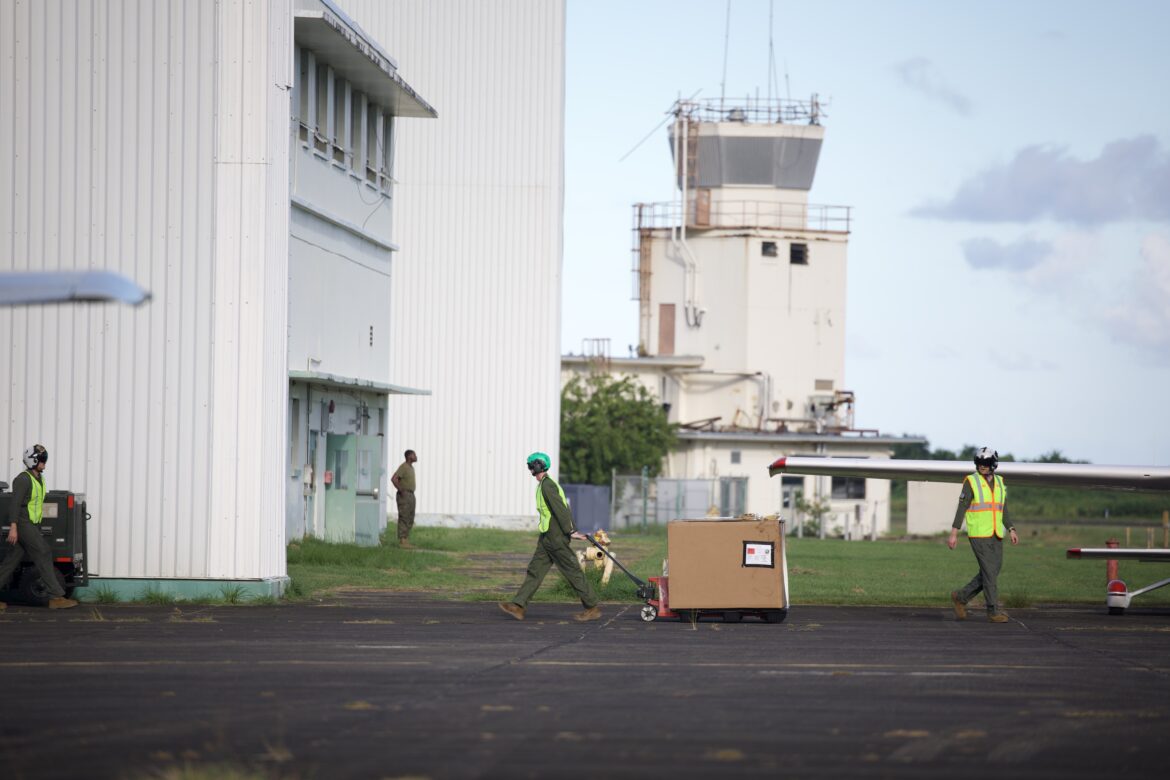
Photo provided
Two fishermen I approached talked among themselves at the old Coast Guard pier, just a few meters from the airport. Right at the entrance to the road leading to the dock stands a sign announcing a multimillion-dollar project that never materialized: the Marine Business Research and Innovation Center (MBRIC), first announced in 2021 by the U.S. Department of Commerce through a grant from the Economic Development Administration (EDA).
“U.S. Secretary of Commerce Gina M. Raimondo announced a $12.8 million grant to the Roosevelt Roads Local Redevelopment Authority in San Juan, Puerto Rico, to construct and establish the Marine Business Research and Innovation Center (MBRIC). This EDA grant, to be matched with $3.2 million in local investment, is expected to create nearly 29,500 jobs and generate $81 million in private investment,” read the May 27, 2021, press release.
On September 3, Department of Economic Development and Commerce (DDEC) Secretary Sebastián Negrón Reichard downplayed the U.S. military’s presence in Puerto Rico, describing it as “temporary maneuvers” consistent with the limited activity the armed forces have historically maintained in certain areas, including operations by federal agencies such as the Army Reserve, the Coast Guard, and Customs and Border Protection.
“These maneuvers do not alter the government’s plans or the governor’s public policy for this zone. The goal remains the economic, social, and tourism redevelopment of Roosevelt Roads, with ongoing civilian projects such as infrastructure reconstruction and others under consideration by the Fiscal Oversight and Management Board,” Negrón Reichard said in a written statement following the public disclosure of the agreement with the local government.

Photo provided
What could easily be seen as a step backward — new U.S. military exercises in Ceiba more than 20 years after the Navy’s withdrawal — takes on a more hopeful tone in the eyes of two fishermen casting their lines among the ruins where the much-touted Marine Business Research and Innovation Center (MBRIC) was supposed to rise. The project was announced nearly five years ago by the administration of former U.S. President Joe Biden. Both men are longtime Ceiba residents who have lived through the before, during, and after of that promise.
“My goodness, you know all the things we’ve been hearing?” one of them says after I remind him of the federal government’s pledge four years ago. “How long are people supposed to keep waiting? Ever since they left [the military], all this just died out and Ceiba sank right along with it, son,” the other fisherman says.
For now, Ceiba is holding its breath as what appears to be a new cycle of militarization begins. Some locals pin their hopes on the return of the same power that, decades ago, drew widespread condemnation across Puerto Rican society and political parties for its deadly impact in Vieques. Forgotten, once again, are the promises of development that never materialized — promises that still fade today into the haze of jet exhaust. The base has never ceased to be a strategic asset for others’ interests. Now the skies are once again filled with planes, even as sustainable development for the people who live here has yet to take off.
Journalist Damaris Suárez contributed to this story.
This translation was generated with the assistance of AI and reviewed by our editorial team to ensure accuracy and clarity.

The newspapers will say literally anything to complain about the people who gives the food. Puerto Rico is definitely a floating island of trash, that includes the media too. The best thing that could ever happened to Puerto Rico is to be a free country. PR doesn’t deserve to be part of the US of A. Their destiny is to become a third world country and they are willing to allow that. Free Puerto Rico! Kick them out of the US!