

At the end of last semester, the University of Puerto Rico (UPR) eliminated all protections that transgender and nonbinary students had secured, under pressure from President Donald Trump’s administration, which tied federal funding to the cancellation of programs and policies that promote diversity, a Centro de Periodismo Investigativo (CPI) investigation found after reviewing documents and interviewing students, faculty members and university officials.
“This decision is being made to ensure regulatory compliance, preserve financial stability in the face of the possible loss of essential federal funds, and protect the interests of our university community,” Ángelica Varela Llavona, chancellor of the Río Piedras campus, wrote in a circular letter when she eliminated inclusive restrooms that had primarily served those communities on campus.
Beyond eliminating inclusive restrooms, UPR’s Governing Board approved in October — without opposition — the cancellation of the Work Plan for Compliance With Regulations on Transgender Students and changes to the Chosen Name Recognition Protocol, removing any mention of transgender students, nonbinary students or the LGBTQ+ community from the policy. The board includes representatives of the government, faculty and students, as well as members of the public appointed by the governor with the advice and consent of the Senate.
The moves followed guidance published in July by the U.S. attorney general, which conditions federal funds on eliminating programs that could be deemed “discriminatory” or that promote diversity, equity and inclusion at universities and agencies in the United States and its territories, guidance that UPR President Zayira Jordán Conde complied with in October. The decision drew criticism from faculty members, who said the president complied without any real threat of losing funds, Jorge Colón Rivera, spokesperson for the faculty caucus of the Río Piedras Academic Senate, told CPI.
“Simply going along with eliminating inclusive restrooms before there’s even a threat … we believe that runs counter to our principles as a university,” he said.
Students from the affected communities have begun to feel fear — both from their erasure and from the potential harassment they may now face — said Kai Marrero Pérez, secretary of the Colectiva de Estudiantes Cuir at the Río Piedras campus, which has about 50 members.
“Trans communities are unprotected right now,” said the psychology student.
“No one knows what the protocol is for handling violent incidents, what can and can’t be said, where this administration’s boundaries are, or how far these measures and policies attacking us will go. Everyone is confused and scared,” he added.

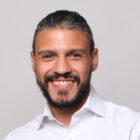
Photo by Víctor Rodríguez Velázquez | Centro de Periodismo Investigativo
Kai, 20, began his gender transition four years ago. He said that since Trump’s return to the U.S. presidency — and the University of Puerto Rico’s policy shifts related to diversity — he has faced ongoing tension and repeated questioning.
He said the behavior extends even to faculty members, who at times use pronouns that do not match a student’s gender identity or insist on calling him by a name he no longer uses, while also minimizing his gender identity.
He recalled that a research mentor — whom he chose not to identify — told him he would prefer “not to know” about his identity and warned that if Kai published research, he should not allow it to become known that he is transgender because that would “take away validity” from his work.
Discrimination from sports to student housing
With a single administrative action last October, UPR nullified a requirement to train professors, nonteaching staff and security personnel on the rights and needs of transgender people. It also relieved the Office of Legal Affairs and the President’s Office of the responsibility to establish institution-wide regulations that would “protect the right of transgender students to use the restroom that corresponds with their gender identity, free of intervention, problems or any barrier.”
The changes also opened the door for athletic directors to discriminate against transgender students on sports teams and removed any obligation for the Office of Permanent Improvements to include the transgender symbol on signage for restrooms, showers, locker rooms and changing areas across UPR’s campuses. The university also eliminated the option for transgender students to choose student housing provided by campuses in accordance “with their gender identity.”
With the protocols dismantled, the confidentiality of personal information is also at risk, and the university loses the guidelines that ensured compliance with Title IX and the Family Educational Rights and Privacy Act (FERPA), leaving transgender students without protections against harassment and discrimination on campus, warned Fabiola Morales, coordinator of the Colectiva de Estudiantes Cuir.
“Trans students don’t feel they can count on the secretarial offices on campus when they need help navigating university matters,” Morales said.

Photo by Víctor Rodríguez Velázquez | Centro de Periodismo Investigativo
For the foreign languages student, the climate of fear and tension is not new for transgender people on campus, but the uncertainty has deepened with the recent changes.
She said she fears these situations could force many students to “stay in the closet.”
“It’s heartbreaking that after so much time — and so many hard-fought struggles to make these spaces more inclusive — we’re moving backward and forgetting everything our predecessors lived through,” Morales said.
UPR’s Governing Board approved the elimination of the protocols at its regular meeting on Oct. 30. With that decision, the board repealed a policy that had aligned with requirements previously promoted by the federal Departments of Education and Justice, before those requirements were later rolled back under the Trump administration.
The move followed another step taken in March 2025, when the UPR’s Governing Board dissolved the Special Committee on Accessibility, Diversity, Inclusion and Equity. Created in 2021, the body was tasked with developing policies and identifying solutions to confront discrimination and promote respect, inclusion, equity and the well-being of the entire university community.
In December, the Governing Board also eliminated the position of chief diversity officer, held by Professor Juan Jorge Rivera. From that post, Rivera oversaw diversity, equity and inclusion matters within the UPR President’s Office — a role seen as central to meeting standards set by the Middle States Commission on Higher Education. The accreditor has kept its DEI requirement in place, though it has warned it will not penalize institutions that fail to meet it in the context of the Trump administration.
Nassim del Río, a nonbinary student, said the absence of a strong institutional policy leaves queer people exposed to “threats and insults” even in spaces that should be safe.
According to del Río, a Christian group on campus known as the Confraternidad Universitaria de Avivamiento — or Confra — allegedly “repeatedly harasses visibly queer students.”
The encounters, del Río said, are often intimidating and laden with religious pressure. “They approach you confrontationally and shout things like, ‘God loves you,’ or ‘You’re going to hell,’ along with other insults,” said del Río, 22, a fine arts student.
CPI requested comment from Confra at the Río Piedras campus but received no response.

Photo by Víctor Rodríguez Velázquez | Centro de Periodismo Investigativo
The group is formally recognized by the campus through the Office of Student Organizations, which describes it as an “interdenominational fellowship focused on bringing the gospel to the university and growing in knowledge and relationship with God.”
“It makes me so angry — it’s a huge feeling,” del Río said. “They don’t stop to think about how those words can affect people’s mental health. And why does my existence bother you so much that you feel you have to take such direct and violent action?”
For the 2025-26 academic year, UPR has 22 religious student organizations registered across the university system. Among them, Confra has the largest institutional footprint, with active chapters on seven of the system’s 11 campuses, CPI found after reviewing student organization records.
Chosen-name policy broadened at the expense of gender identity protections
By amending its chosen-name recognition protocol, UPR’s Governing Board eliminated a mechanism that, since 2024, had explicitly identified — in the policy’s own title — nonbinary students and students with transgender experience as the primary beneficiaries of the process.
The new protocol states that the policy will now apply to “all students,” regardless of gender identity. “This Protocol is hereby promulgated to provide students the option of recording not only their legal name, but also their chosen name … to self-represent in the university setting,” the document reads.
The previous protocol made clear that it applied to nonbinary students and, in its definitions, broadly recognized discrimination based on sex or gender, including against lesbian, gay, bisexual, asexual, transgender and nonbinary people. All that language was removed from the new document.
The earlier protocol also included an article prohibiting discrimination and authorized any student who felt discriminated against by faculty or staff to file complaints involving gender-identity discrimination, harassment, sexual harassment or sexual assault, intimate partner violence and stalking through Title IX offices, in line with federal and institutional rules. The revised version establishes a new article on “complaints” that narrows discrimination claims to cases in which a person fails to use a student’s chosen name.
Gabriel Andrés Negrón, 21, studies music and, because he has not yet completed the name-change process on campus, he said he ran into a situation with an English professor who insisted on referring to him with feminine pronouns, even after he corrected her multiple times.
“I explained that my name is Gabriel — that I’m a man and that ‘he’ is my pronoun,” he said. Even so, he said, the professor continued using feminine pronouns in front of the entire class.
“It was really hard because I felt humiliated,” he said.

Photo by Víctor Rodríguez Velázquez | Centro de Periodismo Investigativo
The episode happened at least two more times: once when the professor called on him to answer a question, and again when he had to leave early because of a family emergency. “The professor said in front of everyone, ‘It’s that she has something going on and she has to leave,’” he recalled.
Under the new protocol, incoming students will be able to select a chosen name when they complete their UPR admissions application.
Although Marrero and Morales welcomed the initiative, they said it comes at the cost of rendering LGBTQ+ communities invisible.
“It’s erasing us little by little from history — from all the records. And it’s deliberate,” Marrero said.
For Negrón, who began his gender transition four months ago, UPR loses its spirit of innovation and universal mission when it sidelines the experiences and perspectives of people who have developed outside traditional norms.
“By removing protections for trans people, you could push a lot of people to leave — or to stop telling their stories at the university to avoid bullying,” Negrón said.
Eliminating inclusive restrooms will bring new costs for the campus
When inclusive restrooms were established in 10 of the more than 60 buildings at the Río Piedras campus in 2019, the university did not incur costs because “the work was carried out by the campus’s own plumbing staff,” Mario Alegre, the campus press director, told CPI.
Restoring those spaces to their original layout, as UPR President Jordán Conde ordered in September, will require “the purchase and installation of urinals, valves and related fixtures, as well as plumbing and masonry work,” Alegre said in written statements. But the campus currently has no funds set aside in this fiscal year’s budget to return the restrooms to a gender-binary format, he added.
Still, the university has already purchased 20 signs to label restrooms “Ladies” and “Gentlemen,” at a cost of $818.80.

Photo by Víctor Rodríguez Velázquez | Centro de Periodismo Investigativo
Chancellor Varela Llavona justified the elimination of these restrooms as necessary to “ensure regulatory compliance, preserve financial stability in the face of the possible loss of essential federal funds and protect the interests” of the university community.
She cited the “Guidance for Recipients of Federal Funding on Illegal Discrimination,” which emphasizes the “importance of sex-separated intimate spaces and athletic competitions,” and warns that requiring employees to share intimate spaces with people of the “opposite sex” would be illegal. Under that interpretation, UPR dismantled an inclusion policy in place since 2019 and championed by then-Chancellor Luis Ferrao.
Varela Llavona insisted, however, that the Río Piedras campus “reaffirms its commitment to the respect and dignity of every member of our university community, fostering an environment of respect for all students, faculty and administrative personnel.”
For Morales, the coordinator of the Colectiva de Estudiantes Cuir, the chancellor’s statement clashes with how quickly the campus moved to roll back inclusive restrooms.
“She says she respects people who want an inclusive restroom, but she’s removing them,” the student said. “There can’t be that kind of contradiction when we’re talking about a community’s rights — especially a community that has been so vulnerable under these policies. If there’s true support and she really wants to show it, then the university would take other steps, maybe look for other funding sources, or take a clear stand against these (Trump’s) measures.”
Negrón agreed, saying the chancellor’s actions “suggest she doesn’t really know the Río Piedras campus — its community or its history.”
“If the chancellor truly knew Río Piedras, she would know this campus survives because of Black people, because of diverse people — even people who are poor — because we’re the ones who contribute so much within the university,” he said. “Maybe being in a position of power means she doesn’t really see the problems and needs of certain groups. In the end, privilege blinds a lot of people.”
By contrast, Jan Carlo Tousset Rivera, a member of the Río Piedras campus chapter of Students for Life — a student organization opposed to abortion rights that has been vocal in calling for inclusive restrooms to be eliminated — praised Varela Llavona’s decision.
“This was the prudent decision because these bathrooms were being used for harassment and were putting federal funds at risk — funds that are so important to the university, especially given the university’s fragile financial situation,” he said in a video posted to his Facebook account.
But campus records from the Río Piedras Office of Compliance and Audits show that reports of sexual harassment and sexual assault have declined in recent years, although the university itself does not have data that would allow it to attribute the change to any specific cause. In 2022, the campus reported seven cases of sexual harassment; three in 2023; and one in 2024. In 2025, it reported one case involving indecent exposure. Even so, the complaint data do not include where incidents occurred, meaning the campus has no way to confirm whether inclusive restrooms served as sites of harassment involving members of the university community or visitors.
Asked about the issue by CPI, Tousset said the campus’s official data do not reflect improved safety, but rather “a decline in trust in the institution’s reporting mechanisms.”
“I received dozens of private accounts through social media from students who described discomfort, fear and inappropriate situations that occurred in restrooms labeled ‘inclusive.’ I personally met three young women who have been harassed inside those bathrooms,” he said.
Tousset pointed to the case of student Arialys Meléndez, who testified at a public hearing last May in support of House Bill 165, which would ban inclusive restrooms in public buildings in Puerto Rico. Meléndez described three instances of sexual behavior she said she witnessed in inclusive restrooms at the campus law school at night, while she was studying and needed to use those facilities.
Tousset also criticized the university for not documenting where violent incidents occur — something he argued “prevents the identification of patterns, risk areas and structural failures, and seriously limits any effective prevention policy.”
“The reality is that insecurity and fear of harassment among female students is enormous,” he said. “If they sleep soundly while lying to themselves, that’s on them.”
After the elimination of inclusive restrooms, the Río Piedras Academic Senate approved a resolution in October supporting their existence, calling them “key to promoting justice, inclusion, equity and dignity” and warning that eliminating them represents “a setback in the rights and protections not only of transgender and nonbinary people, but also of people with disabilities.”

Photo provided
“Implementing inclusive restrooms at UPR acknowledged the scientific reality — broadly documented by medical and psychological associations — that these spaces are necessary to address diversity and recognize people’s rights,” Professor Colón said. “That hasn’t changed.”
The chancellor declined an interview with the CPI and referred questions to the statements included in the circular letter sent to the university community in September, when she announced the elimination of inclusive restrooms.
This story was possible in part with the support of True Self Foundation, Coalición Orgullo Arcoíris and Amnesty International Puerto Rico.
This story was produced through a collaboration between the Centro de Periodismo Investigativo and Open Campus.
This translation was generated with the assistance of AI and reviewed by our editorial team to ensure accuracy and clarity.
