



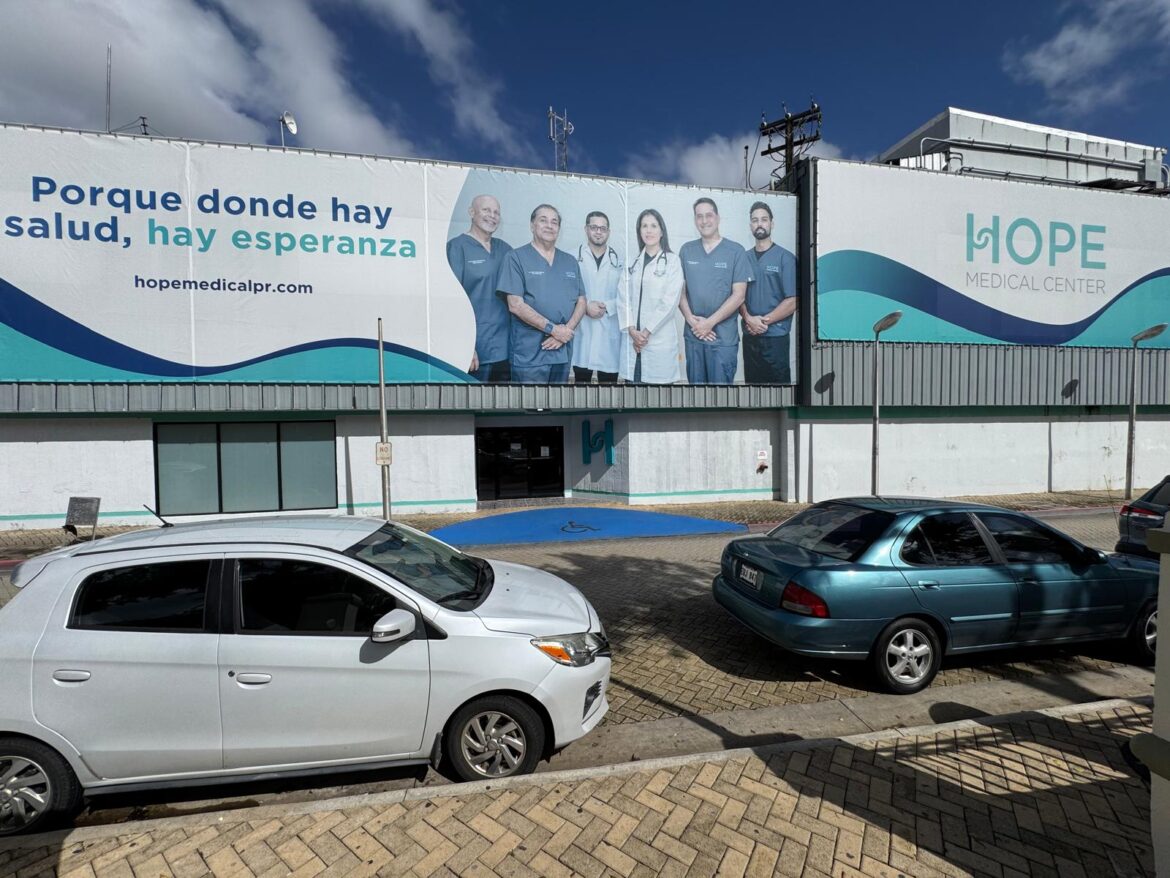
The deal that a group of Puerto Rican physicians — led by radiologist Josué Vázquez Delgado — and several beneficiaries of Puerto Rico’s Act 60 tax incentives, headed by crypto magnate Brock Pierce, announced with great fanfare as the salvation of the bankrupt HIMA Hospital in Humacao, ultimately became its undoing.
The facade of the Hope Medical Center building, beside Humacao’s town square, is still plastered with a giant image of Dr. Vázquez Delgado and other doctors. But none of them are there. Less than two years after the hospital was acquired through a bidding process in U.S. Bankruptcy Court, the doors are chained and padlocked shut, 168 employees have been left without jobs with two weeks of back pay owed, and the institution is carrying debts that exceed $1 million.
Meanwhile, the Puerto Rico government does not know who owns the company that holds title to the hospital — or how those owners will respond to creditors — according to an investigation by the Centro de Periodismo Investigativo (CPI). The reporting included interviews with internal sources, a half-dozen people close to the operation, a review of court filings and records at the Puerto Rico Property Registry, and interviews with some of the top officials responsible for ensuring compliance with applicable laws and regulations.
“That part of the corporation — who is or isn’t involved — is not something Health gets into,” said Puerto Rico Health Secretary Víctor Ramos Otero. He said he does not know who the hospital’s current owners are beyond the corporation Eastern Health, which was granted the licenses and the Certificate of Need and Convenience (CNC) — a document issued by the secretary of health authorizing a person to carry out an activity related to health services. The official attributed the closure to “mismanagement.”

Photo provided by Hope Medical
The physicians who originally applied for the license — Drs. Freddy Velázquez, Harry Negrón Judice and Vázquez Delgado — are no longer part of that corporation. The first two left before the sale was finalized, and the last left in January 2025, when he sold his stake in the company. The change in ownership and management was not reported to the Puerto Rico Department of Health. The secretary’s regulations governing the construction, operation, maintenance and licensing of hospitals in Puerto Rico state that when there is a change in “ownership control,” a new license application must be filed. But the secretary told the CPI the corporation did not have to notify the Department of Health because the company holding the license — Eastern Health — did not change.
Pressed by the CPI on who, as individuals, is responsible for the defaults and the debts, Ramos Otero said that although they are not the debtors and are not being fined, members of the corporation’s board of directors “have responsibility.”
Humacao’s finance director, Peter Vega Santana, and the president of the Municipal Legislature, Ángel David Rodríguez Medina, told the CPI they also do not know who owns the hospital. Rodríguez Medina said the hospital — more than 100 years old — has changed hands four times, and the ownership was always clear… Until now.
Vega said that in April 2025, Hope Medical Center filed a preliminary statement of gross revenue volume with the municipality for the prior year, but did so without the required income tax return, and requested an extension that expired in October. He said the municipality is now conducting an internal audit and will issue a letter notifying the company of its findings and violations, which officials expect to send before Jan. 31, 2026.
The CPI learned that the company reported preliminary gross revenues of less than $100,000 for 2024. That figure does not align with information from three sources tied to the operation, which reported monthly expenses exceeding $1 million. Vega declined to confirm the revenue figure, citing confidentiality, but acknowledged that less than $100,000 a year would not be consistent with a hospital operation like Hope Medical Center’s. Asked who submitted the documents on the company’s behalf, Vega said an email address associated with Negrón Judice was used — even though he had left the company in December 2023.
As neither the central government nor the municipality knows which legal entity — and which individuals — are behind the operation, a legal fight in the courts over debts, transfers and purchases remains active, offering no clearer answer as to who holds title to the hospital.
On Dec. 5, the Department of Health suspended Hope Medical Center’s CNC and operating licenses after the hospital abruptly shut down without prior notice to the agency. The Municipality of Humacao also confirmed to the CPI that Hope operated without a business license and is out of compliance with the final gross-revenue filing and the income-tax return for its first year of operations, 2024.
Meanwhile, employees were “temporarily suspended” — without prior notice and with no return date — and left unpaid in the middle of the Christmas season.
“I had to tell my son: Santa Claus can’t come”
Hope Medical Center employees still have not been paid the wages they have been expecting since the day after Thanksgiving. The situation has left workers devastated — not only because they lost their income, but because it happened during the holidays.
Nicole Peña, the hospital’s general nursing supervisor, said employees had been struggling for the past six months to cash some paychecks because the accounts lacked sufficient funds. The last paycheck arrived Nov. 14, she said, but some employees needed several days to cash it because there still was not enough money to cover the checks.
“We don’t know anything,” Peña said of when they will be paid. “I worked four extra shifts so I could buy gifts for the kids. And I ended up with nothing — no rope, no goat — just me,” said the mother of three, invoking a Spanish idiom for being left empty-handed.
She said Good Samaritans lent her money so she could buy a birthday present and a cake for one of her children because “I literally had nothing.”
“I had to tell my son, ‘Santa Claus can’t come’ … when my 10-year-old still had that illusion,” she said, her voice breaking. “I had to take away his belief in Santa Claus. That’s not easy.”
Greika Meléndez Cintrón, who also worked as an emergency room nurse at Hope, said the situation has taken a toll on her mental health after she suddenly lost the income she earned at the hospital.
“I had to go back to the psychologist… I’m not sleeping,” said the mother of an 8-year-old.
“Management’s answer was always, ‘We’re working on it.’ And when we asked, ‘What about the checks?’ they’d say, ‘We’re working on that,’” she said.
The Puerto Rico Department of Labor and Human Resources confirmed to the CPI that 126 hospital employees have filed wage claims with the Bureau of Labor Standards for pay periods running from Nov. 9 through Dec. 6. Agency spokesperson Marimar Alicea Torres declined to estimate how much the hospital owes, saying officials are still reviewing the cases and more employees continue to seek guidance through the bureau.
Karla Vallejo De Jesús, the deputy secretary for worker benefits at the Puerto Rico Department of Labor and Human Resources, told the CPI the agency has received 146 unemployment insurance claims. She did not provide information about what Hope may owe the department, stating that the information is confidential and that the hospital is not in bankruptcy proceedings.
From HIMA to Hope: A Repeat of the Same Warning Signs
Many of the problems that pushed the HIMA hospital network into Chapter 11 reorganization bankruptcy in August 2023 now appear to be resurfacing — including unpaid electric and water bills, as well as outstanding debts to employees and vendors — according to two sources familiar with the operation. LUMA said it could not disclose what customers owe, and the Puerto Rico Aqueduct and Sewer Authority had not responded to a records request as of publication.
In HIMA’s case, the Puerto Rico government allowed $180 million in debt to accumulate over 50 years.
Even before the closure, Hope faced nearly $500,000 in collection lawsuits in Puerto Rico’s courts, some of which have already been resolved. Among them is a lawsuit filed by PR Health Management Group — a company owned by Dr. Negrón Judice that managed the emergency room — seeking $118,257. The other cases involve failures to pay for medicines and cleaning products.
Eastern Health’s authorized representative, Venezuelan businessman Gustavo Higuerey, declined to answer the CPI’s questions. Higuerey, according to Vázquez Delgado, one of the original owners, would not even confirm whether he is still an owner.
“We are waiting for something to be determined at the Department of Health, and once that happens we will be willing to participate in your interview,” Higuerey said, referring to a report to be issued by the hearing examiner for the Division of Administrative Hearings within the Office of the Deputy Secretary for Regulation of Public Health at the Puerto Rico Department of Health. He made the remarks after an administrative hearing held on Friday, Dec. 12, at the Department of Health regarding the cancellation of Hope’s CNC and its operating permits.
In the resolution and report issued after that hearing, on Friday, Dec. 19, the hearing examiner ordered the revocation of the CNC, the hospital operating license, the laboratory license, the controlled substances registration certificate, the medications and pharmacy license, and the license for the preservation and record-keeping of biological materials. The examiner also imposed a $30,000 fine.
The CPI called Higuerey again, but he did not answer.
At the hearing, Hope Medical Center appeared through attorney Arturo Bauermeister and several members of its board of directors, whom the lawyer identified as Christopher Valentine, Cassandra Wesselman, Sanjeev Kaila, Pierce and Higuerey. The report from the administrative hearing said Higuerey was appointed interim CEO to handle the situation. In that administrative process, Hope challenged the Department of Health’s cancellation of its licenses and certificate, arguing that the cancellations were improper because the company has the right to close and that the closure is temporary.
Crypto entrepreneur Pierce, who is involved in dozens of lawsuits in Puerto Rico and is facing a reassessment of his tax decree on the island, told the CPI that Wesselman — his right-hand aide and the hospital’s chief financial officer — would call to answer the CPI’s questions. But as of publication, the call had not come. Valentine answered one call but said he would not be available to respond because he would be in Florida for two days. The CPI later called again and sent a text message, but he did not respond.
Short life, long history for Hope
In its short existence, Hope Medical Center’s story has involved a web of limited liability companies — nearly a dozen of them, most formed primarily by foreigners and including at least one beneficiary of the tax exemption granted under Act 22 and its successor, Act 60.
The network also includes lawsuits — in which much of the supporting evidence remains sealed in court records — with multimillion-dollar allegations of nonpayment and fraud, and even the alleged foreclosure of parcels tied to the former W hotel property in Vieques. The legal war, centered on a $6 million loan that began before the hospital sale closed, sheds some light on the people who have held — or still hold — ownership stakes in the business.
According to court filings, Act 60 beneficiary Christopher Valentine, along with Gustavo Higuerey, sought a loan through Higuerey’s company, Celeres Holdings LLC, from another Act 60 investor and former contractor for COR3’s Hurricane Maria recovery work, Joseph Lipsey III. The loan provided the cash needed to bid for the Humacao hospital in U.S. Bankruptcy Court. Pierce, according to court documents, would provide the collateral for the loan. Both Lipsey and Pierce would receive an ownership stake in the corporation to be created to purchase the hospital.
Lipsey, a transportation and logistics contractor for FEMA in the United States, was arrested in 2019 in Aspen, Colo., on allegations that included distributing cocaine to a minor, possessing drug paraphernalia and providing nicotine to minors. He later pleaded guilty to other, lesser offenses. That same year, he resigned as CEO of his companies, according to trade publications and Aspen-area media reports.
But according to Valentine’s and Higuerey’s allegations in court, Lipsey and Pierce later turned on them and negotiated a secret agreement between themselves to partner and jointly lend the money to Celeres, without Valentine and Higuerey knowing the terms of that contract.
Soon afterward, Lipsey — who argues in a response to one of the lawsuits that the money he provided was only for the deposit, not for the purchase — foreclosed on the Vieques parcels from his partner Pierce for nonpayment before the hospital purchase was completed in mid-December 2023. That same month, Pierce sued Lipsey for fraud, and Lipsey demanded that Valentine and Higuerey immediately repay the full loan, even though he had already taken the collateral. Lipsey argues that these were separate contractual agreements and that he is entitled to both remedies: the Vieques property negotiated with Pierce as collateral for the loan, and the repayment of the loan made to Celeres.
This tangle of litigation remains unresolved, and the settlements, much of the contracts and many of the exhibits in the cases remain confidential at the San Juan Superior Court, making it impossible to determine where ownership of the hospital now stands. Lipsey’s attorneys did not return CPI’s calls seeking an interview.
The company that ultimately acquired the hospital — along with its land, equipment and licenses — through the bankruptcy process was Eastern Health LLC. Its president, Dr. Vázquez Delgado, who owned 50.1% of the shares due to his operational and human-capital contributions, sold his shares more than a year ago to a Delaware-registered firm, Gogoplex Fund LLC. The physician, who provided the CPI with evidence of the sale, said Higuerey signed on behalf of that corporation but does not know who owns it. He said he was paid for his stake with a parcel of land near the Palmas del Mar resort and residential complex that was acquired as part of the hospital purchase in bankruptcy court.
Eastern Health LLC and the hospital’s operating company, Hope Medical Center LLC, are governed by boards of directors made up of the same seven people: Cassandra Wesselmann, Christopher Valentine, Nick Vidar, Sanjeev Kaila, Luke R. Fox, Gustavo Higuerey and Pierce, who serves as chairman. Pierce, Valentine and Kaila are Act 60 beneficiaries, the Puerto Rico Department of Economic Development and Commerce confirmed.

Photo provided by Hope Medical
All those individuals are also investors in the hospital, according to three sources tied to the operation.
Negrón Judice told the CPI he stepped away after realizing the people involved lacked experience in the hospital industry.
“In this case, the investors who came in were completely unknown — they didn’t know the health care industry. Obviously, that worried me tremendously,” Negrón Judice said.
He said his initial goal when founding the company was to attract physician shareholders who understood the industry.
“I didn’t feel comfortable negotiating and being in business with people I didn’t know, and from day one I preferred to step aside,” Negrón Judice said.
Dr. Velázquez declined to speak with the CPI. Vázquez Delgado, meanwhile, distanced himself from the hospital’s financial and operational problems, telling the CPI they began after he left. He said he exited the operation because that was his plan from the start. That claim conflicts with statements he made in December 2024, when he said the group had invested $10 million in hospital improvements over the previous 12 months and spoke about plans for the institution.
“My agreement with the investors was clear from the beginning: We were going to complete the purchase, credential the hospital and stabilize it, and after that I would have an exit and return to my main profession as a radiologist,” Vázquez Delgado said.
He said that when he left the hospital a year ago, “the hospital’s billing and occupancy targets had been met.”
Aside from those physicians, the only person who has publicly presented himself as part of HOPE Medical’s ownership group is Pierce.
A Shutdown Without Notice
The secretary of health said the hospital violated the law by failing to follow the proper steps to close the institution. The agency received only a letter from Higuerey notifying it of the closure after the fact, not beforehand, which would have allowed for an orderly transition. Ramos Otero said that to request changes to a CNC — including a CNC for closure or an emergency CNC — the applicant must upload and submit supporting documents through the department’s online portal. That did not happen.
Before receiving Higuerey’s letter, the Department of Health learned the hospital no longer had patients.

Photo by Brandon Cruz González | Centro de Periodismo Investigativo
“The reality is that both closures have been due to mismanagement — the Hospital del Maestro and this one, Hope,” the secretary said. “The main cause of the closure may have been something else, but the principal cause was this: When we got there, there wasn’t even an administrator. There was no one. They had discharged the patients three days earlier. When we spoke with the medical director — who was the only one admitting patients there — she told us the oxygen ran out. She got tired, resigned and transferred her four patients: three to Ryder and one to Pavía Caguas,” he said.
“They didn’t notify me of anything, but they also didn’t notify the Department of Labor,” Ramos Otero added, saying they also failed to notify the Puerto Rico Department of Economic Development and Commerce, which they were required to inform because they were beneficiaries of Workforce Innovation and Opportunity Act funding aimed at developing the workforce.
The secretary said he does not know how the different groups that bought hospitals once owned by the HIMA San Pablo network were vetted in the bankruptcy court sale process.
To reopen, he said, the hospital would have to apply for a new CNC and meet all requirements.
Although the hospital’s future remains uncertain, the official said there are groups interested in buying it.
Employees, meanwhile, continue to wait for the wages they are owed during the Christmas season, with no one able to tell them who is responsible — or when they will finally be paid for their work.
Journalist Amanda Pérez Pintado contributed to this story.
This translation was generated with the assistance of AI and reviewed by our editorial team to ensure accuracy and clarity.
