

University of Puerto Rico President Zayira Jordán Conde will keep in place the rollback of diversity, equity and inclusion initiatives that were scrapped last year to comply with directives from the U.S. Department of Education, even though the agency lifted those restrictions last month after a ruling by the U.S. District Court for the District of New Hampshire.
The court order permanently struck them down and barred their enforcement or reinstatement in the United States and its territories.
Asked whether, considering the ruling, the UPR will restore the initiatives that were eliminated, Jordán Conde told the Centro de Periodismo Investigativo that the university does not make decisions automatically.
“The University of Puerto Rico acts in accordance with the federal and state regulations in effect at the time it adopts its administrative decisions. When the regulatory framework changes or becomes subject to judicial review, the University reassesses its scope and adjusts its policies as appropriate,” she said in written statements.
“This is a dynamic process that is part of the compliance obligations of any institution that receives federal funds,” Jordán Conde added.
To align itself with the policies of President Donald Trump’s administration, the Special Committee on Accessibility, Diversity, Inclusion and Equity on the UPR Board of Governors was eliminated in March 2025, and a census aimed at collecting data on the university system’s Afro-descendant community was halted. Other initiatives were also affected, including grants from the National Institutes of Health (NIH), by the Trump administration’s anti-diversity policies, as well as the Department of Energy’s Reaching a New Energy Sciences Workforce, or RENEW, program, which is intended to support institutions that serve communities underrepresented in the sciences.
Jordán Conde, who took office in June 2025, after Trump’s policies were already in effect, said the university administration is still evaluating the scope of the Feb. 3 court ruling and has therefore made no changes to the policies imposed last year that rescinded protections and guarantees of respect for diversity.
She argued that the institution’s decision to eliminate diversity initiatives under the justification of protecting federal funds “has not affected essential services or protections against discrimination.”
“Our commitment remains to guarantee an academic environment that is accessible, respectful and in compliance with the law, while also protecting institutional stability and access to federal funds that sustain multiple academic and research programs,” she said.
But Jordán Conde’s decision could suggest that the diversity, equity and inclusion initiatives were not eliminated solely to protect federal funding, because even after the court’s ruling she has chosen to keep them on hold and maintains that further analysis is needed before restoring them, according to Annette Martínez Orabona, executive director of the American Civil Liberties Union in Puerto Rico.
“There is absolutely nothing preventing the UPR administration, or any educational entity, from restoring any program or initiative previously affected by a directive that is no longer in effect. Even while it was in effect, the proper course was to challenge and oppose its enforcement, as it was clearly discriminatory and illegal. Given that this was not done and that, instead, the decision was to immediately implement the directive and dismantle diversity, equity and inclusion initiatives, it is fair to question the real reasons those initiatives would not be restored with the same speed with which they were put on hold,” Martínez Orabona said.
The ACLU was the organization that sued the U.S. Department of Education on behalf of the National Education Association, the Center for Black Educator Development and several New Hampshire school districts.
When the court issued its ruling, Sarah Hinger, deputy director of the ACLU’s Racial Justice Program, said that “the ruling affirms that educators must be free to teach and that students have the right to a full and honest education that reflects the diversity of their communities and prepares them to participate in our democracy.”

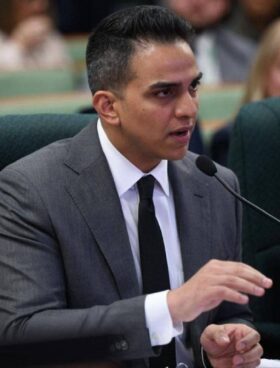
Photo by Víctor Rodríguez Velázquez | Centro de Periodismo Investigativo
The U.S. Department of Education issued a circular in February 2025 warning that it would treat initiatives promoting diversity, equity and inclusion as illegal and threatened to withhold federal funding.
In its lawsuit against the federal agency, filed in March of last year, the ACLU argued that the restrictions violated rights protected by the First Amendment to the U.S. Constitution and improperly imposed limits on what faculty may teach and research, as well as on what students are allowed to learn.
The ACLU contended that the Department of Education’s letter misrepresented a 2023 U.S. Supreme Court ruling against Harvard University and in favor of Students for Fair Admissions, an organization seeking to eliminate racial and ethnic considerations in college admissions. In the lawsuit, the ACLU argued that the decision in favor of the organization focused only on the use of race as a formal factor in university admissions and did not impose bans on curriculum, student groups, DEI programs or race-neutral diversity initiatives.
Testimonies gathered by the CPI document complaints of racist actions reported by students and professors, as well as statements from transgender students who say violence against them has increased since policies advanced during the Trump administration led the UPR to eliminate protections aimed at that population. In the case of the elimination of gender-related protections, the UPR maintains that it is acting in compliance with the “Guidance for Recipients of Federal Funding Regarding Unlawful Discrimination,” issued July 29, 2025, by the U.S. Attorney General.
The Trump administration’s policies on racial diversity have also extended to entities that fund UPR research, such as the NIH, which last year canceled eight university projects focused on diversity and race — four of them at the Medical Sciences Campus — leaving the university without more than $4.5 million in undisbursed funding, according to NIH reports.
In establishing its anti-diversity policies, the U.S. Department of Education interpreted Title IV of the Civil Rights Act, which prohibits discrimination on the basis of race, and the Equal Protection Clause of the U.S. Constitution as grounds to require universities to eliminate diversity-related programs and policies.
After the February ruling, Martínez Orabona urged school and university administrators to “immediately restore any program, research or initiative affected during the past year by this illegal directive.”

Photo by Vanessa Serra | Centro de Periodismo Investigativo
The attorney said that “all students have the right to an education in a safe environment that respects their dignity and provides them with all the tools necessary for their development; no one should be made invisible in any classroom in Puerto Rico.”
She added that “those who educate know that diversity, equity and inclusion are the foundation of a democracy that aspires to be just.”
This story is possible through a collaboration between the Centro de Periodismo Investigativo and Open Campus.
This translation was generated with the assistance of AI and reviewed by our editorial team to ensure accuracy and clarity.