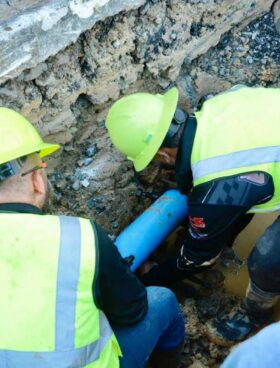

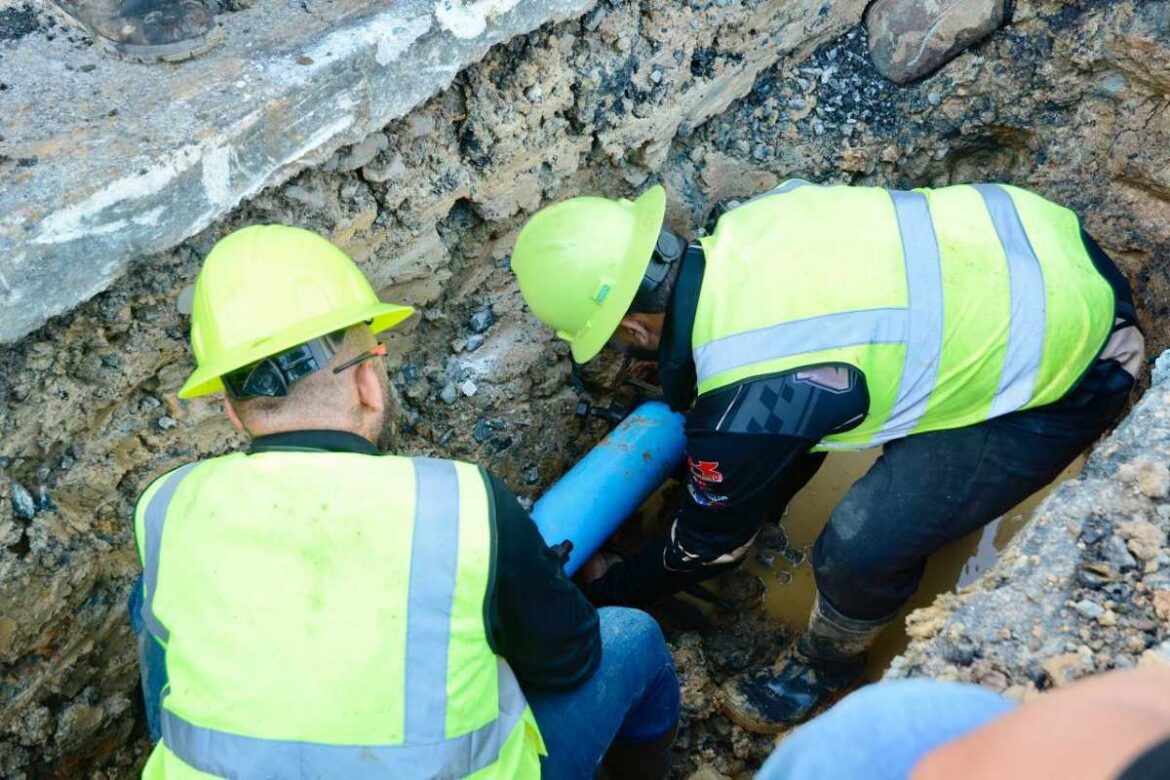


Over the past five years, the Puerto Rico Aqueduct and Sewer Authority (AAA, in Spanish) has not increased the share of funding allocated to repairing and replacing obsolete pipes, valves or connections. That share stands at just 4% for 2026 — a proportion the agency says will decline over the next two years, an investigation by the Centro de Periodismo Investigativo (CPI) found. This is despite broken pipes being the leading cause of treated water loss in Puerto Rico.
The remaining 96% of capital improvement funds has gone toward rebuilding structures damaged by hurricanes and earthquakes, complying with Environmental Protection Agency (EPA) requirements, mitigation projects, water quality improvements, and purchasing electric generators, pressure gauges, technology infrastructure and new vehicles.
Although the budget for repairing and replacing drinking water pipes has increased since 2021, the share of funding devoted to those efforts has been smaller than that allocated to the other categories in the capital improvement budget since that same year. The percentage decline in funding to fix pipes and connections comes as water losses have worsened, in part because of the aging of the AAA’s distribution system, at least seven sources connected to the agency told the CPI.
Of the $845.8 million the AAA allocated for capital improvements in 2025, only $60.8 million, or 7%, was set aside to repair existing infrastructure, according to reports from the public corporation. Sixty-one percent of those funds is for reconstruction projects subsidized by the Federal Emergency Management Agency (FEMA) to repair structures damaged by hurricanes and earthquakes.
That figure contrasts with 2019, when the AAA allocated 43% of the capital improvement program’s $73.5 million to projects to repair and replace pipes and other assets in the distribution system.
AAA President Luis González Delgado acknowledged that the aging of the agency’s 20,000 miles of pipes is one of the main causes of water loss. Still, he did not answer the CPI’s questions about why increasingly less money will be allocated to repairing or replacing obsolete systems.
“Unaccounted-for water loss,” as the AAA calls it, is the calculation of drinking water that is produced and enters the system but does not generate revenue. In addition to physical losses, it includes commercial losses caused by billing or metering errors and theft. Unaccounted-for water loss rose from 59% in 2017 to a record 69% in 2022, according to data analyzed by the CPI.

Photo Provided | Centro de Periodismo Investigativo
Hydrologist Jorge Ortiz Zayas, an expert in water systems and reservoirs who was part of the group that represented the University of Puerto Rico in developing the government’s Water Plan in 2004, said it would be more efficient to devote more funding to repairing and replacing the distribution system, which would reduce losses and make more water available.
“If you reduce [water losses] from 62% to 25%, which is normal in countries with more experience in this and more resources, the AAA would have an additional supply equivalent to 200 million gallons a day. That is practically the equivalent of two Superaqueducts,” Ortiz Zayas explained. The Superaqueduct (Superacueducto) is a 46-mile treated-water transmission pipeline, 72 inches in diameter, that carries water from the Río Grande de Arecibo basin on Puerto Rico’s north coast toward the San Juan metropolitan area.
AAA management has conflicting figures on water loss. Not even the public corporation’s executive president, González Delgado, knows for certain how much water the agency he heads loses. The AAA Fiscal Plan says the agency lost nearly 63% of the water it produced in 2024, but González Delgado estimated before the Full Senate Committee in June that the loss was “close to or below 40%.” Meanwhile, Arnaldo Colón, an AAA executive adviser who oversees contractors for the Water Recovery Office (ORA, in Spanish), said at a Governing Board meeting that 66% of the AAA’s water goes unbilled.
Asked by the CPI how he arrived at the 40% estimate, González Delgado said the figure was based on what he had observed in the field.
“To say that we waste two-thirds of the water produced in Puerto Rico — and we’re talking about millions of gallons — we would have rivers in our streets, and that is not happening,” the AAA chief said when confronted with the official figure the agency has provided in numerous documents and public appearances.

Photo by Maricarmen Ortiz | Centro de Periodismo Investigativo
González Delgado said solving the water loss problem requires “a defined plan of priorities,” established through field intelligence, or the process of collecting data directly from infrastructure. For several years, the AAA has contracted Truenorth Corporation, for $34.9 million, for services that include this field intelligence work, without resolving the water loss problem.
Replacements Instead of Patches
Yonaira Hernández, executive secretary of the Unión Independiente Auténtica (UIA), the union representing corporation employees, said that meeting a water loss reduction target requires placing greater emphasis on replacing deteriorated pipes rather than patching them with temporary fixes.
The AAA employee said instead of repairing with couplings, or pipe connectors, the public corporation should “replace the entire” corroded pipe to prevent it from breaking somewhere else. “Instead of installing a new pipe, they decide to patch it,” she said.

Photo Provided | Centro de Periodismo Investigativo
Puerto Rico Society of Engineers President Yamil I. Castillo Crescioni agreed that more should be invested in replacing infrastructure, rather than merely making temporary repairs.
To address physical losses, he said, the replacement of deteriorated infrastructure should be accelerated, illegal connections should be identified and eliminated, distribution systems should be systematically replaced, sediment collection systems should be installed, and telemetry, or remote measurement of water flow, should be used to detect failures at an early stage.
In 2013, under Alberto Lázaro’s presidency, the AAA increased residential and commercial customers’ water bills by $20 to comply with EPA requirements, protect watersheds — with priority given to Caño Martín Peña in San Juan — support systems in rural communities and address the public corporation’s deficit.
Planner Félix Aponte Ortiz, who served on the AAA Governing Board until 2020, recalled that some of the money the utility would collect from that increase was supposed to go toward repair and replacement projects. However, he said those funds were repeatedly diverted to emergency work, particularly to repair breaks or overflows in the wastewater system, rather than to replace obsolete drinking water pipes as originally planned.
“It wasn’t used for what they said it would be used for; that investment wasn’t used to repair water losses. My impression is that it was used to deal with emergencies involving broken mains, particularly sewer mains,” he said.
A CPI source familiar with the AAA’s budget added that the water loss problem persisted despite that increase because the funding for replacing obsolete systems “wasn’t enough.” “It’s a money problem. The AAA allocated only between $50 million and $60 million to replacement projects, and not just pipes, but pumps, valves or any equipment. That budget is barely enough,” the source said.
According to the source, some of the 2013 increase was initially allocated to repair and replacement projects. “But after that, the government declared bankruptcy, we lost access to the [bond] market, Hurricane Maria hit in 2017, the pandemic came in 2020, and all of that became a priority at the AAA,” the source said, referring to the public corporation devoting more effort to dealing with those crises than to replacing obsolete infrastructure.
Luis García Pelatti, who served on the AAA Governing Board when the 2013 increase was approved, agreed that the money projected for repairs and replacements from that rate hike was never enough, and water losses did not improve.
He recalled that as Gov. Alejandro García Padilla’s four-year term was nearing its end, (2012-2016) “another water rate increase was already needed.” He said he proposed small annual increases, but they were not considered.
“We were trying — at least I was — to have increases take place in the second or third year and to try to avoid election years, because those were extremely difficult; they generate enormous political pressure,” he said.

Photo by Brandon Cruz González | Centro de Periodismo Investigativo
During his time on the AAA Governing Board, García Pelatti noticed that money allocated to capital improvements rarely reached leak repairs because capital markets do not lend money to repair existing infrastructure, only to build new projects. “Even though we had a capital improvement program … those [funds] could only be used for new construction. I can’t borrow money, and no one will lend you money to fix leaks. The capital market will lend you money to build a new plant … but you can’t borrow money to fix leaks,” he explained.
A Staffing Problem, Not Just a Pipe Problem
In the AAA’s Western Region, efforts to optimize filtration plants and repair hidden leaks in 2021 depended on a single specialist in San Germán who analyzed water pressure, velocity and flow and was responsible for covering the area’s entire hydraulic network. ORA itself — a division the AAA created in 2014 to address the water loss problem — acknowledged in a 2021 report that it was seeking additional funding to expand its leak-detection crews, with the goal of hiring at least two employees per region by 2022.
García Pelatti recalls that there was constant debate over hiring companies and outside personnel instead of creating permanent positions within the public corporation that would provide continuity for work such as managing water loss. Since its creation, ORA has been operated entirely by Truenorth Corporation, which since 2016 has received $34.9 million in contracts from the AAA to develop projects that include pressure management, leak detection, and analyzing how much drinking water is produced, consumed and lost, CPI found.
“At the Aqueduct and Sewer Authority, there was a strong tendency to outsource. The corporation saw it as a way to solve problems,” García Pelatti told CPI. “We had demands from the employees’ union, and I think there was even a genuine argument that they should try to hire staff, because I remember the discussions about having trained personnel within the corporation to handle these issues [such as water loss].”
However, García Pelatti does not understand why the decision was made to delegate those functions to Truenorth personnel and other firms.
“I can’t tell you why they contracted out the water loss work. It was a surprise to me. I would have thought [managing water loss] was an operational matter. But I did notice that the AAA contracted out a lot of work. As the head of an agency [the Planning Board] where I couldn’t hire, I would look at those things and it seemed like they were at Disney in the middle of the crisis,” he said.
AAA Has Lost 13% of Its Workforce in a Decade
Hernández, the UIA executive secretary, said the AAA currently has vacancies it has been unable to fill, which she attributes to the pay gap between what the agency pays and what its private contractors pay. According to the Office of the Comptroller, the AAA had 219 vacant positions as of July 2026.
“The pay our colleagues receive is not fair for the work they do. They recruit people, and a month later they quit, because the kind of work we do is worth much more than the $10.50 an hour we get paid, especially with the heat we face out on the street,” she said.
Hernández has worked at the AAA for 15 years. She started by cleaning meters, then moved on to reading and replacing meters and shutting off water service.
She described the sometimes difficult conditions of working for the AAA in the field. “They arrive, park and head out on foot. They don’t get water until they return to the vehicle. We’re talking about dehydration because of the temperatures, vehicles being provided to them that aren’t in good condition, not having tools, and sometimes the equipment and tools aren’t comfortable to work with. People leave as fast as they can,” referring to the conditions new hires face.
Over the past decade, the AAA’s workforce shrank by 13%, from 4,789 filled positions in December 2016 to 4,167 in December 2025, according to the Office of the Comptroller.

Photo Provided | Centro de Periodismo Investigativo
Hernández also attributed part of the problem to appointments to trust positions, which she said are based more on partisan political connections than technical expertise. “We depend on a government that appoints political allies to work at the AAA, but don’t have the knowledge,” she said.
According to Office of the Comptroller data, the number of trust positions at the AAA increased from 149 to 185 between December 2016 and December 2025, a 24% increase. Meanwhile, filled career positions declined by nearly 11%.
The union leader described a chain of positions that she believes do not contribute to the agency’s actual work. “We have the assistant to the assistant to the assistant to the assistant, and that keeps draining the Authority,” she said.
González Delgado, the AAA’s executive president, acknowledged during a public hearing in the House of Representatives in late August that the agency’s staffing decline contributes to its inability to repair leaks and breakdowns promptly, complicating the availability of water that reaches customers and ultimately is lost.
He noted that AAA crews take between three and five days to respond to a reported breakdown, depending on the region.
“It depends, in this case, on the size of the region; it depends on the number of resources the region has,” González Delgado explained. He also acknowledged challenges in hiring personnel.
Responding to lawmakers’ questions, González Delgado cited low wages as the main reason the public corporation has not hired the personnel it needs, an issue the union has also raised.
“An operational systems worker, a water systems worker, basically starts at $10.50 an hour, and although we have benefits such as health insurance, among other things, some people prefer to have the cash in hand rather than the benefits,” the executive president said.
Lost Revenue Limits AAA Reinvestment
Engineer Carl Soderberg, a former EPA director for the Caribbean who previously worked at the AAA, said the agency’s staffing reductions have also affected efforts to combat water theft and collect from delinquent customers, which are components of the unaccounted-for water calculation that reduce the agency’s revenue. In 2024, commercial losses accounted for 17% of the water lost, according to AAA data.
“To the best of my knowledge, they aren’t carrying out operations to detect water theft, which is different from leaks, especially hidden ones. The leaks people see in the streets are only the tip of the iceberg when it comes to those losses,” he said.
He pointed to last summer leaks in the Superaqueduct system that could only be located after crews excavated to depths of more than 30 feet because the leaks were not visible from the surface.

File Photo | Centro de Periodismo Investigativo
Soderberg said that if the AAA does not conduct enough inspections to detect water theft, it sends people the message that no one is watching. “It’s like an invitation to steal water,” he said.
Hernández, of the UIA, said there are high-consumption customers, such as hotels and industrial companies, that receive service regularly and do not pay, but when the AAA moves to disconnect their service, they make a small payment and the public corporation requires employees to reconnect them. She cited hotels that owe more than $40,000 on their water bills and, when faced with disconnection, pay just $2,000, for example, to avoid having their service shut off.
“Because it’s a hotel, you shut off the service and half an hour later they’re telling you, ‘You have to go turn the water back on.’ That’s where the AAA is taking a loss because it’s water that was billed, it’s water that was processed, but it isn’t receiving the full amount of the debt immediately,” she explained.
Hernández said this pattern of unpaid debts extends to other industries, such as factories and pharmaceutical companies, and even to government agencies themselves.
“We see the case of the [Department] of Corrections, which owes the Aqueduct and Sewer Authority $17 million. That is money the Authority loses after having produced all the water they consumed,” she said.
At a Governing Board meeting on Sept. 18, AAA Finance Director Alexander López García revealed that 14 government agencies and municipalities owe the public corporation $73.3 million.
That combination, Hernández said, explains much of the 66% water loss reported in official figures. “It’s not that the water is lost by spilling into the street; sometimes it gets where it’s supposed to go, but it isn’t paid for,” the UIA representative said.
Puerto Rico’s 2007 Comprehensive Water Resources Plan, developed by the Department of Natural and Environmental Resources, had already identified unaccounted-for water as a priority issue requiring attention through the creation of an effective program to reduce losses. In 2008, the AAA established a program to reduce unaccounted-for water. According to the plan, the problem began to intensify in the 1980s.
This translation was generated with the assistance of AI and reviewed by our editorial team to ensure accuracy and clarity.